


The Fraunhofer Institute for Machine Tools and Forming Technology (IWU) has investigated manufacturing and structuring approaches for particularly lightweight bipolar plates made of carbon fiber reinforced plastic (CFRP) in the StruBiPlate research project. The aim was to combine the advantages of metallic and graphite bipolar plates in a fiber composite concept. According to the institute, fuel cells for aero-mobility could particularly benefit from the results, as weight and space are especially critical there.
Bipolar plates perform several tasks in the fuel cell stack: Their fine channel structures guide the reactants and the cooling medium. Metallic plates are thin, robust, and industrially well manufacturable. Graphite offers good electrical conductivity and chemical resistance but requires greater wall thicknesses. CFRP combines high strength with low weight. Additionally, the thermal transport in the component can be specifically influenced through fiber orientation and layer construction.
Hybrid approach: Metallic flow field on CFRP basis
Initially, the researchers examined whether typical flow field geometries could be directly imprinted into CFRP prepregs. In more than 35 individual experiments, it was shown that high molding qualities were only achievable when the channels ran parallel to the carbon fibers. At deflections transverse to the fiber direction, the formability reached material-related limits.
Subsequently, the IWU developed a hybrid approach. A flat CFRP base is combined with a pre-configured metallic flow field. Flow field contours made of stainless steel were cut out and laminated onto uncured CFRP prepregs. A previously developed laser process increased the roughness of the stainless steel surface to about six times, creating the basis for bonding to the CFRP. Of the five roughening variants examined, the "Mattiert N5" variant achieved the best results in terms of bonding and flatness.
Laser structuring of cured CFRP plates
In parallel, the IWU pursued a second technology path: the direct structuring of already cured CFRP plates with ultra-short pulse lasers. The different thermal properties of epoxy resin and carbon fibers initially made processing challenging. A rotation of the laser paths by 37 degrees from layer to layer proved advantageous. The average shape deviation from the CAD model was initially a maximum of 0.04 millimeters and could be reduced to 0.01 millimeters in the optimized process. A subsequent coating smoothed roughness peaks.
For corrosion protection, a project partner coated the CFRP samples with a combined copper-nickel layer. According to the IWU, one of the samples achieved behavior comparable to titanium in terms of corrosion current density and corrosion potential.
Prototype stack built – mass production still distant
The IWU manufactured bipolar plate demonstrators, developed the seals, and built a CFRP bipolar plate prototype stack from them. A leak test with nitrogen at 1.4 bar showed no pressure drop. However, further leak tests indicated that a more precise analysis of the pressure distribution in the cell layers is necessary.
According to the IWU, several hurdles remain before mass production. The productivity of laser processing is currently low: In the demonstrator stage, processing one side of a flow field took several hours. For mass production, a closed process chamber would also be necessary, as contamination occurs during CFRP removal. Further research is also needed according to the IWU in sealing, coating, electrical insulation, and economical manufacturing.
The StruBiPlate project is part of the "WIR! – GRAVOmer" initiative and is funded by the Federal Ministry for Research, Technology, and Space (BMFTR). Project partners are Connova Deutschland, SWG Sächsische Walzengravur, and the Research and Transfer Center Leipzig at HTWK Leipzig. An associated partner is HZwo e.V.
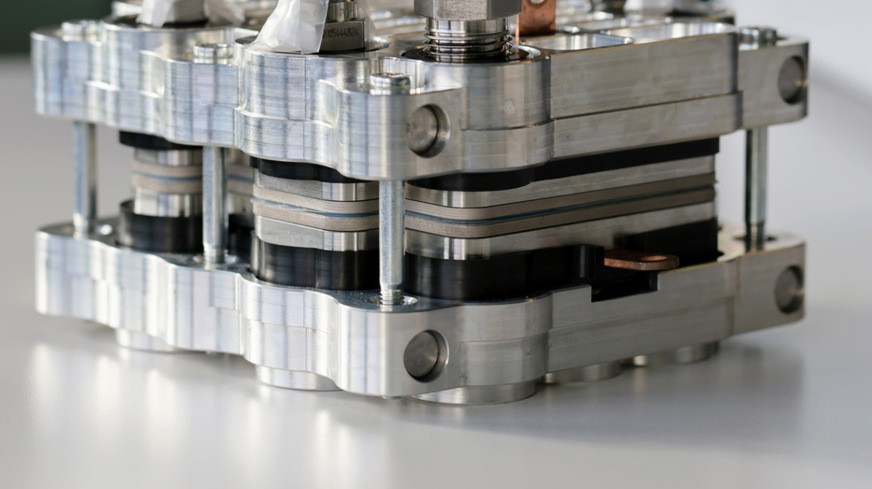
Fraunhofer IWU