

© Fraunhofer Umsicht
High pressure is as much a given in hydrogen applications today as its low volumetric energy density. To reach common pressures, often 200 to 1,000 bar, mechanical compressors are used, for example diaphragm compressors. The disadvantage: they are not only maintenance-intensive but also very noisy. The latter makes them unattractive for use in residential areas, especially in small energy systems for single-family homes.
This is where the ELCHPEM 2.0 project (Elektrochemische Zellen auf Basis der neuartigen hydraulischen Verpressung von Einzelzellen zur Verdichtung von Wasserstoff, i.e. electrochemical cells based on novel hydraulic compression of individual cells for hydrogen compression) comes in. The project is coordinated by the company Obitronik, with the Fraunhofer Institute Umsicht, the company ProPuls, and the Westfälische Hochschule Gelsenkirchen (Westphalian University of Applied Sciences Gelsenkirchen) participating as project partners. “Our goal is to further develop and test a reactor for the electrochemical compression of hydrogen based on hydraulic compression that was created in the predecessor project ELCHPEM 1.0, and thus to offer an alternative to the use of mechanical compressors with our product for decentralized energy storage,” explains Professor Ulrich Rost, chair holder for hydrogen technology and energy storage at Hochschule RheinMain (RheinMain University of Applied Sciences) and employee of ProPuls. The initial aim is to compress 90 g of hydrogen per hour. This corresponds to 1 m3 of hydrogen at ambient conditions, sufficient for a residential system.
Compressor also suitable for H2 separation
Electrochemical compression is still in its early stages compared to mechanical compression. But it offers considerable advantages: “Mechanical compression involves friction of moving parts that require maintenance,” says Professor Rost. This leads to regular downtimes at hydrogen plants because the compressors need to be inspected. A low-wear system could eliminate this problem. In addition, contamination of the hydrogen by lubricants, as used in mechanical compressors, could be avoided. What is more: in electrochemical compression, only hydrogen is compressed, because a membrane in the compressor prevents other gases from being included in the compression process. This means the electrochemical compressor could also be used for separating hydrogen from gas mixtures. Furthermore, the noise level of an electrochemical compressor is significantly lower than that of a mechanical one.
Design resembles a PEM fuel cell
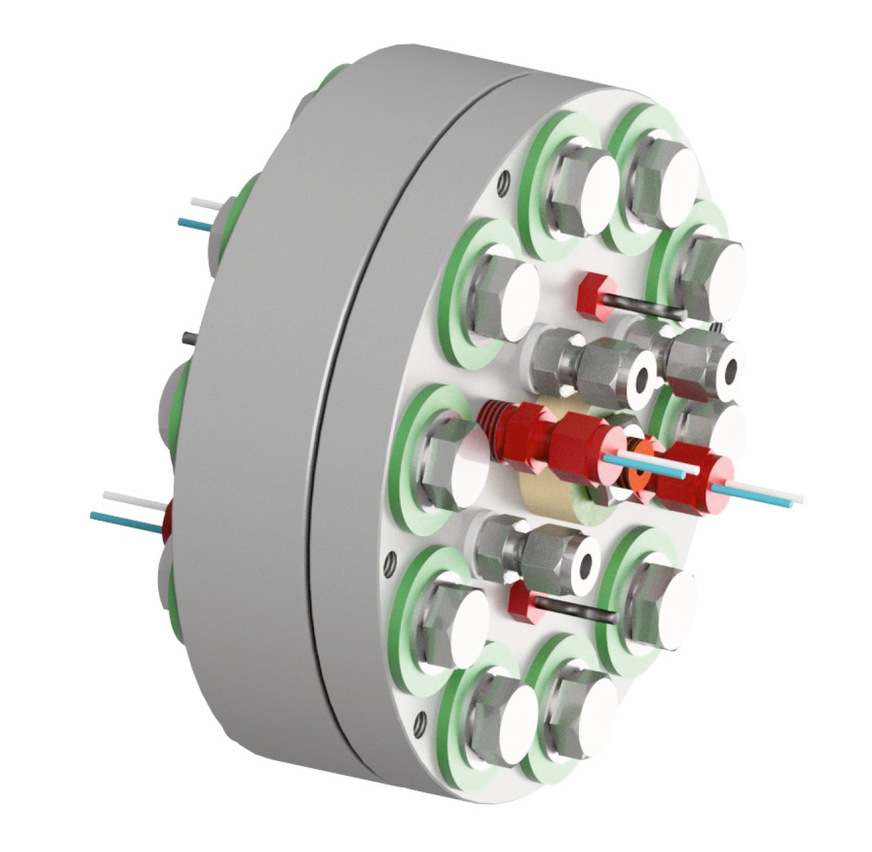
The electrochemical compressor used in this project resembles a PEM fuel cell in its design. It consists of two electrodes (anode on the low-pressure side, cathode on the high-pressure side) and a proton-conducting membrane (PEM) arranged between them. The membrane is gas-tight and electrically insulating and is coated on both sides with a catalyst (CCM, catalyst coated membrane). Using an electric field, a mass flow is generated through the catalyst-coated membrane. Hydrogen is catalytically split on the anode side of the CCM. Due to the electric field, the protons flow through the membrane to the cathode, where they are reduced to hydrogen and leave the electrochemical compressor at a higher pressure level. Currently, the compressor achieves efficiencies of a good 50 %, meaning it converts slightly more than half of the energy input into compression work. For comparison: mechanical diaphragm compressors achieve approximately 50 to 70 %.
Industrial prototype as the goal
In the predecessor project ELCHPEM 1.0, the researchers succeeded in achieving electrochemical hydrogen compression from 0 to 60 bar based on a hydraulically compressed cell concept. ProPuls also designed a reactor with a single cell in this project.
The ELCHPEM 2.0 project, which started in April 2025, is now intended to scale up the reactor. ProPuls is responsible for reactor designs, the Westfälische Hochschule Gelsenkirchen for the process and the system into which the reactor is integrated, as well as the experimental setup and operation. Obitronik is responsible for power electronics and plant management.
The goal is to develop and test a near-industrial prototype. A multi-stage compressor system is planned, with the individual stages to be operated dynamically and in coordination with one another via intelligent power electronics from Obitronik.
The targets for the project’s completion in April 2028: a pressure differential of 100 bar per stage, a fully modular functional demonstrator with output pressures of up to 300 bar, and nearly arbitrarily large cells (over 1,000 cm2).
Challenge: bipolar plates
One problem is the heavy and expensive bipolar plates that serve as wear protection. A bipolar plate based on a polymer-graphite composite is therefore intended to reduce costs, weight, and volume and is to be developed by the Fraunhofer Institute Umsicht within the project.
The high pressure differentials also pose a design challenge. The membrane is only 100 micrometers thick. “Pressure differentials of 100 bar place enormous stress on the membrane. It must not be damaged. Therefore, the forces must be distributed as homogeneously as possible within the cell so that the membrane is not subjected to such high stress,” says Rost. Current, temperature, and waste heat should also be distributed as homogeneously as possible. Improved long-term stability of the overall system leads to cost reduction.
Interim results on overall functionality are expected by summer 2026.
The first area of application is intended to be the compression of small gas volumes for energy systems in single-family homes. Decentralized compression at fueling stations is also conceivable, as is filling standard gas cylinders at 200 bar. In the semiconductor industry, the electrochemical compressor could be used as a gas purifier. The researchers even see a potential application in the future German hydrogen core network, at least in the longer term.
Powder-to-roll process
The powder-to-roll process was developed by the Fraunhofer Institute Umsicht. It is a solvent-free technology for coating flexible carrier materials (films, strips) through electrostatic deposition of functional powders, for example to produce battery materials or other functional layers. The material is continuously unwound from a roll, coated, and wound up again. This saves energy and reduces costs.