


© COG
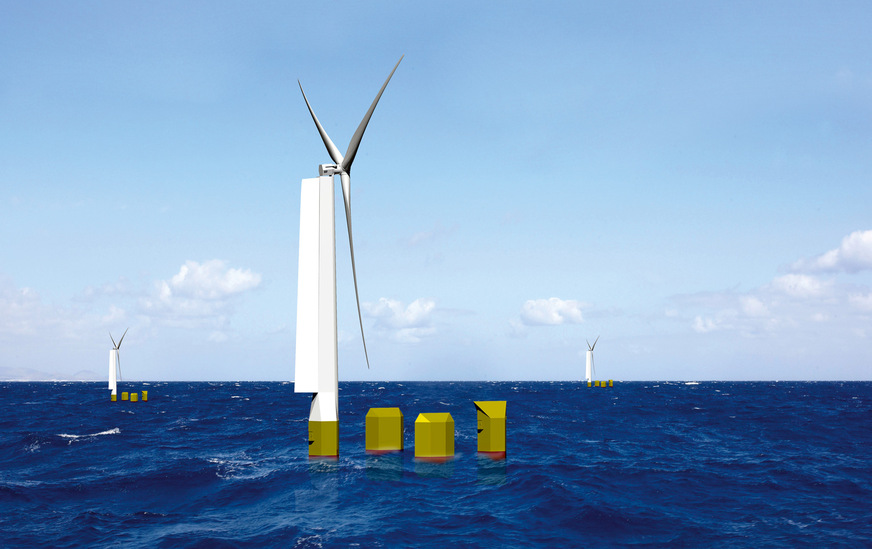
The success of the hydrogen economy depends largely on whether green hydrogen can be provided reliably, cost-effectively, and in large quantities. This is of decisive importance for future energy sovereignty and industrial resilience in Europe. A floating offshore hydrogen generator uses the energy from offshore wind turbines directly on site and converts it into hydrogen via electrolysis, without connection to the onshore power grid.
The principle is similar to the operation of a ship: the generated electrical energy is consumed directly on the platform. The largest share flows into the electrolyzer, which produces hydrogen from desalinated seawater. For storage and transport, a liquid hydrogen carrier is used, a so-called Liquid Organic Hydrogen Carrier (LOHC). This carrier fluid enables hydrogen to be stored and transported safely at ambient pressure and ambient temperature.
For transport, the concept is based on established solutions from the offshore oil industry. Similar to floating production, storage and offloading units (Floating Production Storage and Offloading Units, FPSO), the energy carrier is not transported ashore via pipelines. Instead, shuttle tankers, for example on a monthly basis, exchange the LOHC loaded with hydrogen for unloaded carrier fluid.
The tankers transport the loaded LOHC to major industrial ports such as Hamburg, Antwerp, Amsterdam, Rotterdam, or Dunkirk. These locations already have a high-performance infrastructure with connections to inland waterways and rail networks. Another advantage is that existing facilities and logistics structures of the oil industry can also continue to be used.
After dehydrogenation, that is, the release of hydrogen, the unloaded LOHC is transported back to the offshore facility via the same route and reloaded. The system thus essentially functions like a liquid battery that continuously circulates between the offshore facility and industry.
A key cost factor of the hydrogen economy lies less in production itself than in transport, storage, and conversion. Therefore, the concept considers the entire value chain, from generation to industrial use.
Large hydrogen consumers such as the steel and chemical industries are included in the system analysis. Many of these plants are located either directly on the coast or on navigable rivers such as the Rhine. For them, a reliable supply of cost-effective hydrogen is crucial in order to remain internationally competitive and to meet political carbon dioxide reduction targets.
Research on the way to a prototype
The development of the floating offshore hydrogen generator is being advanced as part of a research project funded by the German Federal Ministry for Economic Affairs and Energy. Participants include the Hamburg University of Technology (TUHH) in the field of offshore technologies and fluid dynamics, as well as Friedrich-Alexander University Erlangen-Nuremberg (FAU) with a focus on LOHC storage technology.
In the project, the platform and overall system are optimized under realistic environmental conditions. This includes extensive simulations, wind tunnel, and wave tank tests. The results to date are promising: the development is approaching prototype maturity. Many of the components used come from established industries and already have a Technology Readiness Level (TRL) of at least 7 in onshore operation.
CRUSE Offshore GmbH has currently reached TRL 4 for the floating body and initially plans the construction of a 5 MW pilot project. This will be followed by series systems with around 15 MW output, which can be used in offshore hydrogen farms on a gigawatt scale.
Modular hydrogen farms on a gigawatt scale
The planned offshore hydrogen farms consist of several floating generators, each supplied by its own wind turbine. This modular concept enables almost arbitrary scaling of plant capacity. Operation is particularly economical in regions with consistently high wind speeds. High capacity factors ensure that the capital-intensive electrolyzer can be operated as continuously as possible and that large quantities of green hydrogen are produced. The systems are to be installed preferably within the exclusive economic zones of the respective states in order to ensure planning and legal certainty.
The northern North Sea as an ideal location
The sea area between the Shetland Islands and Norway is considered particularly suitable. There, high and relatively constant wind speeds prevail, while at the same time enormous sea areas are available.
In addition, this region has decades of experience in the offshore energy industry, an important prerequisite for the transition from fossil fuels to renewable energy carriers such as green hydrogen.
Interest in such concepts is also growing at the European level. The European Commission has launched a program with the “Sustainable Transport Investment Plan” (STIP), which specifically supports investments in sustainable fuels. Hydrogen plays a central role in the production of synthetic aviation fuels (eSAF).
The largest share of costs in the production of such power-to-liquid fuels is attributable to the provision of hydrogen, around 70 percent of total costs. The actual Fischer-Tropsch synthesis and the provision of carbon dioxide, for example via Direct Air Capture (DAC), account for only about 30 percent. Cost-effective offshore hydrogen would therefore make a decisive contribution to the economic viability of such processes.
Hydrodynamics and operating strategy of the platform
In the ProHyGen project, the Institute of Fluid Dynamics and Ship Theory at TUHH investigated in particular the performance and reliability of the system from a hydro- and aerodynamic perspective. Based on weather data from the past 30 years, a realistic wind energy output profile was calculated, which served as the basis for the design of the electrical system.
Especially in autonomous offshore operation, calms and temporary shutdowns play an important role for the operating strategy. Therefore, it was examined how standby times and battery capacities can be optimized. At the same time, the analyses allowed a detailed evaluation of potential locations off the Norwegian and Scottish coasts as well as on the open sea.
Stable even in extreme sea states
Simulations of the planned 15 MW system also show very high hydrodynamic stability. Even under extreme sea conditions with wave heights of more than 30 meters, as can occur in typhoon regions, the platform remains stable and exhibits only moderate accelerations. For the planned 5 MW prototype, corresponding verification has been provided for North Sea conditions.
Safety analyses also confirm the robustness of the concept. Even in the event of a collision with a ship and the resulting leak in one of the floating bodies, the system remains afloat under moderate sea conditions. The lateral floating bodies are additionally protected against major leakages by double hulls of the LOHC tanks and internal bulkheads.
Making sensible use of waste heat
Another research focus lies on the energy integration of the overall system. Among other things, it was investigated how the reaction heat generated during LOHC hydrogenation can be used effectively. During the loading of the LOHC, around nine megawatt hours of heat per tonne of stored hydrogen are released at temperatures between 150 and 200 °C. This amount of energy is sufficient to operate a standardized maritime desalination plant that provides the ultrapure water required for the PEM electrolyzer. For the distillation of the required nine tonnes of water per tonne of hydrogen, about five megawatt hours at around 100 °C are required. In addition, part of the heat can be used to dehumidify the operating rooms.
LOHC as a flexible hydrogen source
The later use of the hydrogen stored in the LOHC was also investigated. For the release of hydrogen from the carrier fluid, about nine megawatt hours of heat at temperatures between 250 and 300 °C are required.
Its use is therefore particularly efficient in processes that themselves generate large amounts of high-temperature heat. One example is the production of synthetic fuels such as eSAF. In Fischer-Tropsch synthesis, about six megawatt hours of heat at around 250 °C are generated per tonne of hydrogen, that is about two thirds of the energy required for dehydrogenation. If carbon monoxide is used instead of CO2, a heat surplus is even generated.
Power generation in high-temperature fuel cells also offers interesting possibilities. Solid oxide fuel cells (SOFC), which operate at temperatures between 600 and 900 °C, provide sufficient heat for hydrogen release or even additional surplus heat depending on the operating state.
Perspective for a new offshore energy infrastructure
Overall, the concept of the offshore H2 generator, combined with the liquid hydrogen carrier LOHC and the use of existing oil infrastructure, shows a possible path to large-scale and economical hydrogen production at sea.
The combination of proven technologies from the offshore oil industry with renewable energy generation could significantly accelerate the transition from fossil to climate-neutral energy carriers and at the same time create a new industrial value chain in the offshore sector.