
© Horiba
Solid oxide cell technologies (SOC) are efficient and well suited for thermal integration. Solid oxide electrolysers can also be used to produce synthesis gas from carbon dioxide in the chemical industry.
A thousandfold increase needed
The current annual output of SOC is in the low hundreds of megawatts range and would need to rise to the high hundreds of gigawatts by 2035 in order to meet climate targets such as the Paris Climate Agreement (UN) or the European Green Deal. Despite uncertain data on the demand required for this, it is clear that the expansion of global production capacities would need to be exponential. Technologically, time-consuming and cost-intensive joining and reduction processes have so far stood in the way.
The automated manufacturing of SOC stacks is technically demanding. For efficiency reasons, the parallel processing of multiple stacks in a single furnace appears sensible. Uniform temperature distribution is essential in order to keep stack quality high while simultaneously keeping the reject rate low. Deviations of more than ±5 Kelvin can already have serious effects on the production result. In addition, the mechanical load plays a central role when joining and reducing multiple stacks, as it determines the tightness and thus the functionality of the stack. Automated and reproducible production with integrated quality control avoids such problems.
Four stacks in a single operation
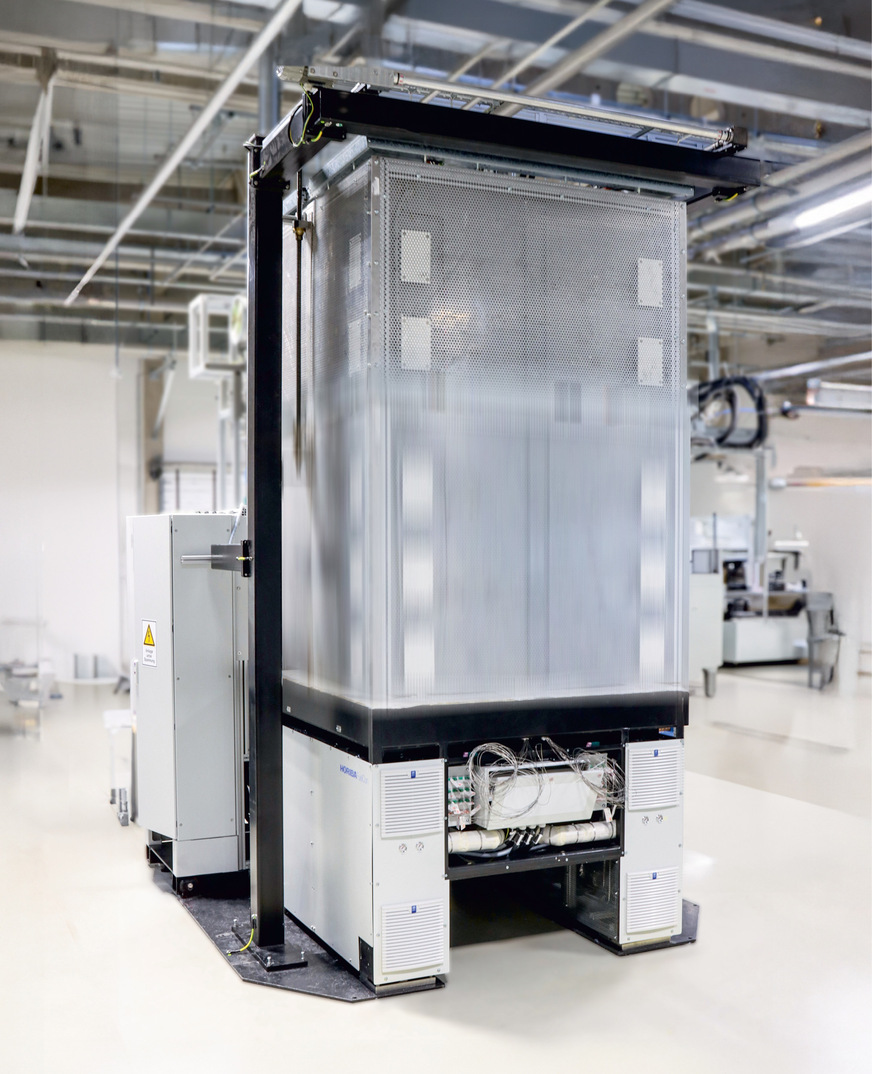
The multiple-joining stations from Horiba FuelCon enable an automated joining, reduction and quality assurance process for SOC stacks within a single system. Depending on stack design and desired output, up to four stacks can be processed simultaneously in the respective process steps within a single production line. If higher production volumes are needed, multiple production lines are required.
The Horiba TestWork automation system controls the process steps and continuously monitors and regulates setpoint and actual parameters such as temperature, pressure, media flow rates as well as test specimen current and voltage in real time. The setpoint values are freely configurable by the user.
The standardised automation software and system architecture ensure that optimised production processes can be transferred to additional systems. The MQTT interface enables integration into an MES (Manufacturing Execution System) in order to control and monitor multiple systems during production ramp-up. Optionally, quality assurance can also be integrated directly into the process.
In a real pilot plant, an error-free production rate of around 95 % was achieved, with the remaining 5 % rejects not necessarily attributable to the systems themselves.
Capex drops by almost a third
Compared with previous individual solutions, capital expenditure (capex) has been reduced by approximately 32 % with the current generation of multiple-joining stations. At the same time, operational expenditure (opex) has decreased by around 24 %. Over the same period, overall equipment efficiency (OEE) has increased by 3 %.
In addition, process steps are eliminated, which reduces personnel costs. Monitoring and electronic documentation work more efficiently and increase the transparency of production processes.
For manufacturers, multiple-joining stations offer an opportunity for a cost-effective ramp-up of SOC stack production with reliably plannable investments. Even when used for high volumes, the systems remain individually customisable. In this way, multiple-joining stations can help solid oxide cells leverage their advantages in the hydrogen ramp-up.