

The base chemical methanol holds high potential as a hydrogen carrier in the energy system of the future. Due to the high greenhouse gas emissions associated with its current production from natural gas or coal, it must be produced in the future from renewable sources or from carbon- and hydrogen-containing off-gases.
One such exhaust gas is found in the steel industry: the smelting of coke and iron ore into steel produces significant amounts of coke oven gas, blast furnace gas, and converter gas. As a result, steel mills account for about six percent of Germany’s CO2 emissions.
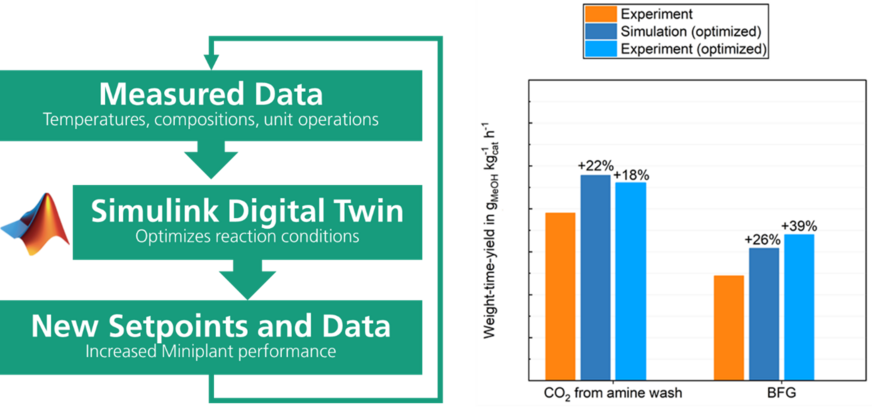
The Fraunhofer Institute for Solar Energy Systems (ISE) has demonstrated the conversion of purified steel mill gases to methanol in a miniplant at the Thyssenkrupp Steel Europe steelworks in Duisburg over more than 5,000 operating hours. In the second phase of the Carbon2Chem research project, the institute produced a total of approximately 2,000 liters of crude methanol. By deploying a digital twin, the production volume of methanol was increased by 39 percent.
Digital Twin Replicates Real Plant
Parallel to plant operations, Fraunhofer ISE developed a simulation platform that serves as a digital twin of the miniplant. "The foundation of the digital twin is knowledge of a kinetic model that describes the underlying reactions with very high accuracy," explains simulation expert Florian Nestler from Fraunhofer ISE. "By combining this with a detailed reactor and process model in our simulation program, both steady-state and dynamic operating conditions of an entire chemical plant can be calculated." Using real measurement data from more than 5,000 operating hours, the researchers adapted the digital twin so that it describes the behavior of the real plant with high accuracy.
Optimization Algorithm Identifies Superior Operating Points
An optimization algorithm searched the plant's operating window for parameters that would yield particularly high productivity. The recommendations could then be implemented directly at the plant. In actual operation, Fraunhofer ISE achieved the 39 percent increase through adjustment of reactor inlet temperatures, recycle ratio, and hydrogen admixture. The model-assisted optimization was significantly more efficient than a purely experimental search for better operating points, according to the institute.
Platform to Be Used for Jet Fuels as Well
"Following completion of our work, we are now focusing on collecting comparable data for other products such as dimethyl ether or jet fuels and utilizing our simulation platform for additional digital twins of plants," says project leader Max Hadrich.
„The work of Fraunhofer ISE enables scenario planning for a range of cases: part-load operation of a plant, scaling to the next-larger production volume, fluctuating production conditions," concludes Dr. Matthias Krüger from project partner thyssenkrupp Uhde.
"Particularly for power-to-X processes with fluctuating input conditions, digital twins are important tools for understanding and optimizing catalysts and process technology," explains Andreas Geisbauer from project partner Clariant. The Carbon2Chem project is funded by the Federal Ministry for Research, Technology and Space Travel (BMFTR) and is currently in its third funding phase, according to Fraunhofer ISE.
Fraunhofer ISE