

Picture the following scene: the final preparations for the commissioning of the gigawatt electrolyzer are underway. A technician connects a nitrogen cylinder in order to inert the compressor system. But the small cylinder is not enough: air remains in one of the lines, and no one notices. The next day, partner companies, the press and political dignitaries gather around the plant. The minister presses the symbolic button and the electrolyzer begins its work. By the time the hydrogen reaches the unpurged spot in the compressor and forms an ignitable mixture with the residual air, the guests have already moved on to coffee. Then an employee at the compressor skid touches a provisional pressure gauge; at the ungrounded measurement line, an electrostatic spark jumps across. A hard bang tears apart the coffee gathering, followed by a scream.
In this scenario, several safety-relevant errors occur in succession. The basis for this chain comes from an exemplary hazard and operability study. An AI thought it up, a safety engineer reviewed it and the author of this text added a few narrative details.
Developing, and avoiding, hazard scenarios
A hazard and operability study, usually referred to by the English abbreviation HAZOP, is a structured method for thoroughly scrutinizing a technical plant before it is built, with the help of many different scenarios. The goal is to avoid dangerous situations wherever possible and, where that is not possible, to at least make them manageable. In the example scenario above, the proposed countermeasures consist of two pressure indicators, one for the cylinder pressure and one with a signal to the plant control system, as well as the calculation of the exact purge volume. In addition, the HAZOP record refers to specific sections of the German operational safety ordinance (Betriebssicherheitsverordnung) and the German hazardous substances ordinance (Gefahrstoffverordnung).
Days-long group processes
A HAZOP is a time-consuming affair. Section by section, an interdisciplinary team works through the plant plans and devises dozens of possible problem cases. From guide words such as “pressure” and “more” or “less”, scenarios emerge: What happens with more pressure? No pressure? Reversed pressure? The experts assess the possible consequences and look for suitable countermeasures.
Such a HAZOP meeting easily lasts a few days; for larger projects it can also be weeks. The costs are correspondingly high, and so is the savings potential. That was what Christian Machens, a safety expert in the hydrogen industry, thought two years ago. In H2international he presented his approach at the time of simplifying the HAZOP with the help of artificial intelligence. This has now become an AI-based software called “HAIZOP”, which also provided the content basis for the opening scene of this text.
A HAZOP is not a review laid down by law or standard with fixed limit values. It is rather a method of structuring the process, similar to how one can use Kanban for project management. The binding values and safety regulations are instead found in the relevant standards, laws and ordinances for the respective industries and plants. This distinction is central, because only in this way is it possible to develop a software like HAIZOP that can in principle cover entirely different types of plants.
The founding and development team consists of three people in three very different locations with different backgrounds: safety engineer Machens in Leipzig, the SAP specialist Daniel Schindowski and Karl Friedrich Klahn in Dresden, whose activity as a working student transitioned directly into the role of shareholder. A meeting with all three has never taken place. Connected purely digitally, they have created a cloud-based tool that guides safety professionals through all the steps of the HAZOP and supports them in many tedious tasks.
© HAIZOP

© HAIZOP
AI learns to read plans
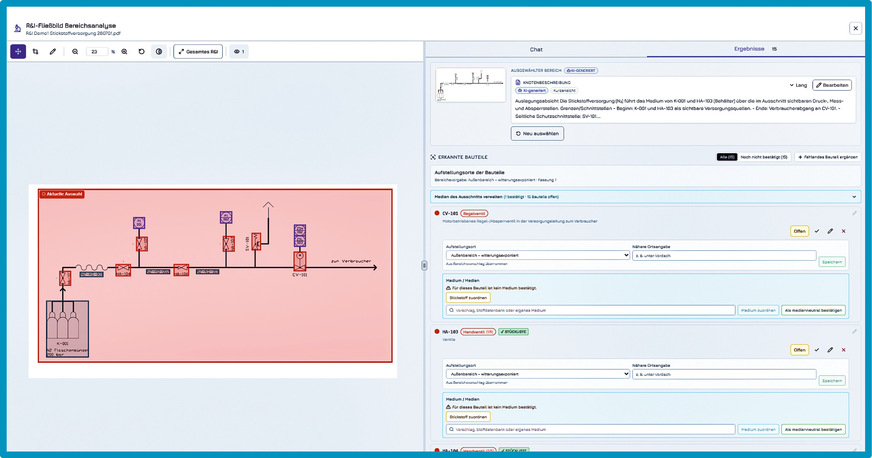
One thing Machens emphasizes again and again: “AI cannot replace people.” Nor can it do their thinking for them. It is rather their attentive assistant. When the plant plans are uploaded to HAIZOP, the AI creates a list of the existing components: compressors, valves, control devices and much more. Each of these must be actively confirmed by a person. Additional information can also be entered: Is the plant located in a residential area? By the sea? In the desert? In the first step, the HAIZOP software is a structured collection point for all kinds of information about the plant. The more precise the input, the better the result later.
In the next step, the plant diagram can be broken down into sections which, similar to a classic HAZOP meeting, are examined individually. Now the AI can play to its strength: it can spit out possible hazard scenarios in a fraction of the time humans would need for it.
Physics tutoring for the AI makes the difference
A focus of the development work lies in these scenarios. The experts have drilled their models to stick strictly to physics instead of producing creative horror movies. “It was not training in the actual sense, but above all a restriction,” Klahn explains. The fact that an AI model can eloquently describe the fundamentals of thermodynamics or the design of a pump by no means implies that it will come up with the idea that any of this might have something to do with its task. It took about two years to drum into the AI what is self-evident to most people: that the laws of nature really do always apply. Now it not only knows which faults can occur with which valve types, but also draws conclusions about how the components influence one another, that a valve closed too suddenly, for example, leads to a pressure surge in the line; or that a pump running without liquid can heat up dangerously.
Here too the following applies: the human remains master of the proceedings. Every procedure must be reviewed and approved, and can be changed or supplemented. And even with the AI-based software, there is no way around a HAZOP meeting. “But you can prepare much more beforehand and work in a more focused way,” Machens explains.
Documentation almost by itself
Last but not least, the AI also helps with what most people particularly dislike doing: documentation and writing work. Every step is automatically recorded: not only the scenarios and measures themselves, but also every check mark that is set. Together with plant plans and parts lists, the AI thus already has the most important things on hand to prepare the final documentation. These, of course, still have to be reviewed, revised and approved by people.
Sticking point: data protection
Where AI and cloud solutions are involved, it is always also about data protection and data security. Many AI companies are based in the USA and have their servers there, not to mention Chinese providers. Exactly which models are used for which steps is something HAIZOP does not reveal. In addition, the models would be swapped out again and again, since now one, now the other is ahead in certain capabilities. The cloud application, however, is said to run on servers that are “at least in Western Europe,” Machens affirms. Further restrictions are also said to be possible at the customer’s request. “Some companies have strict requirements about which data may be transmitted where. We can also run our application on a customer-owned server, if its performance allows for it,” Machens says.
The second topic, alongside possible access by third parties, is: What do the software and the AI itself do with the uploaded information? Machens says: “Our AI does not learn from our customer data.” Plans, projects and also uploaded standards and safety regulations for the databases remain strictly separated from one another, he assures.
AI is no bargain
Instead of replacing people, HAIZOP is thus intended above all to save expensive engineering hours, since these quickly add up to six-figure amounts. About 25 to 30 percent of this is said to be saveable with the software. But the software costs are also no small change, amounting, depending on the number of user accounts, to several thousand euros per month. The licenses distinguish between the different user roles. Engineers carry out the AI analyses and work on the scenarios and measures. Reviewers can go through the documents and comment, and observers are limited to reading along. To illustrate that this is money well spent, HAIZOP has programmed a profitability calculator. There one can enter in detail how many people usually work how many hours per year on the hazard analyses. The ROI calculator then calculates the return the software delivers, using a perfectly normal algorithm without AI.
From launch to scaling
Right now, HAIZOP is taking its first commercial steps. Licenses have been available for purchase since July. Fine-tuning will certainly still take place in the early phase. Above all, however, the HAIZOP team is hoping for a large and rapid rollout. The core of the software is transferable worldwide. It is about substance databases and basic physical principles, and these apply in an electrolysis plant in the Federal State of Brandenburg just as they do in Brazil, in a refinery in Norway just as they do in the Arabian desert. “The customers can then upload the specific standards for the industries and countries themselves,” says Machens. If it is up to the HAIZOP team, the international rollout is to start this year.