


For a long time, monitoring the cell voltage of electrolysis and fuel cells was a topic for research. But that is now changing. At present, a shift is taking place from research to industrial, practice-oriented questions, says Wolfgang Häußler, responsible for Business Innovation in the hydrogen sector at Marquardt GmbH, a supplier of mechatronic systems. The company offers cell voltage monitoring systems (CVM), which are increasingly being used in practice. Because in operation too, the CVM can provide valuable information and uncover faults and aging processes. Whether it is membrane degradation or membrane defects, cell leakages, insufficient electrolyte supply or the loss of the electrode coating. Critical operating conditions under overvoltage are also detected. If such faults are detected early, the process parameters can be adjusted or maintenance can be carried out. The CVM can even contribute to the prevention of accidents, experts say.
Cell voltage monitoring (CVM) refers to the continuous monitoring of the cell voltages within a stack, that is, a system that comprises the hardware for the measurement and the software for data evaluation. Occasionally, the abbreviation is also found for the term cell voltage measurement, whereby this term only describes the actual measurement process of the cell voltage measurement. Cell voltage pickup (CVP) refers to the hardware directly on the stack, which handles the electrical contacting of the individual cells as well as the connection to the measurement technology.
Systems for all common stack technologies Marquardt's CVM portfolio covers all stack technologies commonly used today. In electrolyzers, the electronics can be used in both PEM and alkaline stacks based on the same architecture. In the fuel cell sector, the applications range from passenger cars and heavy commercial vehicles to stationary use cases such as emergency power supply and combined heat and power. “In Europe, we work closely with several of the leading stack developers, which enables us to maintain a continuous feedback loop between our electronics and the requirements of real series stacks,” says Häußler. In doing so, the company uses technology from its business unit for battery management in the automotive sector. “A large part of the know-how comes directly from cell monitoring in high-voltage traction batteries,” says Häußler.
The cell voltage measurement of fuel cell stacks and those in electrolysis does not differ significantly. “Differences arise primarily from the respective system requirements,” says Carsten Krüger, Strategic Marketing Manager at CVM manufacturer Dilico. “These include temperature ranges, humidity influences, possible media contact, cell voltage ranges as well as safety-related requirements such as ATEX specifications. Installation space, accessibility and maintenance concepts also differ significantly in some cases.” Since there are no standardized cell geometries, the company always develops the solutions on a customer-specific basis.
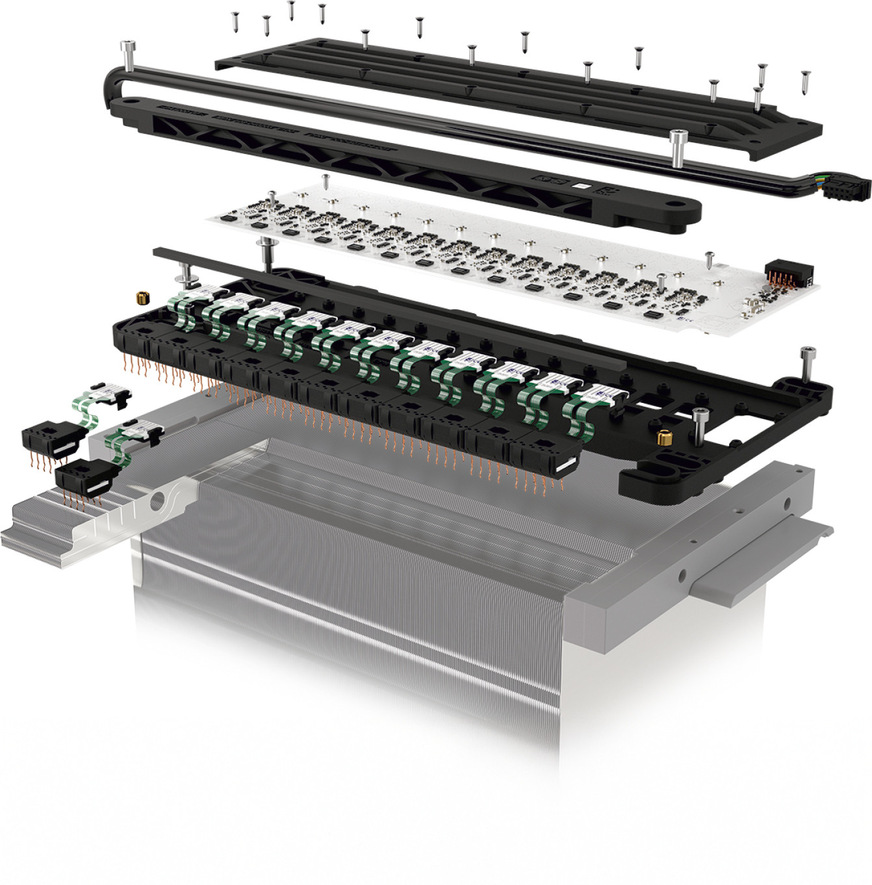
Smart Testsolutions
What matters in CVM Currently, Dilico is focusing on stationary applications. However, further development toward automotive applications is conceivable. Differences between stationary and mobile applications arise from the requirements for robustness, integration and standardization. “In the automotive sector, the focus is in particular on vibrations, dynamic load changes, EMC requirements, installation space restrictions and safety-related specifications. Stationary systems, on the other hand, focus more strongly on long-term stability, ease of maintenance and scalable integration,” says Krüger. According to him, what is important in a CVM is the reliable, continuous and interference-free monitoring of the individual cell voltages. In addition to measurement accuracy, the integration of the measurement technology directly on the stack plays a central role, according to Dilico.
For Marquardt, the measurement range comes first. “A detail that is often overlooked here is the ability to measure negative cell voltages,” says Häußler. “A negative individual cell voltage is one of the clearest indicators of a critical fault: a frozen cell, an under-supplied cell or a cell with strong reversal. A CVM that cuts off at zero loses precisely the information that you need most urgently.”
Functional safety is also a central criterion. In the automotive sector, Marquardt offers, according to the ASIL (Automotive Safety Integrity Level) risk classification system of the ISO 26262 standard, safety levels up to ASIL B. In most series projects, however, level QM for standard quality management processes is sufficient.
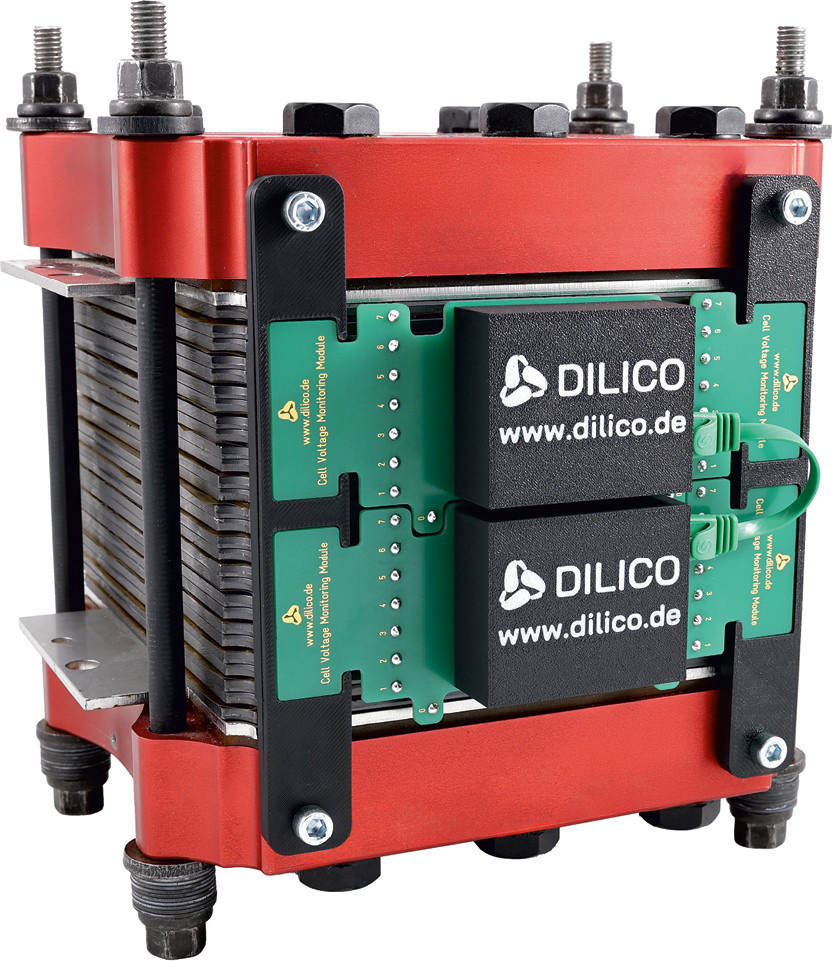
Dilico
Weighing accuracy and measurement frequency against costs “The third point, and one that is very close to our hearts, is not to over-dimension,” says Häußler. “Beyond a certain threshold, additional accuracy and measurement frequency cause costs without providing the stack controller with significantly better information.” Specifying the CVM to the actual diagnostic need and not beyond is an essential part of transferring the system into series production. In research, one wants to measure as much as possible. In practice, on the other hand, what matters is that the technology works reliably and what it costs. “Price is increasingly a topic,” says Häußler.
For the reliability of the measurement, the design must be robust from the CVP through to the evaluation software. In doing so, the software must handle enormous amounts of data. The raw voltage values are only of limited use to the stack controller. Therefore, the CVM condenses them in real time into the relevant variables: minimum, maximum and mean value as well as scatter and gradients per cell. In addition, there are special detection paths for voltage reversal, low-voltage events, drift and line breaks. And speed also matters. “The data must reach the stack controller in time to trigger a protective response,” says Häußler. For Marquardt, on the communication side, CAN and CAN-FD are the relevant interfaces for fuel cell systems in the automotive sector. For electrolyzers, the company supports the communication protocols customary in the industry.
And another point is important: the data provided should also feed into the further development of the underlying models. At Marquardt, therefore, data processing is optimized in close cooperation with the model developers. Dilico is currently developing an intelligent software platform for the evaluation of the measurement data. The goal is to analyze cell voltages, temperature profiles and further operating data on a data-based level and to derive concrete condition and action recommendations from them. In the long term, the aim is to create a diagnostic and analysis platform that improves the safety and efficiency of large hydrogen systems and enables predictive maintenance.
Marquardt
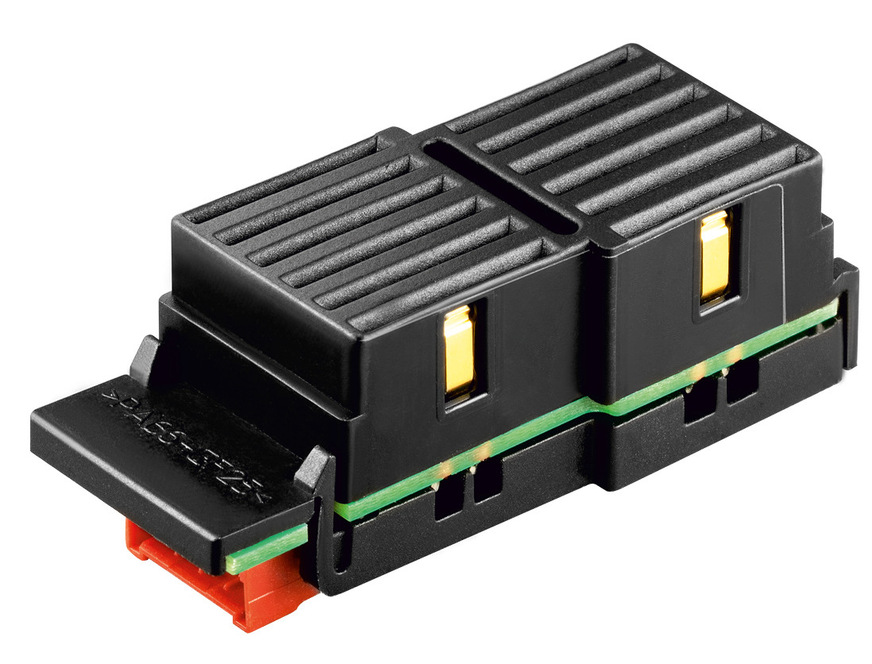
Contacts in the tightest space The contacting for capturing the cell voltage must also be reliable. There are different connection technologies for this. These range from classic individual wiring through spring contact elements to other mechanical contacting solutions. “Which technology is suitable depends strongly on the respective requirements,” says Krüger. Decisive here too are installation space, ease of assembly, vibration resistance, maintenance concepts as well as process reliability and reproducibility of the contacting. Dilico uses customer-specific contacting concepts and develops them specifically further for the respective stack technology.
Marquardt offers two main families of cell voltage pickup products, which differ in the type of bipolar plate. For mechanically sensitive bipolar plates made of graphite, contactings are required that distribute the load carefully and avoid local stresses. For metallic bipolar plates made of stainless steel, the contact partner is a stamped tab. Here the focus is on corrosion resistance and reliable clip engagement with a very thin geometry. Both product families can be adapted to the stack geometry of the customer and cover a wide range of cell spacings. Thus, Marquardt can contact both compact automotive stacks with spacings in the submillimeter range and stacks with larger spacings, as are typical for industrial systems. The spring, tab or pin contacts used in each case are selected by the company on a project-specific basis according to the stack design.
Measurement technology directly on the stack In the past, cell voltages were often captured via individual wiring, in which each cell was connected separately to external measurement technology. If this is done via long cable paths into a switch cabinet, this means a great deal of effort for the wiring and integration into the plant. “At the same time, high voltage potentials, in some cases up to 1,500 VDC, have to be routed over larger distances within the system,” says Krüger. “Long analog line paths can also impair signal quality and increase susceptibility to electromagnetic interference.”
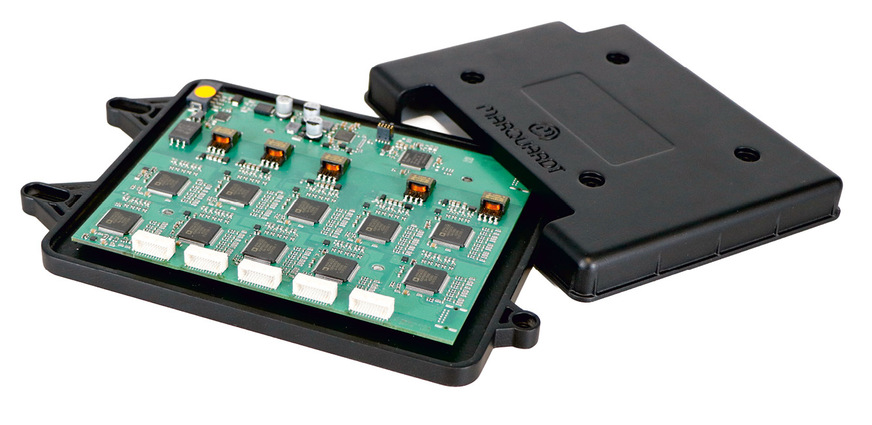
Therefore, Dilico has developed a CVP that enables stack-near measurement with short analog signal routing and immediate digitization near the cell. This significantly reduces line lengths, interference influences and potential sources of error. At the same time, according to Krüger, signal quality, process reliability and integration capability improve considerably. The stack-near integration also creates the basis for additional functions such as temperature measurement, further sensor signals or a targeted individual cell bleed-down. Dilico's patented bleed-down technology enables the controlled discharge of individual cells and can thereby make an essential contribution to cell health, operating stability and service life of the entire stack, according to Dilico. Marquardt also offers a system with the CVMcompact that integrates the measurement electronics in the CVP and passes on the data via a digital interface.
Marquardt
Measure every cell or a representative subset? For research purposes, all cells are measured. In series use, this is not always necessary. The manufacturer Smart Testsolutions, for example, measures the first and last cells and then a few selected ones in the middle (see interview with Wolfgang Neu, Managing Director of Smart Testsolutions). Marquardt recommends monitoring every single cell. “Full coverage offers the best possible insight into the cell stack: in this way, the controller can narrow down a fault to a single position,” says Häußler. Some customers, however, decide to monitor only a certain range of cells. For example, the cells that are most susceptible to faults under their operating profile, or a representative subset. This reduces the number of channels and saves costs. The better the customer already knows the behavior of their stack, the better a selection of the cells to be monitored is possible.