

The US-based One Scientific and Dresden's Ambartec AG have signed a memorandum of understanding for a joint pilot project. At Ambartec's demonstration facility in Freiberg, the two companies aim to test an integrated system of hydrogen production and storage.
The project focuses on coupling two technologies: One Scientific's heat-based process is intended to produce hydrogen from water without the need for electrolysis. This hydrogen then supplies Ambartec's HyCS storage system. The storage is based on the steam-iron process: During loading, hydrogen reduces iron oxide to iron, and at the deployment site, steam releases the hydrogen again.
Heat from the storage process to drive production
For loading the HyCS storage, heat is required to drive the reduction of iron oxide. The hot steam released in the process is intended to be directed by the partners directly into One Scientific's system and used there for hydrogen production. According to the companies, this significantly reduces the cost of hydrogen production because the process heat is utilized and the hydrogen is produced directly at the deployment site.
One Scientific's proprietary Steam-Catalyzer technology combines thermal energy, catalytic materials, and magnetic fields. According to the company, it enables modular hydrogen production directly at the deployment site and is expected to reduce electricity consumption, production costs, and logistics efforts.
Pilot plant with one kilogram of hydrogen per hour
In phase 1 of the pilot project, the partners will use a single module from One Scientific, capable of producing about one kilogram of hydrogen per hour. The companies aim to evaluate the operational behavior, system reliability, and expansion potential.
“This memorandum of understanding is an important step to demonstrate our technology in an industrial environment,” says Jon Barnwell, co-founder and COO of One Scientific. “The collaboration with AMBARtec gives us the opportunity to show how the heat available in the HyCS process can enable more cost-effective on-site hydrogen production without electrolysis while complementing hydrogen storage.”
Uwe Pahl, CTO of Ambartec AG, describes the objective from his company's perspective: “HyCS is designed to safely and efficiently store and release hydrogen. In the pilot project, we are investigating how the heat from our process can be used to produce the hydrogen needed for the loading cycle on-site. Our goal is an integrated solution that increases the efficiency of the overall system and reduces dependence on conventional electrolysis.”
Phase 2 planned with up to 20 kilograms per hour
If phase 1 proceeds as planned, the companies intend to test a larger facility in a second phase. According to the partners, this should be able to produce up to 20 kilograms of hydrogen per hour. The companies aim to pave the way for commercial applications that combine on-site production with Ambartec's storage technology.
The collaboration was facilitated by Hebmüller Verwaltung GmbH, supported by the Innovation Laboratory of East Tennessee State University and its director Audrey Depelteau. “We are pleased to have brought ONE SCIENTIFIC and AMBARtec together,” says Axel Hebmüller of Hebmüller Verwaltung GmbH. “The collaboration combines complementary technologies and offers the opportunity to demonstrate a new approach to integrated hydrogen production and storage.”
Background on the companies
One Scientific, based in Johnson City, Tennessee, is developing a patented, heat-based process for hydrogen production from water. Ambartec from Dresden plans and builds facilities for the production, storage, and transport of hydrogen. According to the company, the iron oxide nuggets it has developed offer the cycle stability required for economical continuous operation. A multi-month field test at the Freiberg demonstration facility has confirmed the energy balance of the overall process, according to Ambartec. For hydrogen production from residual, landfill, and synthesis gases, Ambartec cooperates with the Austrian partner Rouge H2 Engineering, achieving a hydrogen purity of 99.5 percent according to its own statements.
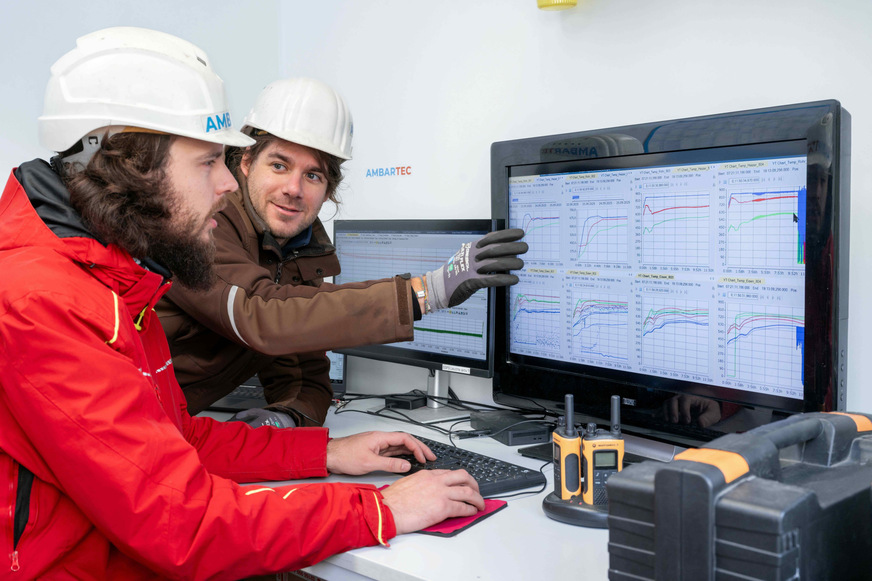
AMBARtec/Detlev Müller