


Electrolysis cells have outgrown laboratory scale. Cells of industrially deployable size now need to be characterized, for example with regard to efficiency and degradation. As at laboratory scale, electrochemical impedance spectroscopy, or EIS for short, is well suited for this purpose. In this method, the impedance, i.e. the AC resistance of electrochemical systems, is determined as a function of the frequency of an alternating current. This concerns, for example, changes in the resistance of an electrolyte, a membrane, or the catalyst or the layer structure of the cells in the stack.
What works as a test specimen in the laboratory may exhibit different properties at large scale. What is therefore decisive is the interplay of the cells in the assembly, from mechanical stability to variations among individual cells and their influence on the overall stack. One objective is reliable monitoring of the state of health (SoH) under provoked aging, and, in the longer term, end-of-line inspection directly in production.
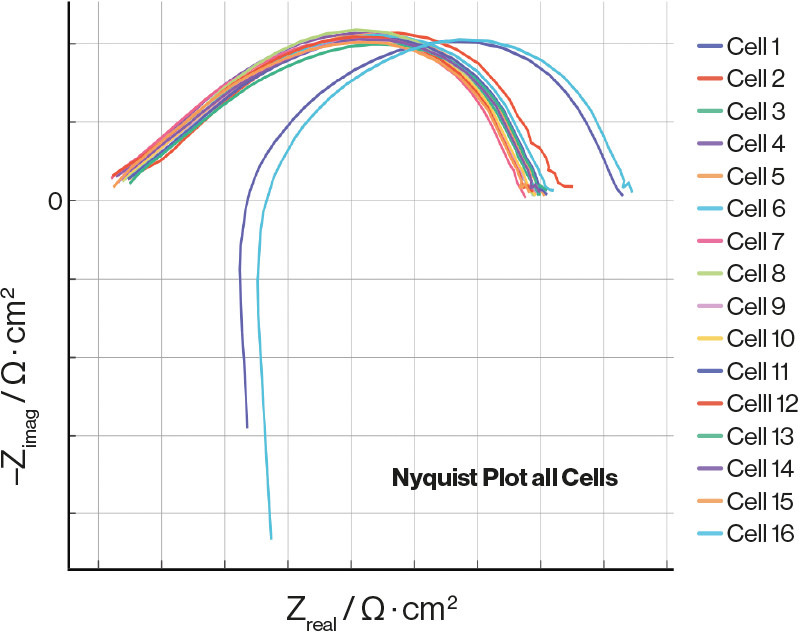
EIS is a non-destructive method for characterizing electrochemical processes such as corrosion, supercapacitors, batteries, fuel cells and electrolysis cells. It offers a good way of observing the processes in the stacks during operation. It thereby opens up new insights into stack design, provides a view of the voltage differences between cells, and allows a description of stack components such as bipolar plates and their influence on stack performance. In addition, data on the state of health of cells and stacks and their aging behavior can be obtained.
The researchers at HyCentA Research, based in Graz, Austria, specialize in the evaluation of data from large stacks. A reliable, dynamic, and very accurately reproducible DC high-power supply with superimposed, precisely adjustable AC frequencies is essential for meaningful measurements. For this purpose, HyCentA Research collaborates with the Austrian company Ing. Erhard Fischer, which, as an OEM and specialist for power supplies and power units, in turn supplies power supply modules from the Swiss manufacturer Regatron.
High-current supply versus small measured values
Large-scale hydrogen production requires high voltages and high currents with power levels reaching into the megawatt range. For scientific investigations and development work, however, approximately ten of the otherwise up to 160 cells connected in series are sufficient. This reduces the required power. The currents, however, are still in the range of several thousand amperes of direct current. Joshua Eder, research associate and doctoral candidate at HyCentA Research, elaborates: “For reliable measurement at these high current levels, in addition to a well-designed test bench setup, very constant AC amplitudes are indispensable in order to avoid errors caused by nonlinear behavior.”
For the measurement, a small alternating current with a frequency of up to 10 kHz is superimposed on the strong direct current, causing the voltage at the cells to oscillate as well. In this process, the current and the phase angle relative to the respective voltages are measured. There is a linear relationship between voltage and current when the amplitude is chosen small enough. These can be amplitudes in current levels from a few amperes to over one hundred amperes, depending on the active cell area of the cells. Smaller cell areas have higher resistances and therefore require less excitation current to deliver a measurable voltage response. “For this, the G5 power supplies with the G5 function generator from Regatron are used, which, ideally matched to each other, deliver both the high operating currents and the superimposed AC modulation. Time-consuming adjustments and analyses of interferences, as they occur with separate DC and AC sources, are thereby eliminated,” says Eder.
At the HyCentA Research test bench, stacks of different designs and power ratings can be examined. Depending on the current demand, the modularly designed power units can be interconnected to form a power supply of up to 8,000 amperes.
© HyCentA Research GmbH
Load changes precisely programmable
Many measurements place further demands on the supply modules. To provoke aging processes in the cells, for example, the stacks must be ramped up in frequent cycles and then quickly shut down again for special investigations. Switchable resistors are not ideal for this, since variable discharges are very complex to implement.
The modules used in Graz therefore operate in bidirectional mode. Unlike resistor-based solutions, this provides full freedom in programming the current ramp-up or ramp-down. Joshua Eder explains: “The modules are the foundation for us to be able to carry out efficient measurements. They do cost more than standard supply modules, but they save enormous labor costs for preparation time and calibration work. The versatile interfaces also facilitate integration into the test bench and programming of the desired sequences. Only in this way can long test series be carried out reliably and the acquired data be stored as free of interference as possible for subsequent evaluation.”
Developing more effectively
Modern electrolysis cells are operated at internal pressures of up to 40 bar. Purely mechanical changes to cell components and seals can therefore also have major effects. EIS measurements can provide information on these sources of error as well. HyCentA Research is currently working on generating evaluation curves for different operating scenarios from the measured values that can be used for quality control.
For industrial deployment as end-of-line inspection, further extensive test series are required. While operating and control parameters can still be adjusted on test benches when measurement accuracy is insufficient, a stable measurement system is indispensable for automatic inspection, ideally with a supply module that integrates all requirements. The work of HyCentA Research thus provides important prerequisites for reliable quality testing of electrolysis stacks at industrial scale.