
© Siemens / Collage NEONBOLD
The company Turn2X produces renewable natural gas (RNG) by combining green hydrogen, obtained through electrolysis using renewable energy, with biogenic CO2 from sources such as landfills and organic waste. The synthesized methane is chemically identical to fossil natural gas but has a net-zero carbon footprint.
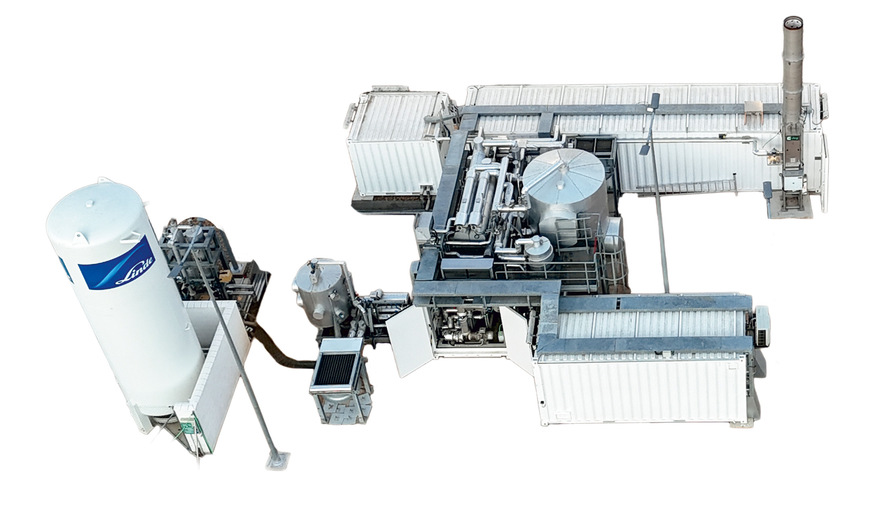
Turn2X’s first commercial plant is located in Miajadas, Spain. There, the company takes advantage of the country’s abundant renewable energy supply to operate an electrolyzer. In doing so, the company uses non-potable water, an important consideration in water-scarce Spain. The first customer for the gas produced is a glass manufacturer that uses RNG to improve its carbon footprint.
In addition to industrial applications, RNG can be fed into existing gas grids and blended with conventional natural gas. Another option is to produce RNG at times when renewable energy is available in surplus and at low cost, store the gas, and use it as needed. This makes RNG a strategic tool for energy management with a high share of renewable sources such as solar and wind.
Process control system enables retrofit digitalization
The plant in Miajadas comprises systems for water treatment, biogenic CO2 handling, heat recovery, and gas conditioning. The central link from the very beginning was the Siemens process control system, Simatic PCS 7. It is deployed in thousands of installations worldwide. The captured and archived operational data form the crucial foundation for Turn2X’s plan to transition to remote operation and maintenance.
To realize this vision, Turn2X, with support from Siemens, created a digital twin of the existing plant, based on Siemens Hydrogen Technology Stack components: standardized engineering templates and blueprints for the hydrogen industry. At the core of this modular solution are Simatic PCS 7 and Comos. The system can be expanded as needed, including with gProms, Simit, Comos Mobile Worker, and the cloud-based Hydrogen Performance Suite. Each of these modules provides additional functions and customization options.
The creation of the digital twin began with data from Simatic PCS 7, which were imported into Comos, the integrated engineering platform from Siemens, to create a consistent digital representation of the entire plant. Existing documentation, detailed process engineering diagrams, and 3D models of the plant were also incorporated. This is how the digital twin was created: a virtual representation of the processes in Miajadas.
Remote operation and maintenance have been a reality since June 2025. No personnel are required for operation; for maintenance, two people are on site every two weeks. Maintenance documentation is centralized and continuously updated, so that technicians, whether on site or on the go, receive precise, up-to-date instructions, for example via Comos Mobile Worker. This means mission accomplished for the Miajadas site, for now. But with the digital twin, this is only the beginning of the digitalization journey.
Second plant digital from the start
The new plant, being built directly adjacent to the first, will be digital from the outset. Insights and data from the first plant feed into the design and engineering, with benefits such as shorter project timelines and reduced risk.
Various technologies that have not yet been fully implemented in Turn2X’s existing plant are set to play a central role.
For example, the digital twin is intended to support gProms, software that captures deep process knowledge in the form of precise, predictive process models. Plant operators can use these models to make complex design and operational decisions. Thanks to the digital twin, personnel can also work with the simulation platform Simit. It enables comprehensive testing of automation applications without affecting ongoing operations. In addition, Simit provides realistic training environments for operators even before real systems go into operation. This promotes process optimization and knowledge retention, shortens commissioning times, and significantly accelerates time to market.
Additionally, the Hydrogen Performance Suite supports operators in optimizing operations with real-time monitoring and analytics, performance improvements, and predictive maintenance. This allows plant availability and efficiency to be maximized as operations scale.
Beyond integration into the Hydrogen Technology Stack, the digital twin enables the use of SiGreen for managing the product carbon footprint (PCF). This web-based solution collects emissions data along the entire supply chain and delivers verifiable PCF values to support customer reporting and regulatory requirements.
Blueprint for further digital twins
From commissioning onward, operators benefit from simulation, training, and performance optimization. Thanks to integrated digitalization, this second plant can also be remotely operated and maintained, just like the first.
Through remote operation and maintenance, personnel can use their experience more effectively to continuously optimize the plant. This enables the scaling of Turn2X’s RNG business model. With the partnership between Siemens and Turn2X, and the implementation of the Digital Hydrogen Plant in the project, there is now a blueprint for other companies looking to follow the same path.