

Electrolyzers, sensors and AI models for the control, regulation and monitoring of plants are today highly developed from a technical standpoint. Nevertheless, project developers often have difficulty convincing financiers. What is often missing is the trust of the financial players, who ultimately have to approve a project, in the operation of the electrolysis plant.
To solve this problem, one has to understand what lenders, insurers and offtakers actually need from an AI system. And this differs significantly from what most of today’s systems are designed for.
The transparency problem
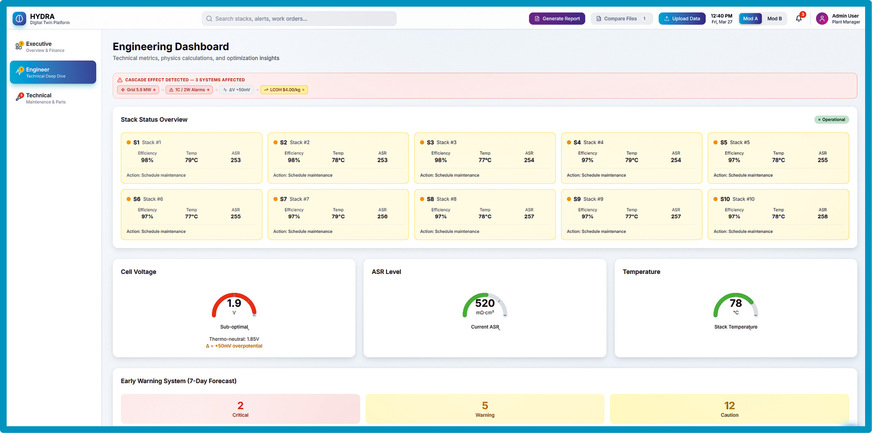
The prevailing paradigm for AI in electrolyzers currently focuses on operational transparency. Sensor data are collected, processed and made available to operating teams in near real time. Voltage curves are tracked, efficiency metrics monitored. If certain limit values are exceeded, the system triggers alerts regarding possible anomalies. These functions help operators to react more quickly, to detect faults earlier and to better understand how a specific plant behaves under certain conditions.
For the financing decision, however, they are not the goal, but the starting point. Lenders, technical advisors and insurers do not evaluate whether an electrolyzer is operating efficiently today. They examine whether it will generate predictable cash flows over a loan term of twelve to fifteen years. Real-time operating data are necessary for this, but not sufficient.
What is required instead is a documented and verifiable history of plant performance: How is the plant aging? What interventions have been carried out? How is its remaining useful life estimated? And on the basis of comprehensible physical relationships, not on the basis of proprietary correlations that cannot be independently verified.
A high model accuracy based on test data may convince a data scientist. It does not necessarily convince a lawyer specializing in project financing or a risk committee tasked with underwriting the future cash flows of a plant worth several hundred million dollars.
What makes AI credible for banks
The credibility gap of AI systems for electrolyzers has three central dimensions. All of them must be addressed if AI is actually to make a contribution to financing decisions.
· Traceability: Every optimization recommendation, every fault classification and every forecast of the remaining useful life must be traceable to an underlying physical mechanism, for instance to the increase in the area-specific resistance (ASR), the thinning of the membrane or the kinetics of catalyst layer detachment. Lenders regularly commission independent technical advisors to review operational systems.
If an AI system cannot explain why it issues a particular recommendation, and in a form that an electrochemistry engineer can verify, then this recommendation has no robust evidentiary value in a formal due diligence process.
· Physics-based foundations: There is a fundamental difference between a machine learning model trained exclusively on historical operating data and a model whose solution space is bounded by thermodynamic and electrochemical laws.
A model that relies only on historical data may deliver physically impossible results under extreme conditions. This can easily happen when electrolyzers respond dynamically to fluctuating power generation from renewable energies and in doing so reach operating states that lie outside the training data.
A model with a physically bounded solution space will not do this, because impossible states are excluded by design.
For a lender evaluating a plant that is to be operated for 13 years with variable renewable energy sources, this difference determines whether AI results are reliable even under previously unobserved conditions. For financiers, it is decisive whether AI results can be transferred to new operating states, a question that becomes particularly important in the later years of many hydrogen project financings.
· Auditability: A credible AI system must deliver not only insights, but also evidence. This includes:
· time-stamped performance logs
· histories of interventions and maintenance measures
· the documentation of degradation trajectories
· comparisons between predicted and actual behavior.
Technical due diligence reports are prepared on the basis of this information. If it is missing, there is nothing for technical advisors to review, and in that case even a technically highly developed system makes no contribution to the financing process.
Analysts and advisors frequently speak, in the context of green hydrogen, of a “bankability gap”: projects are technically sound, but cannot demonstrate the operational predictability that project financing without comprehensive recourse to the project sponsors requires.
© Polestar Technology
The financing gap: an example
This bankability gap primarily does not concern the plants themselves. It concerns the intelligence layer between the physical plant and the financial players who have to evaluate it.
Take an electrolyzer that has been operated for two years with conventional monitoring systems. The technical advisor of a lender receives voltage curves, pressure logs and maintenance records. The advisor can calculate the capacity factor and estimate the remaining useful life on the basis of conservative assumptions.
What the technical advisor cannot do, however:
· quantify the efficiency loss caused by an undetected increase in ASR
· verify whether dynamic load operation has stressed the membrane more than intended
· assess risks that are not visible in the available data set.
So the advisor is literally pricing in a risk that cannot be seen.
Now let us consider the same plant with a physics-based AI system. This continuously monitors degradation processes, creates traceable logs of interventions and delivers forecasts of the remaining useful life on the basis of electrochemical kinetics.
The technical advisor can now:
· review the previous degradation trajectory
· understand the physical basis of the service life forecast
· assess whether the operating decisions of the past two years were geared toward maximum service life.
The risk becomes visible. And what is visible can be assessed and priced. In this way, a project becomes financeable.
A framework for the industry
The AI industry in the electrolyzer sector must focus on one central question: Does this system deliver evidence that a lender can rely on?
From this, several concrete requirements follow:
· Physical boundary conditions must bound the solution space of the AI, not as a subsequent add-on feature, but as a fundamental architectural principle.
· Every output must contain a comprehensible explanation in the language of the respective target audience.
· Operating data and degradation trajectories must be continuously documented in formats that enable independent review.
· Performance forecasts must be supplemented by a quantification of uncertainty, based on physical models and not solely through point forecasts.
The best dashboards and visualizations do not help here. This does not mean that real-time functions have to be dispensed with. It merely requires the decision to treat credibility toward lenders as a central requirement already at the system architecture stage, and not only as a downstream problem.