


The hydrogen racing series Extreme H draws a positive conclusion regarding the safety of its fuel cell racing vehicles after its first year of events. After approximately 550 kilometers of driving time in the Pioneer 25 vehicles – including accidents and rollovers – the series sees proof that hydrogen can also be used as a propulsion technology in motorsport.
“One of the great advantages of the Extreme H World Cup is that it shows that it is a technology that is not rocket science, that works and is safe,” says Serge Grisin, who at the time headed the motorsport and off-road divisions at fuel cell supplier Symbio. Symbio supplies the fuel cells for the Pioneer 25 vehicles of the racing series. The finale of the season, in particular, with several departures and rollovers, demonstrated the robustness of the technology.
FIA crash tests with increased requirements
For approval, the Pioneer 25 had to pass special crash tests by the FIA (Fédération Internationale de l’Automobile). According to the series, these went significantly beyond the requirements for production vehicles. “The role of the FIA in all motorsport is to continuously push the boundaries of research and development in safety systems, technologies, and procedures,” says Xavier Mestelan-Pinon, Chief Technical and Safety Officer of the FIA.
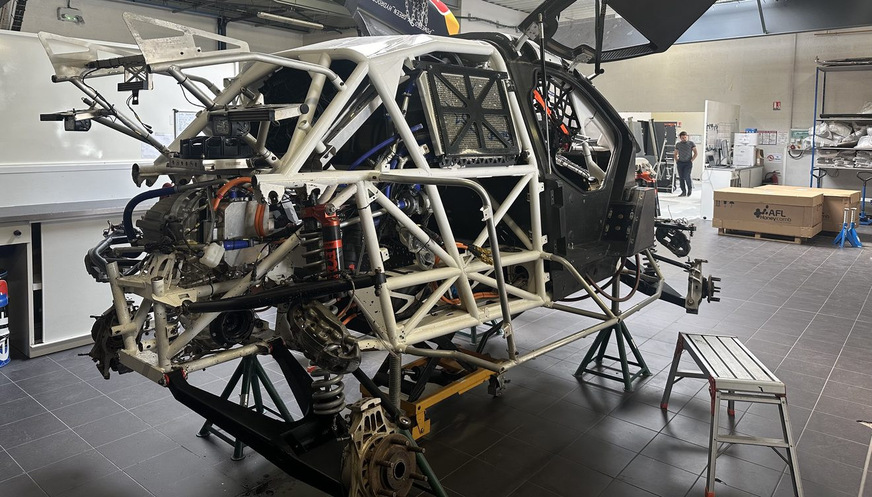
Mark Grain, Technical Director at Extreme H and project manager for the Pioneer 25, describes the tests conducted: There were two types of impact tests. In one, the chassis was mounted on the ground and tested against a solid wall. In the second, a 2.3-ton mast struck the chassis sideways at 60 km/h. “And although 60 kilometers per hour doesn’t sound like much, it is because of the inertia. It’s an enormously violent test,” says Grain.
During the tests, the hydrogen tanks, the fuel cell, and the piping were mounted and pressurized. “I am pleased to say that nothing was damaged, even though the criteria would have allowed us to damage some of these elements,” says Grain. In another test setup, the chassis was fixed to the wall at a 45-degree angle while an impact sled of the same weight was driven onto the roof. Again, the components remained intact.
The hydrogen tanks are also bulletproof: According to Grain, high-caliber sniper rifles could be fired at the tanks without damaging them.
Safety also considered in the paddock
A significant difference from conventional production vehicles, according to Grisin, lies in the frequent disassembly and reassembly of the racing vehicles in the paddock. The safety concept therefore had to consider not only racing operations but also maintenance and transport. The goal was to use as many standard components as possible to facilitate maintenance.
Since hydrogen technology is comparatively young in this area, the developers were able to build on high safety standards from the outset, according to their own statements. The Pioneer 25 is equipped with numerous sensors and special materials that make it safer in this respect than a conventional gasoline vehicle.
Drivers see no particular burden
For the men and women who drive such a racing car, the hydrogen vehicle in the cockpit is hardly different from an electric vehicle. “For us in the cockpit, it’s like an electric car,” says Johan Kristoffersson, two-time Extreme E champion and winner of the Extreme H Time Trial 2025. The briefing by Spark Racing Technology, the manufacturer of the Pioneer 25 fleet, clearly explained all safety-relevant aspects.
Gray Leadbetter, a driver at Zeroid Motorsport, also reports that the term hydrogen initially caused nervousness. “It’s definitely nerve-wracking when you hear the title,” she says. However, the Extreme H organization thoroughly informs the teams about the systems and safety precautions.
Extreme H