

Asahi Kasei developed its Aqualyzer system on the basis of decades of experience in chlor-alkali electrolysis. This approach does not represent a fundamentally new technology pathway, but rather demonstrates how established industrial processes can be adapted to meet the new operational requirements of the hydrogen sector.
One of the structural challenges in Europe's hydrogen ramp-up is the mismatch between the traditional design of industrial processes for baseload operation and the variable power generation from renewable energies. Electrolyzers originally optimized for continuous operation must now respond flexibly to the feed-in profiles of solar and wind power.
Tests in Fukushima show: electrolyzer switches from minimum to maximum load within seconds
Experience from large-scale demonstration projects shows that this transition is technically feasible, but requires more than just incremental adjustments. In the Aqualyzer system, development focused not only on electrochemical components such as electrodes and membranes, but also on system-level controls, including pressure management and automated operation.
Operational data from the Fukushima Hydrogen Energy Research Field (FH2R) demonstration project shows that alkaline systems can handle rapid load changes. The transition between minimum and maximum output takes place within a few seconds. This dynamic performance is particularly relevant for European markets, where electrolyzers are increasingly expected to provide grid-balancing services alongside hydrogen production to stabilize the power grid.
Plant survives earthquakes and long-term test with more than 10,000 operating hours
FH2R was equipped with a 20 MW solar power system, a large-scale alkaline water electrolyzer system in the 10 MW class, and a facility for hydrogen compression and loading at 20 MPa. At the time of commissioning, it was the world's largest demonstration plant for a renewable power-to-gas system. The facility survived two magnitude 7-class earthquakes in 2021 and 2022 and was safely shut down in each case, without any damage to the electrolyzer or leakage of hydrogen or electrolyte. The total operating time of this electrolyzer is now more than 16,000 hours.
Another key aspect for European hydrogen projects is long-term reliability. Many announced projects are still based on limited operational experience, particularly under conditions of fluctuating power supply.
Long-duration operation at industrial scale therefore provides an important reference point. Systems with more than 10,000 operating hours under variable renewable input allow insights into aging behavior, maintenance requirements and overall system stability. In this context, the observed stability of gas purity, the absence of major component degradation, and safe operation under external stresses, such as earthquakes, contribute to a better understanding of the performance of alkaline systems outside controlled laboratory environments.
For European stakeholders, whose financing conditions are closely tied to perceived technology risk, such operational experience can help reduce uncertainty. However, regional conditions and regulatory frameworks remain important influencing factors.
Modularity enables scaling from pilot to megawatt scale
A persistent bottleneck in Europe is the transition from megawatt-scale pilot plants to installations of 100 MW and beyond. This step introduces not only technical complexity but also financial and logistical challenges.
One approach to managing this transition is modularization. Instead of relying on single large units, systems can be built from multiple standardized modules operated in parallel. As part of Asahi Kasei's development work, pilot projects were carried out in which several sub-megawatt modules are operated together and coordinated via a central control system.
Asahi Kasei
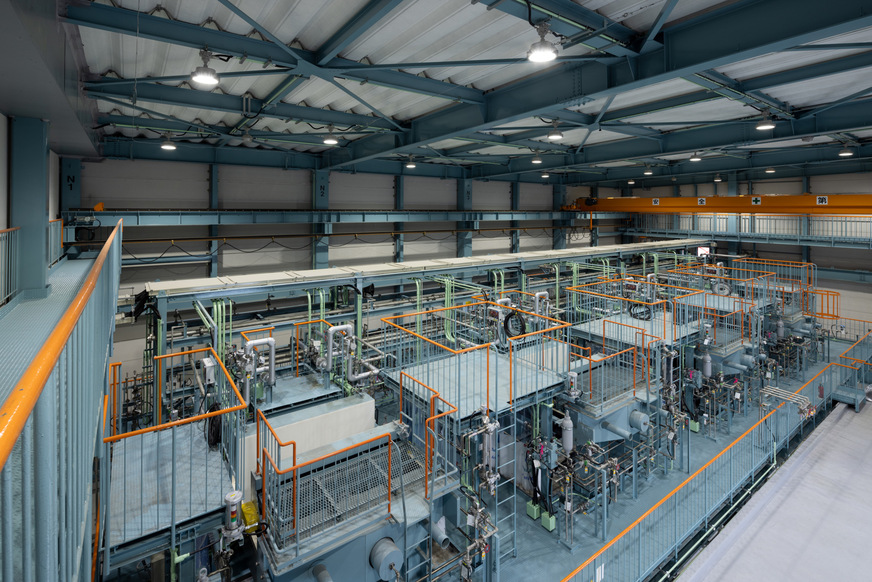
At Asahi Kasei's Kawasaki plant, four modules of 0.75 MW each consist of ten stacked electrolysis cells with an electrode area of 2.7 m² each. The modules are arranged in parallel, enabling both coordinated operation, in which the modules are automatically switched and overall efficiency is optimized, and individual operation, in which each module can be operated independently under defined test conditions. The facility also enables testing of the integrated pressure control system, including the compressor. After more than 5,000 hours of continuous operation, the modules have proven to be extremely robust and efficient.
100 MW electrolyzers are the next step
The data from the pilot projects in Fukushima and Kawasaki provide the basis for the next development step: water electrolysis systems with a maximum output of 100 MW per plant, consisting of up to ten 10 MW modules connected in parallel and producing 20,000 Nm³/h of hydrogen. The number of modules can be adjusted to specific customer requirements, thereby offering a high degree of flexibility.
Such architectures allow capacity to be expanded incrementally and can be better aligned with phased investment strategies as well as evolving hydrogen demand. In addition, they offer operational flexibility: individual modules can be taken offline for maintenance without shutting down the entire system, and power input can be distributed dynamically to optimize efficiency under partial load conditions.
For Europe, where projects are often implemented in several development stages and must adapt to regulatory and infrastructure conditions, this flexibility can offer practical advantages.
Industrial supply chains and gigawatt-scale manufacturing lower hydrogen costs
Reducing costs remains one of the central challenges of the European hydrogen economy. Policy support instruments can close part of the economic gap, but long-term competitiveness depends on technological learning curves and industrial scale-up.
This is where the importance of established industrial supply chains becomes apparent. Leveraging existing manufacturing capacities, such as those built up for chlor-alkali electrolysis, can support the rapid production of key components such as membranes and electrolysis cells. Planned expansions of manufacturing capacity in Kawasaki toward the gigawatt scale illustrate how Asahi Kasei is preparing for rising demand.
At the same time, standardized systems and repeatable module designs are likely to be crucial for reducing engineering and installation costs. Together with higher operational efficiency and longer service life, these factors contribute incrementally to lowering the levelized cost of hydrogen (LCOH).
Combination of industrial maturity, flexibility and modularity makes the difference
Not least against the backdrop of increasing geopolitical uncertainty, the European hydrogen industry is moving from policy ambition to industrial implementation. In doing so, it faces challenges in the areas of cost, scalability, reliability and system integration. The further development of established alkaline electrolysis technology represents one possible way to meet these requirements.
Rather than relying on as-yet unproven concepts, this approach builds on the industrial expertise of the chlor-alkali industry and combines it with the flexibility required for renewable energy systems. Its relevance for Europe lies less in individual technical features than in the combination of demonstrated operational experience, modular scalability, and suitability for operation under variable power supply.
As the sector continues to evolve, such hybrid approaches, which link industrial maturity with the requirements of modern energy systems, are likely to play an important role in bridging the gap between pilot-scale validation and large-scale industrial deployment.