

Many of the 115 participants at the Hamburg Offshore Wind Conference (HOW 2026), decision-makers from the areas of production, grid infrastructure, industry and regulation, agree: high costs, supply chain problems and continuously rising interest rates are placing too many risks on companies.
HOW 2026, which traditionally takes place in spring at the Hamburg Coffee Exchange (Kaffeebörse), is jointly organized by the industry network Renewable Energies Hamburg (Erneuerbare Energien Hamburg, EEHH) and the international consulting and certification company DNV.
The success of the European hydrogen economy depends significantly on the expansion of offshore wind energy. From the industry’s perspective, the failed offshore tender in Germany in August 2025 and the postponement of this year’s auction appear all the more alarming.
This development is also a warning signal for the ramp-up of the hydrogen economy: if reliable and scalable green electricity is lacking, the business models of the H2 economy start to falter.
A reduced offshore expansion could also worsen the economic and infrastructural conditions for projects such as AquaVentus (see H2international No. 5-2025) or ProHyGen (see H2int. No. 2-2026). These aim to produce green hydrogen using wind power directly at sea.
The current auction regime is evidently no longer working. The offshore wind industry had already pointed this out last year.
“Now it is up to policymakers,” says Peter Frohböse, segment director wind at DNV. The importance of reliable framework conditions is also emphasized by Jan Rispens, managing director of EEHH: “In order for offshore wind in Europe […] to remain a growth engine, investments along the entire value chain must be plannable.” It is precisely this plannability that is lacking, with direct effects on the hydrogen ramp-up.
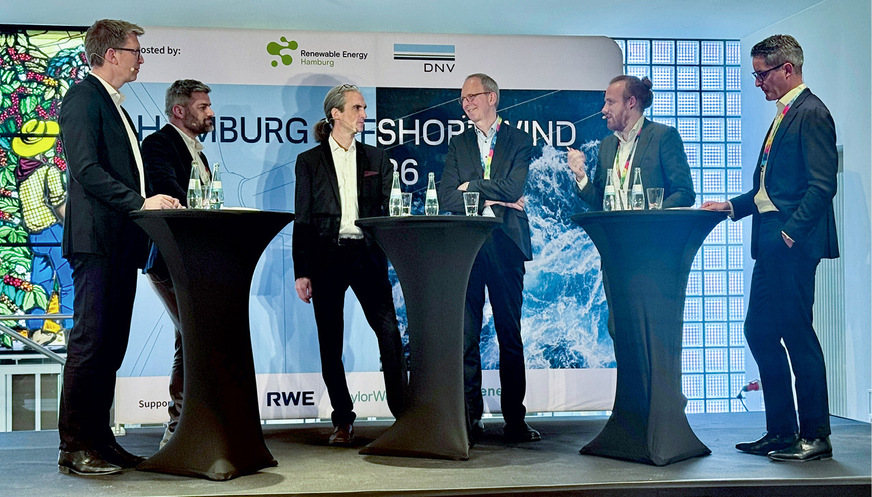
Missing lead markets = systemic risk The close connection between hydrogen, offshore wind and steel becomes particularly clear at HOW 2026 during the panel discussion on “Green Lead Markets.” “Both today’s primary steel production and secondary steel production must be decarbonized,” explains Yannik Sparrer of the German Steel Federation (Wirtschaftsvereinigung Stahl), where he is responsible for lead markets as head of industry policy and circular economy. “This requires new plants, affordable renewable electricity sources and, in the long term, corresponding hydrogen.”
The conversion of primary steel production alone will massively increase the electricity demand of the steel industry, and with it the necessity for a rapid expansion of offshore wind installations. “The steel industry’s electricity demand from the grid is already around 12 TWh per year and will rise significantly further through the operation of direct reduction plants and electric arc furnaces.”
However, offshore wind installations themselves are considered one of the most important sources of this additional demand. This is because they consist largely of steel. “A 1 GW offshore project requires around 100,000 tons of steel,” explains Korbinian Ott, commercial managing director at Steelwind Nordenham. Like others, he points to the unfair competition from cheap imports from Asia while at the same time emphasizing the role of his industry as a potential lead market for climate-neutral base materials.
Monika Rößiger
Public investment important Through the decarbonization of towers for wind energy installations, the sector could specifically create demand for green steel. However, the prerequisite is reliable political framework conditions and stable expansion pathways. Korbinian Ott warns against watering down the European Union Emissions Trading System (EU-ETS) as an important market-based instrument.
He too confirms the importance of public investments in infrastructure for the demand for green steel. This is decisive for the hydrogen ramp-up: without this market, a key demand anchor is missing.
The mutual dependency is obvious: offshore wind needs green steel; the steel industry needs green electricity and hydrogen at affordable prices. The automotive industry also needs green steel, as does the renewal of infrastructure. However, without functioning markets for low-CO2 steel, the willingness to pay is missing.
“The entire manufacturing sector is currently in a difficult economic situation,” says Yannik Sparrer. “That is why there is currently little willingness among the customer industries to pay more for low-emission steel.” Policymakers could provide support by creating lead markets and stimulating demand for low-emission steel, both in public procurement and in the private sector. The EU at least plans to count low-emission steel towards fleet emission limits in the automotive sector.
Against the background of necessary investments in public infrastructure such as bridges, railway tracks and H2 pipelines, Sparrer appeals to legislators: “Let us create cross-sectoral win-win situations.”
The switch to low-emission steel could reduce the CO2 footprint in the manufacture of offshore wind turbines by up to 80 percent. “Steel is not just a necessary base material here; it also contributes to the reduction of Scope 3 emissions.”
Industry for green lead markets Offshore wind energy could become a leading market for low-emission steel made in the EU, according to Sparrer, if policymakers create the right incentives. For example, with the help of instruments that bring advantages for both sectors and the targeted use of the German “Special Fund for Infrastructure and Climate Protection”.
Like the European hydrogen association “Hydrogen Europe,” Sparrer argues against relying on 100 percent green hydrogen from the outset, because this is “unrealistic.”
With the gradual use of so-called blue or turquoise hydrogen, CO2 emissions could already be significantly reduced while at the same time incentivizing the hydrogen ramp-up. Environmental associations and parts of the EU Commission are, as is well known, critical of this or fundamentally reject blue hydrogen as a bridging solution.
Monika Rößiger
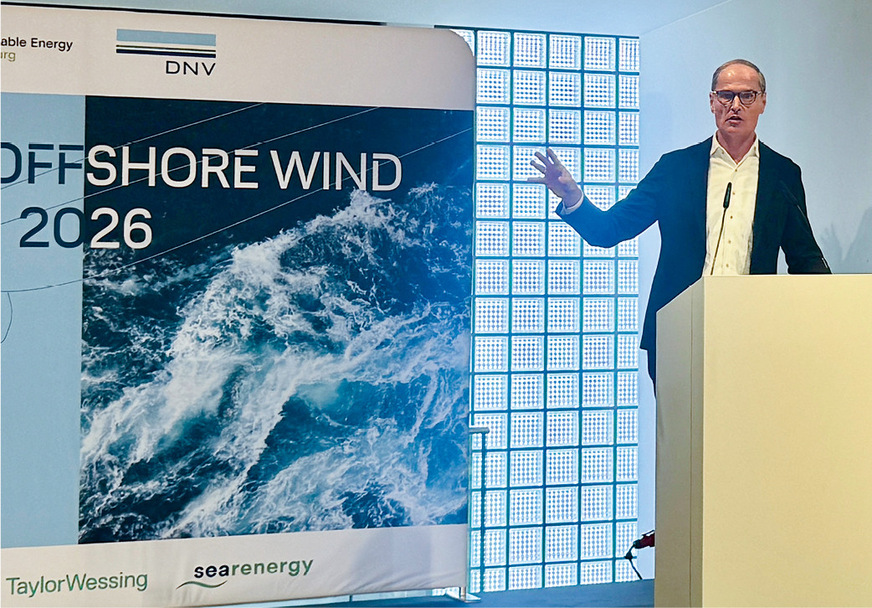
Fossil dependence is expensive In view of geopolitical crises, Ditlev Engel, CEO Energy Systems at DNV and member of the DNV executive committee, points to sharply increased costs for fossil energy imports: “44 days ago, the conflict in the Strait of Hormuz began. And since then, we in the EU have lost 22 billion euros, in additional costs for fossil fuels such as oil and gas.”
The importance of energy independence can hardly be illustrated more aptly. And that is merely the monetary side of the equation. Germany currently covers around 30 percent of its energy demand from its own production, Engel continues. The largest portion must therefore be imported, which is correspondingly susceptible to crisis. “I do not understand why this aspect is not a top priority in politics.”
Energy security of utmost importance A DNV survey among more than 1,000 leading representatives of the energy industry at the beginning of 2026 shows that 72 percent of respondents view energy security as the most important goal. This was, it should be noted, before the Iran war. Engel advocates an accelerated expansion of renewable energies, which is “the cheapest and fastest method to produce energy.”
At the same time, he calls for simpler and more strongly harmonized framework conditions in Europe, because differing national standards slow down expansion. Furthermore, Engel recalls that Germany is a decisive player in achieving the targeted expansion goal of around 15 gigawatts of offshore wind capacity per year across Europe.
With industrial scaling combined with long-term, binding political commitments, as most recently at the North Sea Summit in Hamburg, this is certainly realistic.
Recycling in focus The panel discussion also reveals potential for closed material cycles. The steel from dismantled offshore installations can definitely be recycled and reused. Admittedly, this too is initially associated with higher costs. Nevertheless, concrete approaches and pilot projects should be considered here, argues Yannik Sparrer.
“The question is: how much more money are we as a society, industry and European states willing to pay for resilience, sustainability and stability?” he concludes at the end of the event. Nobody can expect to get all this for free. And policymakers are slowly grasping that a price tag has to be attached to it.