

Müllheim, a small town in the southern Black Forest, not far from the Swiss border. In the bright, spotlessly clean production and assembly halls of Weil Technology, laser welding systems hum and robotic arms join metal parts with surgical precision. Sales assistant Susanne Tegel, who guides visitors through the plant, explains the complexity of all these processes and what is being created here: machines that in turn build machines, for washing machines, air conditioning systems and exhaust systems. And now also for fuel cells.
That sounds almost like a logical further development. But behind it lies a strategic decision that put the company at a crossroads a few years ago: continue to sail in the slipstream of the combustion engine, or change course before the wind shifts.
Roots in the can industry
Weil Technology was founded in 1987 by Florian Weil’s father – the same year, as it happens, that today’s managing director came into the world. “I am employee number 1, even though that’s not really true,” says Florian Weil with a smile. “Because in fact that’s Susanne Tegel.” The founding father came from the can industry: roll a piece of sheet metal, weld it, done. This basic artisanal principle has shaped the company to this day.
The first in-house development was a laser welding system for chimney pipes, a genuine innovation at the time. “In the early 1990s, that was not yet widespread,” Florian Weil recalls. The fall of the Berlin Wall brought the young company a boom: in eastern Germany, dilapidated houses and factories were being refurbished, and chimney pipes were in short supply. Weil Technology supplied the systems to manufacture them.
Chimney pipes were followed by laser-welded washing machine drums, among others for Miele, and then catalytic converter housings for exhaust systems. Always the same basic principle: form sheet metal, laser weld. With every emissions standard, from Euro 1 to Euro 6, demand for more sophisticated exhaust gas treatment systems grew, and with it Weil Technology’s business. The company grew from an initial 20 to around 270 employees today.
But the growth had a weak point. Around 70 percent of sales came from the exhaust business with the automotive industry, a market that came under structural pressure when the debate about climate protection and reducing emissions in the transport sector began.
© Monika Rößiger
The internal mobility transition
“From 2017 onwards, as a medium-sized family business, we began thinking about e-mobility,” says Florian Weil. “At a time when it was not yet a major topic in public discussion.”
The question was not whether the combustion engine would eventually be replaced, but how and by what. Purely battery-electric? Fuel cell? Both? And above all: how does a sheet metal processing and laser welding specialist position itself for the future?
Weil and his team found the answer through a sober analysis of their competencies. The company had mastered the joining of thin metal foils by laser, the development of precise clamping technology and the machine building for series production processes.
What was sought was an application that required exactly these capabilities. It was found in the metallic bipolar plate, the most important component in the stack of a fuel cell system.
Formula 1 of laser technology
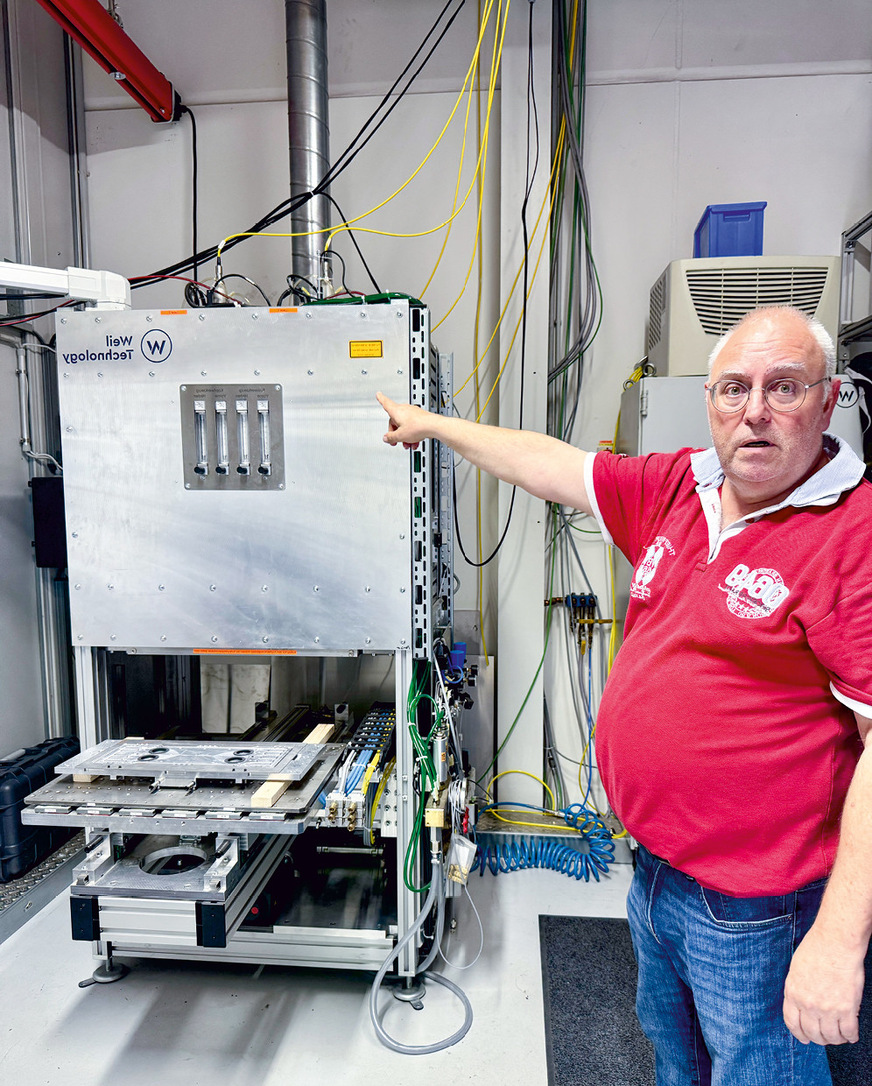
To understand why bipolar plates are such a demanding yet logical application for Weil Technology, it is worth taking a look at the TechCenter. Thomas Frey, industry manager for renewable energies at Weil, stands in the laser welding cell and points to the test rig: two large lenses, a camera and fiber optic cables that guide the laser beam down from the laser source on the roof.
“This is a relatively new technology,” he explains. “Normally, you have to guide the laser head mechanically, with a robotic arm or an axis. Here, we deflect the beam using small mirrors. The head itself stays still.”
Two such scanner systems work simultaneously. The patented dual-field scanner welding module is the heart of Weil’s technology for bipolar plates. The result: a welding speed of one meter per second. 2.7 meters of weld seam, the length required for a single bipolar plate, are drawn in 2.7 seconds.
“A fully welded plate comes out of here every four seconds,” says Frey, explaining why the weld seam is so important. A bipolar plate consists of two embossed metal foils, each just 0.1 millimeters thin.
The anode and cathode are welded together, with the membrane lying on top. Together they form the basic element of the fuel cell stack, in which hydrogen and oxygen react electrochemically to form electricity and water.
Three media flow through the plate: air, hydrogen and cooling water – strictly separated from each other by the weld seam, which seals each individual channel. A leak would be critical: after all, hydrogen must not escape in an uncontrolled manner.
Extreme precision
The permissible gap size during welding is a maximum of ten micrometers, one-tenth of the thickness of a human hair. “This challenged us so much that we grew with it,” says Florian Weil. “For me, this is the Formula 1 of laser technology.”
To ensure that the wafer-thin plates do not warp during welding, Weil developed its own automated clamping technology: with around 800 kilograms of clamping force, the foils are pressed together before the laser is applied. A symmetrical welding sequence, internally called “Butterfly Weld,” distributes the heat input evenly and minimizes distortion and contour deviations.
Corona as a catalyst
The development of this technology took place during an unusual time. During the coronavirus pandemic, Weil Technology set up its own development department and began constructing the first prototype systems.
“From a health and economic point of view, corona was a bad time,” Florian Weil admits. “But for innovation and transformation, it was a very good time.”
The reason: suddenly, top managers were available. Those who otherwise had to wait weeks for an appointment now got someone on the phone within hours. Weil Technology seized this opportunity, pitched its ideas, discussed in sprints with potential customers and continuously refined the concept.
These conversations led to the first orders for sample systems, and ultimately also for series production systems. But the road there was not without setbacks. “When we built the first tool, it ended up in the bin,” the managing director recalls. “That was our tuition. Something like that is part of it.”
From prototype to series production system
Today, at its in-house TechCenter, Weil Technology has a laboratory system that offers customers the opportunity to validate bipolar plate designs before they invest in a fully automated series production line. The company deliberately relies on technological continuity: the tools and processes used in the TechCenter correspond as far as possible to those of the later series production modules. What works in the lab is intended to scale up in production.
For the complete process chain, Weil Technology cooperates with two partners under the umbrella of the German Fuel Cell Cooperation: the Tübingen-based manufacturing specialist Zeltwanger handles the leak testing, and the Dresden-based family business Von Ardenne the coating of the finished plates. Together, the three companies cover the entire chain from joining and testing through to coating.
Stalling hydrogen ramp-up
But Florian Weil also speaks openly about the current market situation. Although Weil Technology has already delivered series production systems, the order volume in the fuel cell sector has recently declined. “At the moment, we have no active project for the construction of a system,” he says.
The reason is that the market for fuel cell vehicles is growing more slowly than hoped, partly because the hydrogen supply is not yet sufficient. This in turn is also due to unclear regulations on the part of the European Union.
“We first have to boost hydrogen production before the uptake can increase,“ says Thomas Frey. A vehicle needs around 300 bipolar plates in the stack; for a thousand vehicles, that would be 300,000 plates. Demand on this scale, however, is so far lacking.
Electrolyzers and cryogenic tanks
Weil Technology is therefore not only thinking about the consumption side of hydrogen, but also about its production. Electrolyzers require bipolar plates similar to those used in fuel cells, but thicker, and they have to withstand higher pressure. Around five development projects with customers from the electrolyzer sector are currently running in the TechCenter. The laboratory system can be converted for these thicker plates.
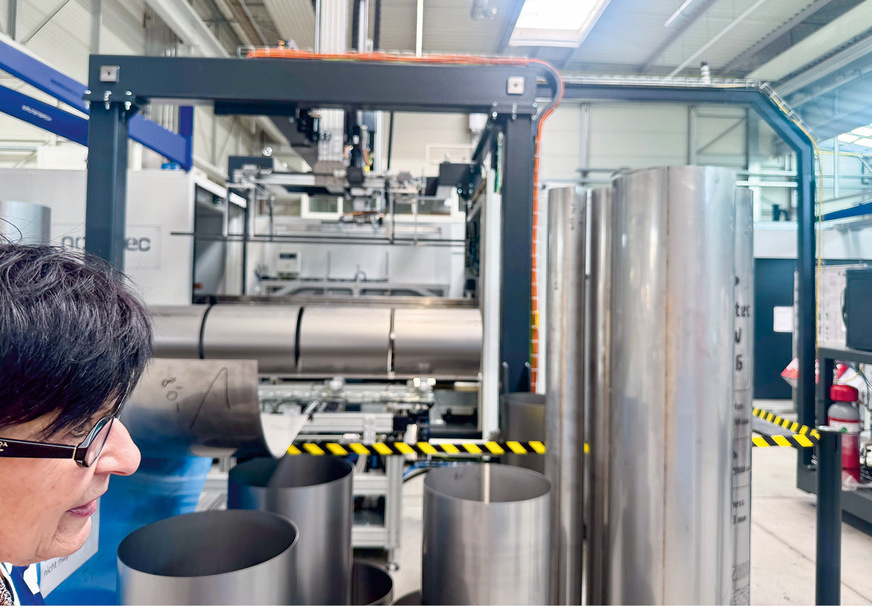
In addition, the technical center enables the round bending of thicker sheets and the subsequent laser welding of cylindrical cryogenic tanks, vessels for cryogenic liquid hydrogen that is needed for transport and storage. “We are machine builders,” Frey emphasizes. “A customer comes to us and needs a machine, then we are on board.”
© Monika Rößiger
Bipolar plates for aviation
A particularly ambitious project connects Weil Technology with the German Aerospace Center (Deutsches Zentrum für Luft- und Raumfahrt, DLR) and other industry partners: the collaborative project “BiPro2Scale,” funded by the German Federal Ministry for Economic Affairs and Energy. The aim is to scale up bipolar plates to a surface area corresponding to a power output in the megawatt range, intended for later use in aviation.
For this purpose, a mirror-based laser scanner optic is used in the TechCenter, which deflects the infrared beam extremely quickly via micro-movements, thus welding two adjacent plates simultaneously. The 200-micrometer-thin metal plates are pressed together with around 800 kilograms of clamping force. The project covers the entire value chain, from the development of suitable joining processes through to the validation of the finished components.
Resilience through broad positioning
Whether fuel cells, electrolyzers or cryogenic tanks: Weil Technology relies on diversification. That has always been the case. “There are always market fluctuations in mechanical engineering,” says Florian Weil. “That is why you should not be dependent on one market and need at least five irons in the fire.”
In addition to the hydrogen and battery sector, the company remains active in the classical automotive industry, in the heating, air conditioning and ventilation sector, as well as in the household appliance industry. And: “We export all over the world,” says Susanne Tegel.
The transformation away from the combustion engine is real at Weil Technology, but it is not an abrupt break, rather a step-by-step expansion of the competency profile. The micro welding technology for bipolar plates, which a dedicated department within the company now develops independently, technically has hardly anything in common with the classical macro welding for chimney pipes or washing machines. And yet it has grown from the same roots: sheet metal, laser, precision.
“I believe it was the right decision to face up to the change,” says Florian Weil. How far that decision will carry will be decided by the market, as soon as enough green hydrogen is on offer.