

© Martin Egbert
The gravel road winds through the mountains of the Namib Desert, over stones, dust and rubble, through hills and peaks full of bizarre formations. Somewhere in this lunar landscape is supposed to be the industrial pilot plant of Hyiron Green Technologies? One of the world’s largest production sites for green iron, according to its operator?
The feeling of having gotten lost in the middle of nowhere is one you’ll have often in Namibia. The Namib Desert alone stretches two thousand kilometers along the coast from Angola to South Africa. At 81,000 square kilometers, the Namibian part is larger than the Federal State of Bavaria. And that’s far from all. Almost half of this southwest African country is desert, an area far larger than Germany.
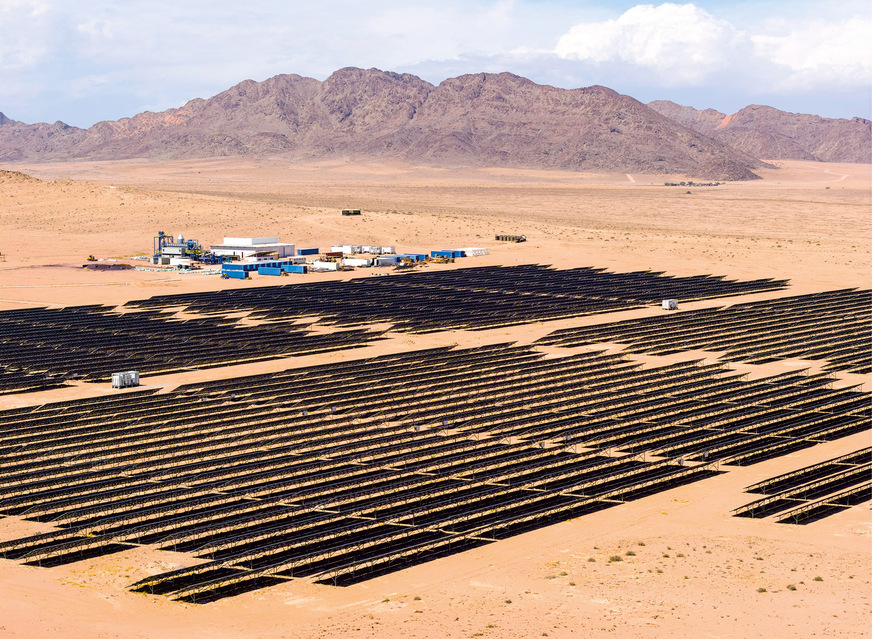
Then, behind the mountains, Hyiron’s solar field suddenly glitters in the glaring sun. The 44,000 modules are hard to miss. The production site itself is also sizable for a pilot plant: numerous containers, tanks, pipes and the large hall housing the two six-megawatt electrolyzers. The facility, known as the Oshivela Project and backed by 13 million euros in funding from the German Federal Ministry of Economic Affairs and Energy (BMWE), could soon grow considerably larger.
Scaling decision on the horizon
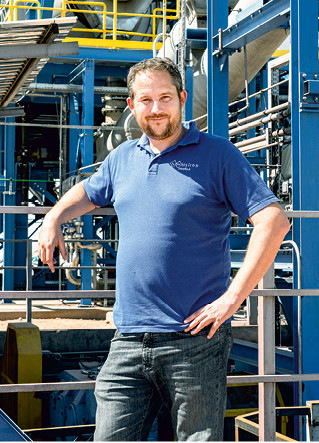
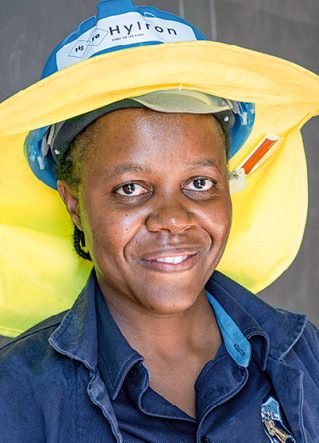
“The investment decision for the next phase will be made this year,” says Johannes Michels, managing director and co-founder of Hyiron Green Technologies. The 25-megawatt solar field is set to grow to 375 megawatts, with battery storage enabling part of the plant to run around the clock. Today’s modest capacity of 15,000 metric tons of iron per year could then rise to 200,000 metric tons. “Every metric ton of iron produced this way replaces 1.8 metric tons of CO2 from the conventional process,” says Michels, who grew up in Namibia and Germany. Behind him, the view sweeps across the wide plain. Before Hyiron bought the site, this was a sheep and cattle farm. After years of climate-driven droughts, it had to be abandoned. Now the focus here is on future technology.
Iron ore is an oxide. Separating it from its oxygen content requires a reducing agent, which until now has usually been carbon, mostly in the form of coking coal. Hyiron uses green hydrogen instead, produced in two electrolyzers that run exclusively on solar power. The green hydrogen is fed into a rotary kiln at 800 to 950 degrees. A chain turns the kiln’s large cylindrical chamber at just one revolution per minute. From the other end, coarse-grained iron ore enters, mostly as iron (III) oxide. “The hydrogen pulls on the oxygen atoms more strongly than the iron does,” explains Kandetu Vetuamuje.
That’s how the iron is reduced. The by-product is water, which, after extensive purification, is fed back into the electrolyzers. “This way we need no more than three cubic meters of water per day for the plant,” the engineer explains during a tour of the site. The water is delivered by tanker truck, which comes once or twice a month along the gravel road from Arandis. The town was founded in 1972 by the Anglo-Australian mining company Rio Tinto for its uranium mining employees. Many of the Black mine workers are said to have fallen ill. Even so, the open-pit mining sites continue to be operated by the subsidiary Rössing. To this day, they rank among the largest in the world.
Green iron sounds better than uranium. But who’s buying the product? Part of the annual production has been secured by the international steel and pipe manufacturer Benteler, for which Hyiron presses the green iron into pellets. Other European customers buy the green iron to produce powder for 3D printing. Demand from Europe is likely to rise. Earlier this year, the EU Commission revised the rules for green steel quotas in public procurement: the steel no longer has to be produced in Europe. “Our price is only slightly above that of conventional iron,” says Johannes Michels. Once the expansion is up and running, there is expected to be no price difference at all. This is thanks to the low cost of coarse-grained iron ore, a by-product from mines in neighboring South Africa, and the sharp drop in battery storage costs. Above all, though, Namibia has a lot of sun. At 2,200 to 2,700 kWh/m²/year, solar irradiation here is more than twice as high as in Germany and still a third higher than in Spain.
© Martin Egbert
Plenty of energy, little electricity, scarce water
“The world’s best solar potential, excellent wind along the long coastline and plenty of space, these are the advantages we want to tap into,” says Jona Musheko. The spokesperson for the state-run Namibia Green Hydrogen Programme welcomes visitors to his air-conditioned office in a new building in the capital, Windhoek. The program was launched five years ago with support from Germany, among others. This year, it is coming to an end. “We’ve only been the midwives of Namibia’s hydrogen industry,” Musheko says. “Now promising pilot projects are off the ground.”
Namibia’s government, led since March 2025 by its first female president, Netumbo Nandi-Ndaitwah, aims to use green hydrogen to diversify the country’s economy. Until now, that economy has depended mainly on exports of diamonds, uranium and other raw materials, on agriculture and fisheries threatened by the climate crisis, and on tourism, which benefits only a very small share of the population. One third of Namibia’s roughly three million inhabitants are unemployed. Investments in hydrogen projects are expected to create tens of thousands of jobs and bring the country improved energy supply as well as substantial tax revenues. Sounds promising, at least at first.
But hydrogen uses a lot of water, and Namibia suffers from water shortages and recurring droughts. In most hydrogen applications, water cannot be recycled the way it is at Hyiron. Producing one metric ton of hydrogen requires nine cubic meters of ultrapure water. That translates into 12 to 13 cubic meters of surface or groundwater, or 20 to 30 cubic meters of seawater.
Electrolysis also consumes a lot of electrical energy, 47 to 55 megawatt hours per metric ton of hydrogen. And this in a country where less than 60 percent of the population is connected to the electricity grid. On top of that, Namibia has to import two thirds of its electricity from neighboring countries, mostly generated by coal-fired power plants. Will the green hydrogen industry improve this situation and benefit the local population? Or will the opposite happen?
© Martin Egbert
The country’s first fertilizer plant
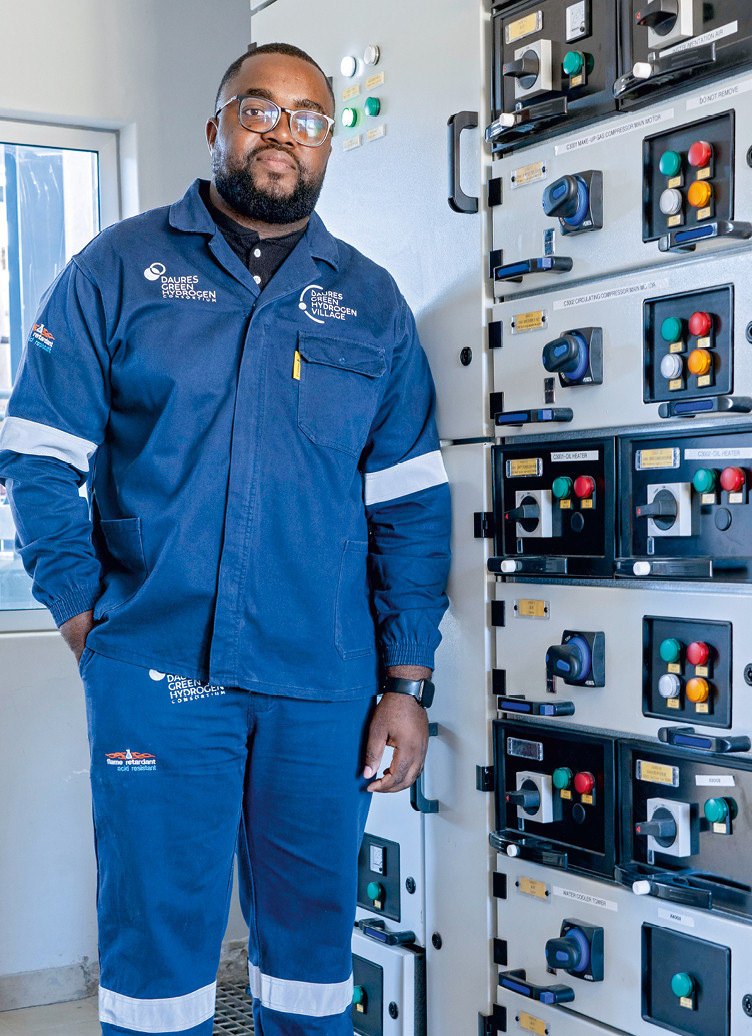
Jeremia Petrus of the Daures Green Hydrogen Village is a firm believer in green hydrogen made in Namibia. “With nitrogen fertilizer from green hydrogen, we want to produce something the country badly needs, this will be the very first fertilizer production in Namibia.” Until now, Namibia has had to import its nitrogen fertilizer from South Africa and Zimbabwe. The sharp spike in fertilizer prices in the wake of the war in the Middle East, if nothing else, has made clear just how important domestic production can be. “My grandchildren will be proud of me for having been part of this future project,” says the engineer in blue overalls.
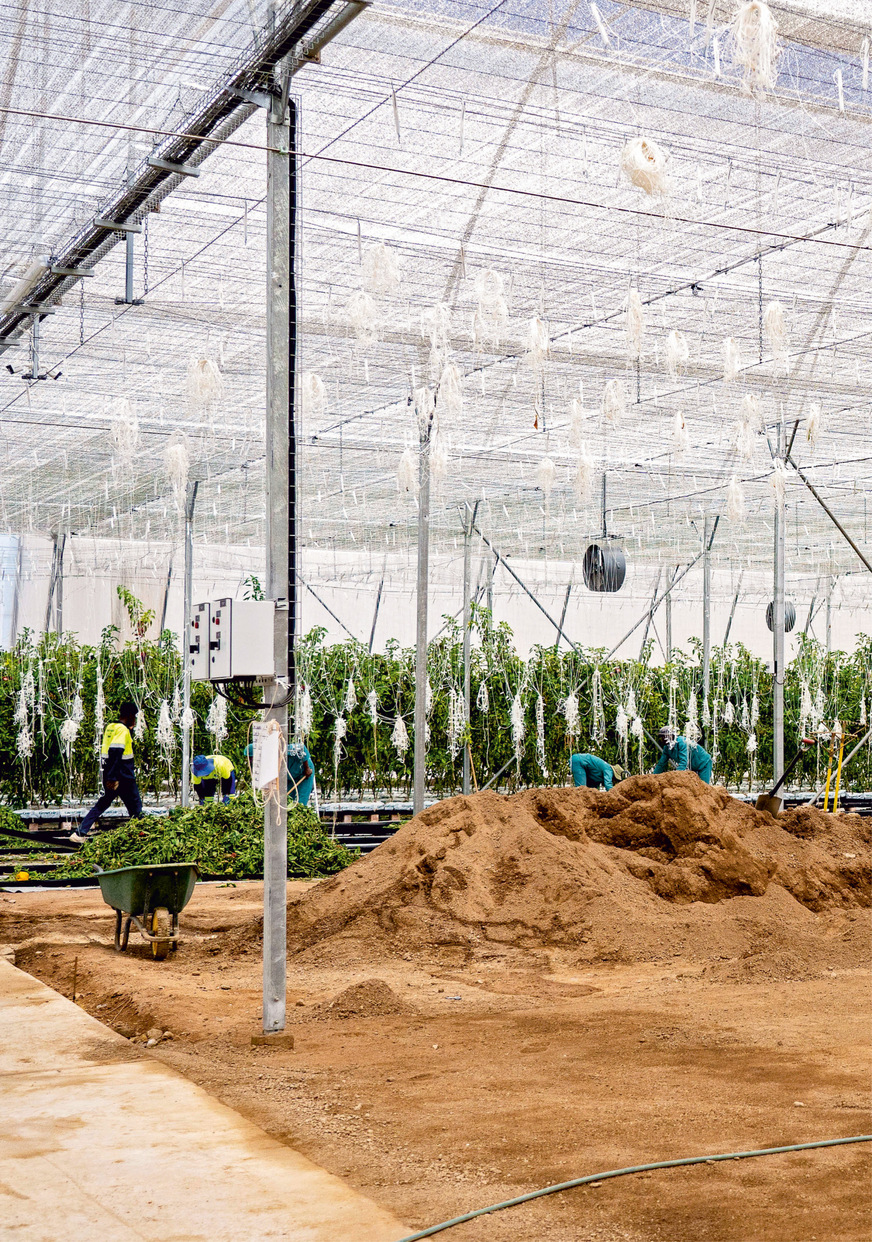
The Daures Green Hydrogen Village, run by the energy company Enersense Namibia, lies about a five-hour drive northwest of Windhoek, between the Brandberg Massif and the Atlantic. The drive, too, offers fascinating steppe and desert scenery. Antelopes dart past. A family of ostriches crosses the road. Next to the Hydrogen Village’s solar field, fifteen modern greenhouses gleam in the sun. Peppers and cucumbers grow here, and will soon be nourished with climate-neutral nitrogen fertilizer. “We’re currently commissioning the plant for the Haber-Bosch process,” Jeremia Petrus explains. Behind him, female workers are painting the last pipes. The smell of paint hangs in the air. Next to the hall housing the electrolyzer and the ammonia plant, other female workers are laying the foundation for a hall that will house the production unit for solid fertilizer, funded by the United Nations Industrial Development Organization (UNIDO). They wear masks against the dust and the biting wind. Most are from surrounding communities. Daures Green Hydrogen Village has committed to filling at least half of its current 50 jobs locally. Representatives of the ethnic group living here also hold a 10 percent stake in Daures Green Hydrogen Village, which was launched in 2023 with around 12 million euros in funding from the German Federal Ministry of Research, Technology and Space. This also underpins the research partnership with the University of Stuttgart, with its counterpart in Windhoek, and with the German consulting firm Fichtner. There is a laboratory and a training center on site. Researchers and interested visitors can book accommodations at the guesthouse. Employees like Jeremia Petrus, who actually lives in Windhoek, also stay on the premises.
© Martin Egbert
Hydrogen brings food, and needs water
Once commissioning is complete, Daures plans to produce 100 metric tons of green ammonia per year, a modest amount. “This is just a pilot plant that doesn’t run around the clock, but it will at least cover our own nitrogen fertilizer needs.” Wind measurement stations are already in place in the surrounding area. Five wind turbines with battery storage are planned, to enable round-the-clock operation. “We want to show that nearly climate-neutral fertilizer and vegetable production is possible in the desert, and then expand it step by step,” Jeremia Petrus explains. Namibia currently has to import the vast majority of its food from South Africa. Daures Green Hydrogen Village is already supplying supermarkets in Swakopmund and Walvis Bay. And at a price that, according to greenhouse manager Jason Angula, is a fifth cheaper than the imported goods.
So, all in the green at Daures Green Hydrogen Village? Not quite. Even the modern greenhouses with their efficient semi-hydroponic technology use 10 to 13 cubic meters of water per hectare per day. Producing 100 metric tons of ammonia requires nearly 18 metric tons of hydrogen. That translates into a water demand of around 0.6 cubic meters per day.
Daures draws its water from seven boreholes, which the company says deliver 70 cubic meters per day. So far, no problem. But what happens once the village grows to the planned size? The first expansion step envisions an annual production of 20,000 metric tons of green ammonia and significantly larger greenhouse areas. Enersense Namibia has a 15,000-hectare site at its disposal.
Pressure on this already scarce desert resource is also mounting from other sides. The area around the Brandberg Massif holds deposits of tin, copper, uranium, rare earths and lithium, which are being, or are set to be, extracted. According to research by the South Africa-based NGO Oxpeckers Investigative Environmental Journalism, there are around fifty licenses for projects in the region. Mines consume large quantities of water. Only about 90 kilometers from Daures lies the mining town of Uis, where there are reportedly already significant problems with drinking water supply.

© Martin Egbert
© Martin Egbert
The hydrogen industry holds great opportunities for Namibia, but also challenges for nature conservation and the use of water. The colonial past comes on top of that. How is Namibia dealing with it all?
Read the continuation in issue 1-2027 of H2international.