

The University of Stuttgart has launched the WAVE-H2 research platform for new hydrogen technologies. The aim is to develop solutions for decarbonising industry and mobility. The platform is to research new hydrogen technologies along the entire value chain – from production to application in industry and energy systems. Germany’s Federal Ministry for Research, Technology and Space (BMFTR) is funding the project with around €36 million.
The Vaihingen campus serves as the main experimental site. A second location in Freudenstadt is to follow in summer 2026, where the technologies developed will be tested at industrial scale.
Research at the WAVE-H2 campus focuses not only on electrolysis but also on conversion into energy carriers such as methanol or ammonia, as well as the recovery of hydrogen from ammonia. The latter is considered a promising approach for transporting hydrogen.
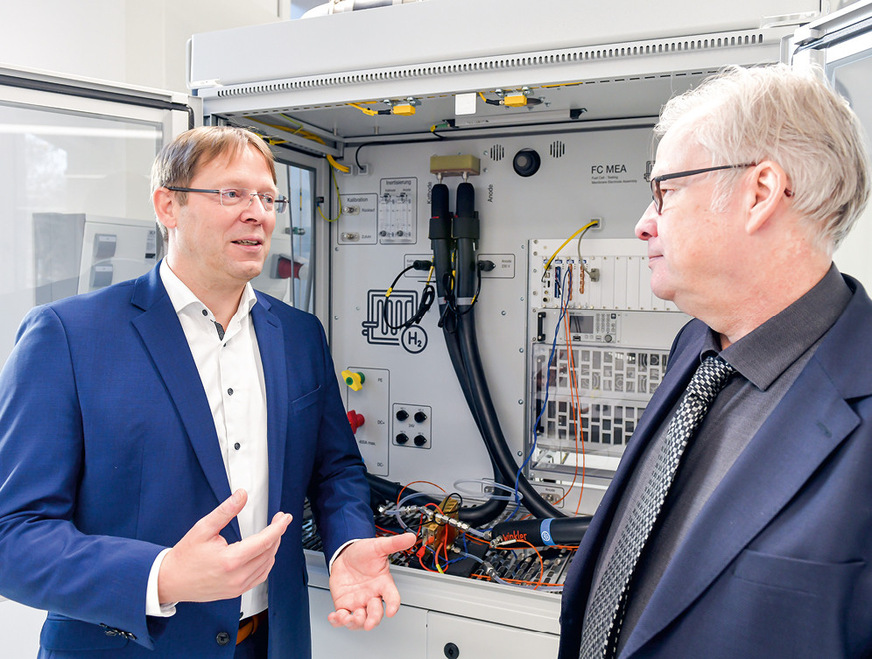
A fuel cell test rig also enables research into the conversion of hydrogen into electricity and heat. Further projects address the production of aviation fuel from biogas and the manufacture of basic chemicals from waste using pyrolysis.
© Universität Stuttgart / Max Kovalenko
The platform is operated by the Institute for Energy Efficiency in Production (EEP) and the Chair of Electrical Energy Storage Systems at the Institute for Photovoltaics (ipv). Project leader Alexander Sauer, Director of the EEP, emphasises: “With our platform, we are making a strong contribution at regional, state and national level to innovative and flexible hydrogen solutions and to the decarbonisation of industry.”
The research is closely linked to industrial practice. The Vaihingen site is located in close proximity to the ARENA2036 research factory. WAVE-H2 also cooperates with the CHEMampere initiative, which is working on CO2-neutral processes for chemical production.
According to the IEA Global Hydrogen Review 2024/25, just under 1 million tonnes of hydrogen were produced worldwide using low-emission technologies – barely
1 percent of the 100 million tonnes of hydrogen in total. That is equivalent to a bucket of water in an Olympic swimming pool. For comparison: photovoltaics in Germany exceeded a 1 percent share of electricity generation in 2009. By 2025, it had reached 18 percent, surpassing both lignite and natural gas.
© Adobe Stock / tarikdiz / NEONBOLD