


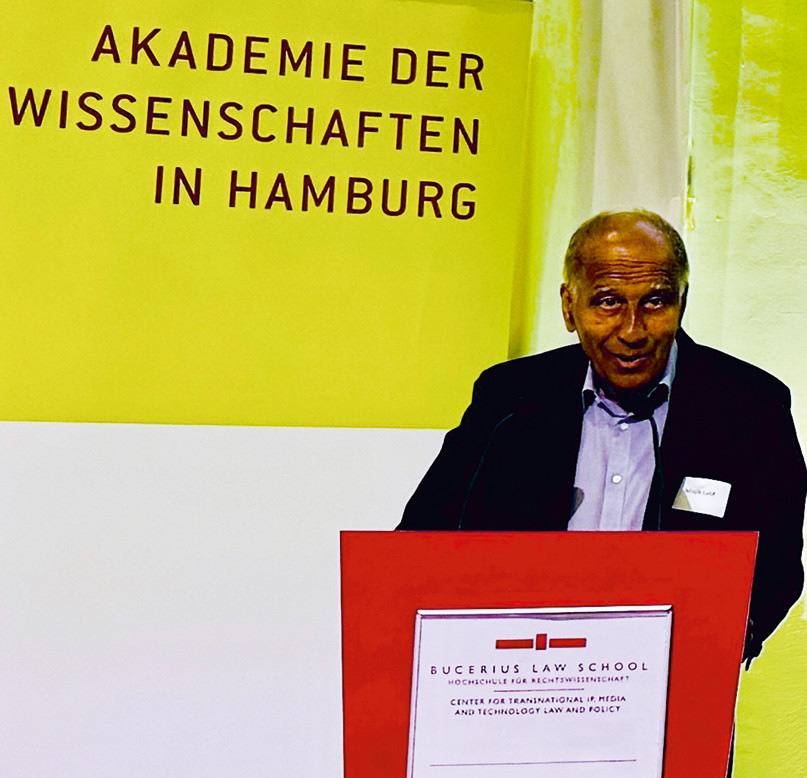
In his welcoming address, climate physicist Mojib Latif, president of the Academy of Sciences and Humanities in Hamburg, recalled the first oil crisis in 1973. “By then at the latest, it should have become clear to us that fossil energy sources do not provide secure supplies. Denmark recognized this. We, on the other hand, are standing still.”
Despite the climate and energy crisis, despite wars and repeatedly flaring conflicts in the Middle East, there is still a lack of insight into how urgently a change of course in energy supply is needed.
The euphoria of the early hydrogen years has faded. The market ramp-up is proceeding more slowly than hoped, but no one at the congress doubted the fundamental necessity of green hydrogen.
The real problems lie less on the technical than on the economic level. “We now have to build a new energy system within 15 years,” said management consultant Marius Buchmann of EERA consulting in Oldenburg. “We need not only CO2 reductions, but a complete transformation.”
As project manager at what was then Jacobs University Bremen, he contributed, among other things, to the dena lead study “Aufbruch Klimaneutralität” (Towards climate neutrality). Dena is the abbreviation for “Deutsche Energie-Agentur” – the German Energy Agency. He admitted that numerous hydrogen scenarios of recent years had been too optimistic in terms of costs. The price for green hydrogen today is around ten euros per kilogram.
“If electrolyzers are no longer exempt from grid fees in the future, the price could even rise to 12 to 15 euros per kilogram,” said Buchmann. That is far from competitive with fossil alternatives. The situation is particularly critical in energy-intensive industries. Even a price of four euros per kilogram is currently considered barely economically viable by parts of the chemical industry.
Bankability as a key issue The term “bankability” came up repeatedly at the congress and has now become decisive for many projects. That is why companies want nothing more than a high CO2 price, according to Buchmann.
In addition, the hydrogen market so far lacks a functioning middle layer of trading players, such as has long been established in the fossil industry.
This could also be built up with the help of the H2Global Foundation, whose basic concept is the so-called double-auction model. Under this scheme, state compensation payments bridge the difference between import and sales prices until the market for green hydrogen sustains itself.
Hermann Held, professor of Sustainability and Global Change at the University of Hamburg, warned of enormous costs that, according to the Intergovernmental Panel on Climate Change (IPCC), would arise from climate damage if we do not act.
For this reason alone, hydrogen is a “no-regret technology” for industrial applications. “In 2050, the abatement costs with the help of H2 technologies could be 15 to 22 percent lower.” In China, the abatement costs are even higher, at around one third of gross domestic product.
The physicist, however, expressly advised against so-called blue hydrogen. An interesting side note: he described himself as “the Chernobyl generation, which walked through the radioactive rain.”
Regulation becomes an obstacle Participants discussed the EU requirements for renewable hydrogen (RFNBO) particularly critically. Detlef Schulz of Helmut Schmidt University and spokesperson for the hydrogen working group of the Academy cited the criteria of “additionality” as well as the temporal and geographical correlation between renewable electricity and electrolyzer operation.
These rules are intended to ensure that hydrogen production is based on additional renewable energies and does not compete with direct electrification.
Meanwhile, many market participants see these requirements as an obstacle to the market ramp-up. Professor Schulz described them as one of the main factors slowing the expansion of electrolysis capacities.
Yet we quickly need much more: “Germany currently has around 185 MW of installed electrolysis capacity,” says Schulz. “That corresponds to only 1.8 percent of the planned final expansion in 2030.” The 10 GW target of the update to Germany’s National Hydrogen Strategy is therefore hardly achievable.
Monika Rößiger
Battery storage as new competition Schulz’s assessment of the role of battery storage also sparked discussion. While in the public debate these are usually regarded only as an important pillar of the energy transition, he pointed out possible conflicts of interest.
Battery storage systems are increasingly competing with electrolyzers for grid connections and grid capacities. They are indeed market-serving and can stabilize electricity prices, “but they contribute neither to system-serving nor to grid-serving functions.”
Often, they even place additional strain on the grid. There is already competition for scarce resources in the area of infrastructure. In order to make better use of flexibility options in the future, correspondingly adapted legislation is required.
Hydrogen without regret Martin Kaltschmitt, head of the Institute of Environmental Technology and Energy Economics at the Hamburg University of Technology, sees the most important fields of application for hydrogen in the chemical industry, steel production, international shipping and aviation, as well as in selected areas of long-term storage. For other applications, direct electrification will remain economically more attractive.
He refers to an estimate by the Berlin Institute for Innovation and Technology (iit), according to which H2 demand in all sectors could rise by 2035 to around ten percent of Germany’s current primary energy demand. In any case, “the supply and delivery chains for cost-effective ‘green molecules’ must also be developed,” said the professor. Otherwise, the goal of defossilization by 2045 cannot be achieved. So for him, too, waiting is not an option.
CCS, competition or complement? Another topic was the relationship between hydrogen and carbon capture and storage (CCS). Professor Michael Fehling of Bucerius Law School warned against placing both technologies side by side as politically equivalent.
In his view, both hydrogen and CCS infrastructures require long-term state planning. A permanent coexistence of different technology paths could complicate investment decisions and generate additional uncertainty. His appeal to policymakers was therefore to set clearer priorities and to define the intended fields of application of the respective technologies more precisely.
At the end of the congress, the experts agreed: it is now a matter of removing the existing political and regulatory hurdles. Because, as Martin Kaltschmitt said: “There’s no way forward without green molecules.”