

Anyone entering the power plant site in Moorburg today finds a construction site in two senses: dismantling work is still underway, while new buildings for the fossil-free energy future are already standing. Heavy-duty transporters deliver the electrolyzer’s massive components.
“At present, it is no longer just the dismantling of the old power plant facilities that is taking place here, but in parallel also a great deal of new construction,” says Christoph Cosler, Head of Hydrogen & Corporate Development at Hamburger Energiewerke.
Hamburg’s Senator for the Environment Katharina Fegebank underscores the symbolic value of Moorburg: “The fact that this hydrogen project is being built at a place where coal was burned just a few years ago is a real milestone.”
H2 Connector under construction
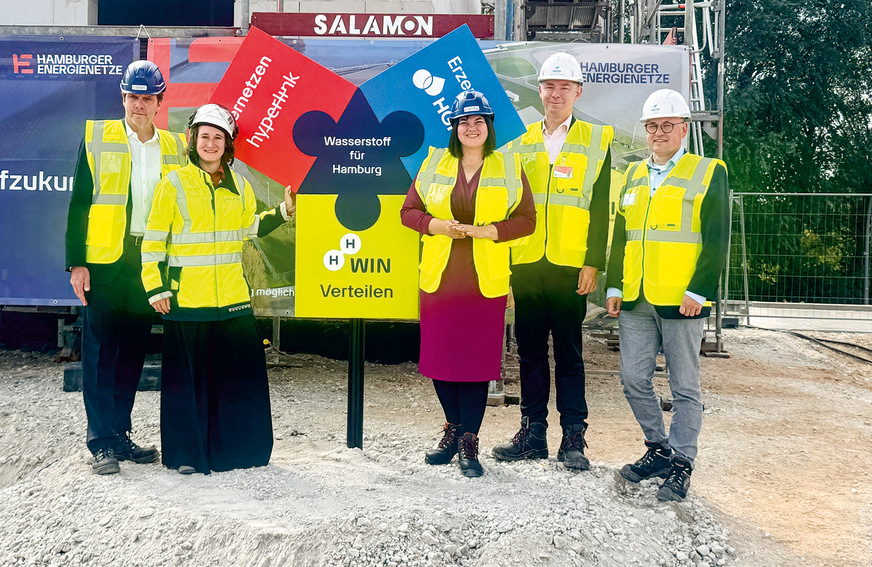
In August 2026, Hamburger Energienetze celebrated the start of construction on the H2 Connector, the technical control center of the Hamburg hydrogen industrial network HH-WIN. The Connector links the local large-scale electrolyzer with the citywide distribution network, which in turn is linked to the nationwide hydrogen core network (Wasserstoff-Kernnetz).
Technically, the challenge lies in the pressure differential: the Hyperlink pipeline, Gasunie’s long-distance hydrogen transmission network, runs at a pressure of up to 70 bar. The Hamburg distribution network HH-WIN, by contrast, is designed for a maximum of 25 bar.
The Connector bridges between these two worlds, with a gas pressure regulation facility that steps down incoming hydrogen from 70 to below 25 bar, and a compressor station that boosts pressure to 70 bar for export.
“For the hydrogen economy to succeed, offtakers need options,” explains Michael Dammann, Technical Managing Director of Hamburger Energienetze. “Our installation hub makes it possible to feed energy from the on-site electrolysis into the grid, but also to source hydrogen from the long-distance transmission network – and, in the future, from the port – or even to export it.”
Bidirectionality by design
Hamburg is intended to be not only a consumer but also a redistribution hub. The Connector’s transport capacities are considerable: in the first expansion stage, up to 360,000 standard cubic meters of hydrogen per hour can be imported into Hamburg, or up to 200,000 exported into the long-distance transmission network.
The network takes shape
HH-WIN, the Hamburg hydrogen industrial network, is the backbone of this infrastructure. Starting in fall 2027, it is to open up key industrial areas around the Port of Hamburg comprising 40 kilometers of network.
By 2031, an expansion to 60 kilometers is planned. Currently, more than half of the first 40 route kilometers has been completed, and all further sections are under construction or in the contract award process.
The projected savings are significant: if industry replaces 6.4 terawatt-hours of fossil natural gas annually via HH-WIN with climate-neutral hydrogen, 1.4 million tons of CO2 per year can be saved in projected terms from 2032 onward.
36 heavy-duty transporters and a topping-out ceremony
In parallel with the network expansion, the 100 MW electrolyzer of the Hamburg Green Hydrogen Hub (HGHH) is taking shape on the Moorburg site, the joint project of Luxcara and Hamburger Energiewerke.
The timeline has been remarkably tight: cornerstone laying on December 1, 2025; topping-out ceremony in July 2026; and in August 2026, 36 heavy-duty transporters carrying the massive electrolyzer stacks rolled onto the site from the Siemens gigafactory in Berlin.
“We are all Team Hydrogen – something is actually being built here,” says Holger Matthiesen, Co-Managing Director of HGHH. “That cannot be taken for granted with new technologies and large infrastructure projects.” To date, two out of three types of large components are on site: six transformers and six stacks. The two compressors are expected to follow at the end of 2026.
Starting at the end of 2027, the facility is to produce around 10,000 tons of hydrogen per year. “Our connection to the HH-WIN hydrogen network creates an essential prerequisite for green hydrogen from our electrolysis facility to become available where it is needed, in Hamburg and beyond,” Matthiesen emphasizes.
The grid feed-in is supplemented by a trailer loading station, through which hydrogen can also be dispensed by truck.
© Monika Rößiger
Core network and European backbone
What is being built in Moorburg is not a Hamburg solo effort. The H2 Connector is embedded in a growing national and European infrastructure. Gasunie, one of the major European long-distance transmission network operators, is building around ten percent of Germany’s hydrogen core network with the Hyperlink project, and doing so with remarkable resource efficiency: around 70 percent of the route consists of converted natural gas pipelines.
“We can now see: something is happening. Hydrogen is no longer a distant future,” says Britta van Boven, Managing Director of Gasunie Deutschland. The numbers back her up: six gigawatts have already been reserved on a binding, fee-based basis – meaning capacities that carry a real financial commitment. “There is serious interest, and progress has exceeded what many skeptics expected.”
From the end of 2029, the core network is also to be connected with the Netherlands and Denmark. “Then we will really have a market,” says van Boven. In this network architecture, Hamburg will play a key role as a consumption and import center.
The Hamburg company Tesa came on board in fall 2025 as the first industrial hydrogen offtaker, a development that Fegebank regards as a “strong sign for our industrial location.” The registration process, in which companies can express their non-binding interest in sourcing H2 from the large-scale electrolyzer, is open until November 13, 2026.
The construction costs for the H2 Connector alone, without the compressor station, which is still in the project planning phase, amount to around 22.6 million euros, of which about 16.3 million euros are covered by IPCEI funding.
On time, on budget
What is being built in Moorburg is being implemented at remarkable speed given the project’s complexity. Fegebank highlights that the project is “fully on schedule and on budget. This shows that things can succeed when everyone works well together.”
Indeed, the coalition behind it is unusually broad: a private project developer (Luxcara), a municipal energy company (Hamburger Energiewerke), a municipal network operator (Hamburger Energienetze), a European long-distance transmission operator (Gasunie), and Hamburg’s state-level politics, all pulling in the same direction.
For a project on a site that just a few years ago stood for the opposite of the energy transition.