


In the new “Naval Hall B8,” naval officers from all over the world are on the move. Several rows of colored ribbon bars adorn their uniforms, and the rank insignia allow even laypeople to sense that there are high-ranking officers among them. They view exhibits on sensor technology and unmanned systems or models of submarines with fuel cell propulsion. Here, hydrogen is not only a vision of the future, but already a reality.
A few halls further on, the question is whether hydrogen is also suitable for ships that have to remain at sea for days on end. As part of the European project NavHyS, work is being carried out on a concept for Service Operation Vessels (SOV) that supply offshore wind farms. Their fuel is to be liquid hydrogen, stored in tanks below deck.
This is still a development project. But it shows how concrete the search for climate-friendly propulsion systems has now become, and which technical and safety-related questions have to be solved in the process.
“Decarbonization, digitalization, safety and resilience” would have to be considered together, summed up Claus Ulrich Selbach, Vice President Exhibitions Maritime & Energy at Hamburg Messe und Congress, who was pleased with this year’s “record attendance.” More than 50,000 visitors from 134 countries attended the SMM, which takes place every two years in Hamburg, and around 2,300 exhibitors were represented.
With today’s propulsion systems, decarbonization begins with a reduction in energy consumption. Because every fuel that is not needed does not have to be produced, stored on board or bunkered.
Efficiency plus hydrogen
The technology is ready, says Uwe Lauber, CEO of engine manufacturer Everllence. “What we need now is a credible IMO framework for net-zero emissions, which creates investment security and rewards decarbonization. Every delay favors fossil fuels over climate-neutral alternatives. The gap is no longer technological, but political“, says Uwe Lauber.
The “Energy Efficiency Hub” in Hall A2 and the “Energy Efficiency Stage” in Hall A4 focused on alternative propulsion systems, green fuels, hybrid solutions, onboard carbon capture and digital optimization of energy consumption. Under the motto “Efficiency First: Powering the Future of Shipping,” manufacturers presented technologies with which emissions can be reduced.
But although there is hardly any way around energy efficiency in the short term, the message of the trade fair is clear: in the medium and long term, shipping needs climate-neutral fuels in order to ensure operation also in the high performance range.
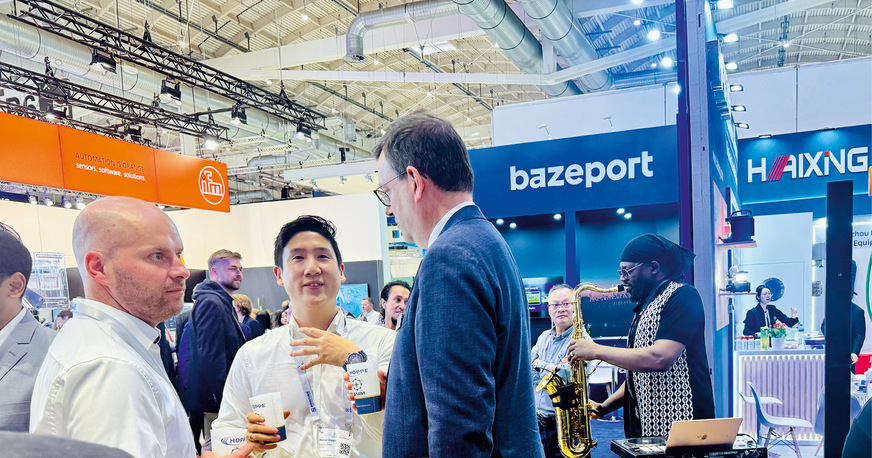
© Monika Rößiger
Rocket science for ships
This is where liquid hydrogen comes into play, as does the NavHyS (Naval Hydrogen Systems) project, which was also presented in Hall A2. While gaseous hydrogen is considered a practicable option for short distances and inland shipping, for longer ranges the higher volumetric energy density of liquid hydrogen (LH2) is needed, for example in Service Operation Vessels. These are ships that supply offshore wind farms in operating cycles of up to ten days.
Since liquid hydrogen has to be stored in special tank systems at minus 253 degrees Celsius, one of NavHyS’s goals is to develop such systems for shipping. These are below-deck tanks with a capacity of 200 to 300 cubic meters and a storage capacity of 12 to 18 tons of liquid hydrogen. The fuel is to be bunkered in less than two hours.
Behind the project is a European consortium of 13 partners, including ArianeGroup, North Star Shipping, Vard Design, Engie, Bureau Veritas and the Maritime Cluster Northern Germany (Maritime Cluster Norddeutschland, MCN). Their common goal is to develop an approvable design concept for the use of liquid hydrogen (LH2) as ship propulsion. The aim is to obtain approval by a classification society by the end of 2027.
The technology of NavHyS
Key components of the NavHyS concept include specialized liquid hydrogen pressure pumps and a coaxial coupling for connecting and disconnecting during bunkering. Such a connecting element for transferring cryogenic hydrogen was originally developed for the FIA World Endurance Championship. Now it is to be adapted for maritime applications.
With the help of the tube-in-tube principle of the coaxial coupling, two separate flow paths can be combined in a single interface of the connecting element. The cryogenic hydrogen flows into the tank via the inner channel, while the evaporating gas (boil-off) that is produced is returned via the outer channel. This keeps the pressure in the tank stable during refueling. In addition, it is ensured that no hydrogen escapes into the environment.
Space industry expertise
Unsurprisingly, the greatest expertise in handling liquid hydrogen lies with the space industry. It is therefore no coincidence that the French-German ArianeGroup, a joint venture between Airbus and the French engine manufacturer Safran, is involved in this project.
“For liquid hydrogen handling and management, ArianeGroup’s experience is of great benefit,” said Elisabeth Loeffelholz, program manager for hydrogen at ArianeGroup. “ArianeGroup has decades of experience in hydrogen mobility and is a pioneer in the application of liquid hydrogen in Europe.”
The project connects European companies and research institutions along the entire value chain, from tank and ship design through safety issues to classification. It is funded with five million euros by the European Commission; the project executing agency is the Clean Hydrogen Partnership. It started in January 2025 and runs for 36 months.
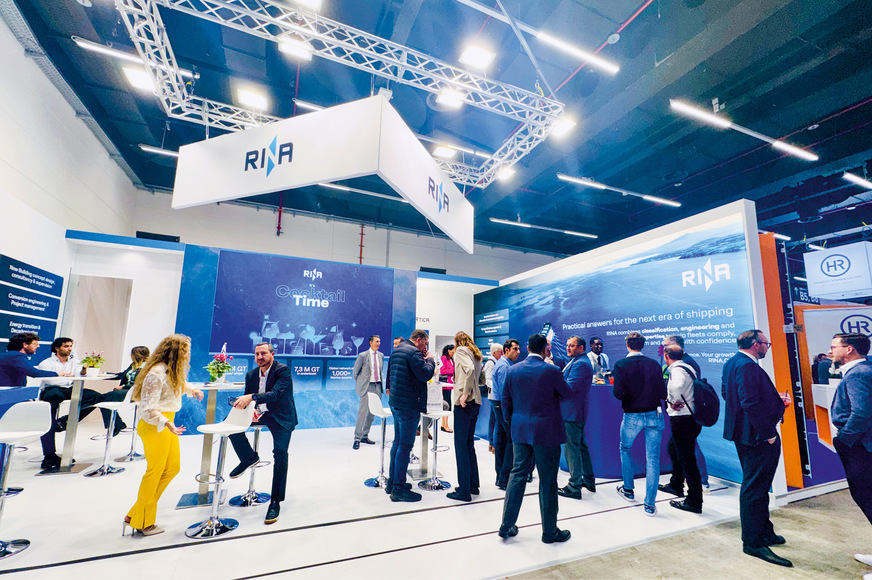
© Monika Rößiger
Maritime industry as part of the energy transition
The “Offshore Dialogue” additionally focused on renewable energies at sea and the future use of the oceans. The maritime industry thus sees itself not only as a consumer of new energy sources, but also as part of the infrastructure of the energy transition, for example in the construction and operation of offshore wind farms and converter platforms.
This priority was underlined by DNV, the classification society and main sponsor of SMM 2026, in its “Maritime Forecast to 2050” published at the trade fair. According to this, in all conceivable regulatory scenarios, energy efficiency remains the decisive lever for immediately reducing fuel consumption and emissions.
According to DNV, with stricter global rules on energy efficiency, the fleet’s energy demand could be up to 25 percent lower by 2050 than with regulation primarily managed on a regional basis. Fleet renewal, hydrodynamic retrofits, optimized routes and digital operational management can thus buy time and limit the costs of the green fuels needed later.
At the same time, the demand for low-greenhouse-gas fuels depends significantly on the political course. For the year 2030, DNV calculates, depending on the scenario, a demand of between four and 22 million tons of oil equivalent (Mtoe). By the year 2050, the range extends from 33 to 185 Mtoe. (According to IEA conversion, 1 Mtoe corresponds to 11.63 terawatt hours.)
These figures illustrate the challenge: the market for climate-friendly fuels does not emerge solely through technical feasibility, but also through binding demand, production facilities, transport chains and bunkering infrastructure.
For this reason, LNG is likely to play a role for ocean-going vessels for a long time to come, Nils Merkens told H2international. He is technical director at the engineering and consulting company Marine Service in Hamburg, which has specialized in alternative fuels such as hydrogen, LNG (including bio-LNG), methanol, ammonia and synthetic methane.
“LNG is already available as a fossil energy source, as are applications of bio-LNG and synthetic LNG, which, with the already existing infrastructure, enables the transition to green LNG.”
Transition to dual fuel
But a transition to further H2 derivatives such as ammonia or methanol is, according to Merkens, also already taking place in new builds: “However, less frequently and always as part of dual-fuel solutions in combination with distillate fuels (diesel), as is also the case with most LNG propulsion systems.”
In new builds, there are also increasingly ships with LNG systems that are prepared for later (partial) use with H2 derivatives as a dual-fuel solution. One example of this are LNG systems whose tanks and transfer systems are designed for later operation with methanol (“methanol-ready”). Combinations with ammonia are also in preparation.
With a service life of 20 to 30 years, before making an investment decision, shipowners have to consider carefully “which energy source will even be available at what cost in their future operating area – costs that ultimately have to be borne by the cargo market,” according to Merkens.
“A consistent step would be ’all-electric ships’ that dispense with combustion engines,” says Merkens. “Then hydrogen or H2 derivatives would be used in fuel cells for electricity generation and direct current motors would propel the ships. In this way, a more efficient conversion of energy for propulsion and onboard supply would be possible, which could also be used in hybrid solutions together with batteries.”
However, such systems are not yet available to a sufficient extent for larger ships, since correspondingly high-performance fuel cell systems with maritime certification are not yet ready for the market.

© Monika Rößiger
Safety first
However, hydrogen is not only a question of propulsion systems and fuels. The safe handling of hydrogen in daily operations must also be learned. In May 2026, DNV published a guideline on competency requirements for the use of hydrogen as a ship fuel with the “Recommended Practice DNV-RP-0703.” The recommendation is aimed at crews, inspectors and technical personnel, both on board and on land.
The background is the specific risks: possible leaks, the low ignition energy of hydrogen, and the requirements for high-pressure or cryogenic storage systems. According to DNV, this requires not only technical barriers and safe ship concepts, but also training, emergency procedures and a strong safety culture. The guideline supplements existing DNV regulations for LNG, ammonia and methanol.
Flexibility as a strategic imperative
For shipping companies, it will therefore be crucial to develop fleet strategies that take several future paths into account. “Ships that are commissioned today will be in service well beyond the year 2050.”
This is how Cristina Saenz de Santa Maria, CEO Maritime at DNV, described the dilemma in which shipowners currently find themselves. A quite comparable situation to that in the aviation industry. “The regulatory requirements are developing faster than the fuels, infrastructures and technological systems required for them.”
Shipping companies therefore need strategies that offer advantages already today and at the same time remain flexible with regard to a variety of regulatory and market-related developments. Without hydrogen, ammonia or methanol, the maritime energy transition will hardly succeed. This also became clear at SMM 2026, because these energy sources are already the subject of concrete ship designs, safety standards and investment decisions.
There was at least some progress in regulation soon after the trade fair: the cross-border initiative Rhine Hydrogen Integration Network of Excellence (RH2INE) received an in principle approval from Lloyd’s Register for the standardized design of exchangeable 380 bar hydrogen containers.
New propulsion systems, missing filling stations
Worldwide, 973 seagoing vessels are currently operated with LNG as an energy source, with 629 further units under construction. These are almost always dual-fuel ships that can also use distillate fuels. 134 seagoing vessels are currently operated with methanol, with 134 further units under construction. 13 seagoing vessels currently have the capability to be operated with ammonia, and six further ones are under construction.
By comparison: in 73 ports worldwide, LNG can be obtained directly for the energy supply of ships. For methanol, there are currently only five ports that offer direct supply of methanol in the port. Direct supply with ammonia as a ship fuel is currently not available in any port in the world.
Source: “Society for Gas as a Marine Fuel” (SGMF), as of August 2026.