

In 2003, Daimler was the world leader in hydrogen propulsion: 36 fuel cell city buses proved their everyday suitability over years, and the bus operators were highly satisfied. And then? Nothing.
The traditional bus manufacturers insisted on diesel. More than 20 years later, Daimler took a tentative step back into the market, with the hydrogen Citaro and a fuel cell from Toyota. Even though there was a series-ready product with comparable properties in-house.
While Germany hesitated, China acted: today, more than 7,000 fuel cell buses and 28,000 hydrogen commercial vehicles are in operation there. The green hydrogen required for this is produced in the sun- and wind-rich regions of Mongolia and transported via newly built pipelines to the country’s industrial centers.
German truck manufacturers, meanwhile, have postponed their market entry to 2030. The question is why it keeps happening, and what the hydrogen sector can learn from it. What is behind this development?
It is not due to the inability of the traditional corporations, and certainly not to their excellent engineers. Behind it are historically well investigated principles for which three economists received the Nobel Prize last year.
One half went to Joel Mokyr for the insight that technological innovation is a prerequisite for sustainable growth; the other half to Philippe Aghion and Peter Howitt for the development of a mathematical model of “creative destruction.” This term, first coined by Joseph Schumpeter for macroeconomics, finds its counterpart at the micro level of companies and their market as “disruptive innovation.”
A pattern that has been repeating itself for 100 years
Henry Ford and John D. Rockefeller once displaced horse-drawn carriages and their entire infrastructure, not through better horses, but through horseless carriages and a fundamentally different system. That is the essence of disruptive innovations: they replace not only a product, but the entire ecosystem.
Today, hydrogen, e-mobility, renewable energies and digitalization face the same task vis-à-vis the fossil vehicle and fuel industry. The pattern is known. Nevertheless, the consequences are regularly underestimated, also because disruptive innovations have an uncomfortable property: they cannot be planned and cannot be stopped by the established players.
Kodak co-invented digital photography, and yet went under. Digital cameras from Asia took over the market before Kodak could react. Then came Apple: the iPhone of 2007 made the digital camera obsolete within a few years. More than 100 million smartphones were hereinafter being produced monthly. Who would have thought that possible in 2005?
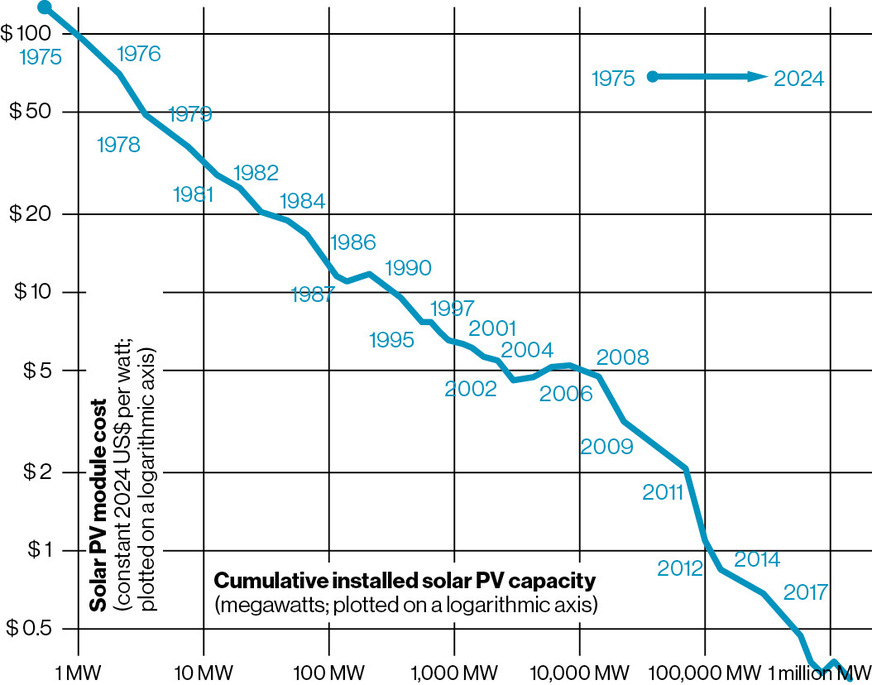
Wright’s law also applies to fuel cells Disruptive innovations do not follow chance, they follow laws. As early as 1936, aircraft engineer Theodore Paul Wright established: with every doubling of total production, the labor input decreases by 20 percent. “Wright’s law” has since been considered the most reliable predictor of cost developments in new technologies.
For electrolyzers and fuel cells, this means: the cost curve will fall, quickly and inexorably. The decisive question is only who builds up the production volumes that set this process in motion.
The chicken-and-egg problem is real: to get from high costs with small quantities to low costs at large quantities, massive upfront investments are needed. Chinese companies have drawn this consequence. Despite temporary pressure on earnings, market advantages are created in this way that can hardly be caught up with later.
Added to this is the learning effect in operation: only in real customer use do weaknesses become visible. Those who are in the market early improve their products faster, a mechanism that Bruce Henderson described as the “experience curve.” Those who wait do not learn.
© Our World in Data / NEONBOLD
Solar modules as a blueprint, and a warning
The cost learning curve of photovoltaics is the most striking example of recent industrial history: 20 years ago, a solar module cost around 5 USD per watt. Today it is 0.10 USD. The efficiency rose in the same period from 15 to almost 25 percent. In 2024, 600 GW were newly installed worldwide.
Hydrogen technology will go through the same curve. The question is not whether, but who will benefit from it. Cheap PV electricity becoming a game changer for electrolysis is no longer speculation. In the sunniest regions on earth, large-scale plants already enable electricity prices of around 1 US cent per kWh, cheaper than any fossil alternative.
If one adds CO2 taxes and the geopolitical risk costs of fossil energy imports, the calculation shifts further in favor of green hydrogen.
The frequently cited argument of supply interruption through fluctuating solar and wind energy also loses force: falling battery storage costs and dynamically operable electrolyzers, which convert surplus electricity directly into storable hydrogen, are increasingly closing this gap.
Vertical integration: whoever builds the entire system wins
In the early phase of disruptive innovations, there is regularly a lack of reliable suppliers, standards and regulatory frameworks. Those who still want to scale quickly have to build the overall system themselves, or secure it through strategic cooperation.
Tesla has demonstrated this for e-vehicles. The result: a closed, scalable system consisting of the vehicle, its energy system and charging infrastructure. Trough the traditional supplier industry, neither the desired product nor the necessary speed could have been achieved.
In battery manufacturing, too, Tesla built up its own competency and optimized route planning via internet-based services. Since then, the company has had a market lead that the established manufacturers have not yet fully caught up with. Early market entries namely bring about an advantage that is difficult to copy: learning effects from real customer use that flow into the next product generation.
With hydrogen, the same development is taking place, only faster and with even larger players. PV world market leader Longi is expanding battery storage and electrolyzers in order to position itself as an integrated system provider. Wind turbine market leader Goldwind is pursuing an analogous strategy. In this way, established champions of renewable energies are consistently diversifying into the hydrogen and e-methanol sector.
China is already today the world’s largest methanol producer and a leader in green methanol; the technologies for producing e-gasoline from methanol are also available. Behind this strategy are two clear political drivers: first, the reduction of geopolitical dependence on oil producers; second, the positioning of China as a climate-friendly industrial nation.
Further examples: Toyota is planning a 3 GW electrolysis production to secure its own hydrogen supply. And BYD as well as CATL, originally a battery manufacturer, today dominate the global market for e-buses, e-cars and energy storage systems. The pattern is clear: whoever controls the overall system controls the market.
As long as the European commercial vehicle manufacturers could divide the market among themselves and reliably had their regular customers, little moved here. But since Chinese companies as well as Tesla, Toyota and Hyundai have been competing with the established players, things are changing.
At IAA Transportation in Hanover in September, Daimler presented, together with partners from vehicle construction, the energy industry and infrastructure, the plan for a scalable deployment of hydrogen trucks in Europe by 2030. Participating are Bosch, Daimler Truck, the Volvo Group, Toyota, Air Liquide, TotalEnergies, TEAL Mobility and MB Energy. According to the companies, the German ecosystem is thereby creating, for the first time in Europe, the conditions for a broad market ramp-up.
It is also worth mentioning that the autonomous truck will bring further radical changes: the short refueling times with hydrogen are an unbeatable advantage, since the drivers’ rest periods for charging the batteries are eliminated.
© Our World in Data / NEONBOLD
97 percent of the fleet is still waiting
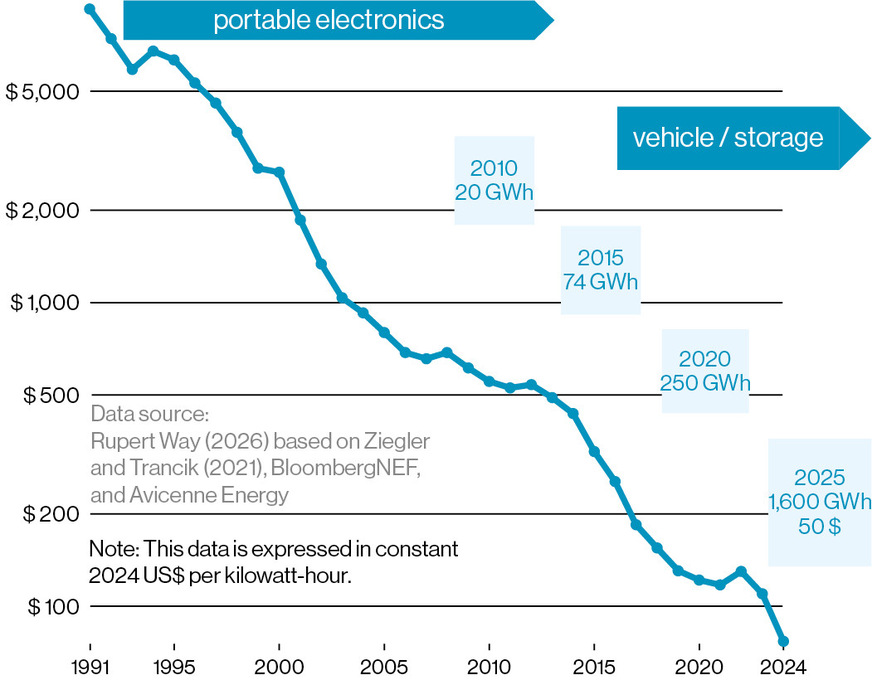
Worldwide, more than 1.6 billion vehicles are on the road. E-vehicles account for around three percent of these, but are growing by over 30 percent annually, while the overall market, at around three percent, is almost stagnating.
In China, the world’s largest vehicle market, the growth rates are even higher, driven by registration restrictions for combustion engines and low charging costs. BEV and EREV have reached cost parity with the combustion engine. Fuel cell vehicles are following. Due to the many buses and commercial vehicles already operating in China, the cost curve is falling. Germany has 211 hydrogen commercial vehicles and around 630 hydrogen buses. The pace has to change.
How dynamic disruptive markets can be is shown by Xiaomi: the smartphone manufacturer entered the market for electric sports cars and sold approx. 500,000 vehicles within two years. No established automobile manufacturer would have thought that possible.
China is pushing the cost curve downward through its huge domestic market, and subsequently exports the new technologies all over the world. Unlike Western corporations, Chinese market participants deliberately forego high short-term returns.
For the export-oriented German vehicle manufacturers, this is an existential threat. The massive job cuts in the German vehicle industry are not a cyclical dip, they are the direct consequence of a global disruptive innovation.
And yet: 97 percent of the global vehicle fleet still have to be replaced. The transformation has only just begun.
Hydrogen as the backbone of the future energy supply
Electricity from sun and wind is already cheaper in the earth’s desert regions than fossil electricity. The catch: it is produced far away from the major industrial centers, and its generation fluctuates.
Hydrogen and e-fuels solve both problems at the same time: they transport energy over long distances and store it over long periods.
While China is building new hydrogen pipelines, Europe is converting its existing natural gas network to hydrogen, one of the most important infrastructure decisions for the energy security of the coming decades.
With electrolyzers as well, China has taken the lead: 4 GW of production capacity are already in operation. The government-supported industry association China Hydrogen Alliance has set itself the goal of expanding production capacity to 100 GW by 2030.
By then, the European Union wants to have reached 120 GW (REPowerEU); of which 10 GW are planned for Germany. However, these ambitious targets are stalling due to slower approval procedures and high investment costs.
The principles of disruptive innovation are known. The learning curves are calculable. What is missing is pace.
Whoever invests, scales and learns now will shape the hydrogen economy of tomorrow. Whoever waits will, like Daimler in the year 2003, eventually enter again a market dominated by technology that others have long since built up.