

The Green Hydrogen Hub in Stuttgart is set to be ready for deliveries starting in 2028, according to Peter Drausnigg, technical managing director of the municipal utility (Stadtwerke) of Baden-Württemberg’s state capital, founded in 2011. He apparently felt compelled to make this commitment in mid-September because investments in the project have more than doubled to 75 million euros since planning began, while the City of Stuttgart has been fighting for every cent since trade tax revenues collapsed dramatically.
From 2022 to 2026, the municipal utility, which is responsible for roughly a quarter of Stuttgart’s planned CO2 emission reductions, is to invest around one billion euros in climate protection projects. The city originally wanted to contribute 300 million from its budget as additional equity. 100 million flowed in right in 2022. As recently as 2024, the city reaffirmed its willingness to contribute the remaining 200 million. “Partnerships are important now in order to maintain momentum,” Drausnigg says. There are also subsidies from the federal and state governments, although their amount is not yet clear.
Behind the Stuttgart H2 project, in which green hydrogen is produced and distributed via a four-kilometer pipeline, stand the federal and state governments as well as the EU, the Stuttgart Regional Association (Verband Region Stuttgart) and additional consortium partners from science and research.
Drausnigg attributes the eighteen-month delay in implementation to a change in legislation. In addition, the project has grown with a third electrolyzer to nine megawatts of installed capacity and an annual capacity of 900 metric tons of H2, and has thus been scaled up at greater cost. The plant is scheduled to enter trial operation at the end of 2027. The technical managing director: “We are building this plant, delivering green hydrogen from 2028, and developing a customer base for it.”
More hydrogen buses planned
Specifically, this customer base is above all the Stuttgarter Straßenbahnen AG (SSB), which operates the majority of local public transport in Stuttgart and most of the bus lines. It currently has 15 hydrogen buses in operation. This fleet is being systematically expanded, Drausnigg says. For comparison: in Cologne, 160 buses already run on H2 in regional passenger transport. “And with the pipeline, we have the option of also supplying industry and the Neckar port with green hydrogen,” says the head of the municipal utility. What he needs now, he says, are clear framework conditions and fewer bureaucratic obstacles. That applies within the city administration, but also at the higher levels.
For competitive reasons, he does not name prices and says nothing about the pricing calculation. Since 2011, the city has invested 447 million euros in its municipal utility, which exclusively sells green electricity, for which its own generation facilities are gradually being built. The SWS also sells natural gas and, through “Stuttgart Netze,” jointly with EnBW operates the inner-city electricity and gas network. The municipal subsidiary is also setting up more and more charging stations for e-mobility in public spaces, has recently been organizing twelve heating networks, and is building up the H2 infrastructure.
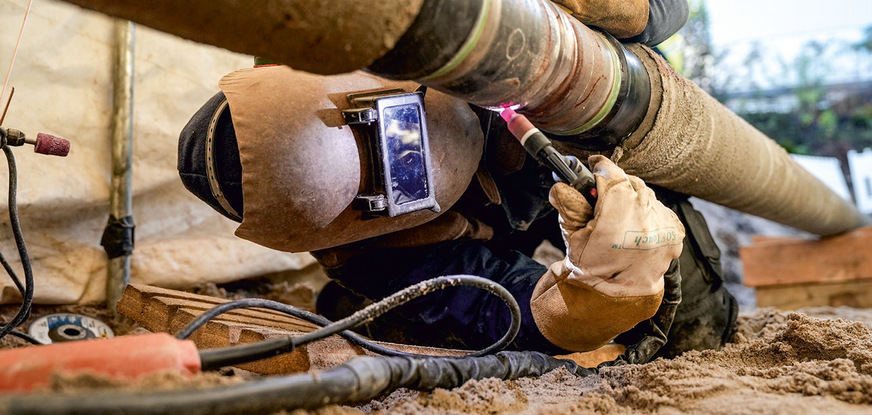
© Stadtwerke Stuttgart
Flagship Daimler Truck
Companies in and around Stuttgart are also continuing to bank on hydrogen. Daimler Truck, headquartered in Leinfelden-Echterdingen near Stuttgart, recently announced that it will invest several hundred million euros in hydrogen trucks by the end of the decade. Karin Radström, CEO of the DAX-listed group: “We have invested a lot in battery-electric vehicles, but now in the next step we are putting a great deal of money into helping hydrogen succeed.”
While several competitors are withdrawing from H2 drivetrains and focusing solely on battery-electric drives, Daimler Truck is deliberately pursuing a dual strategy in order to actually achieve decarbonization in logistics. Radström: “Hydrogen is definitely part of the solution in truck transport across Europe.” This applies to high payloads and ranges, shorter refueling times, and a long-term limited electricity infrastructure. To this end, Daimler Truck is working together with corporations from the logistics sector.
Stuttgart’s small and medium-sized enterprises (Mittelstand) are also showing motivation to participate in building up the H2 infrastructure. In nearby Ebersbach/Fils, the waste management company ETG from Göppingen has been working for nearly two years with the Augsburg-based start-up Green Hydrogen Technology (GHT). In a pilot plant, different types of waste that cannot be recycled as materials are converted into H2 and liquid CO2. Until now, these have been “thermally utilized,” that is, incinerated in waste-to-energy plants or in the cement industry in order to at least make use of the released energy.
The central point of the process: the material, ranging from contaminated wood residues and plastic shreds to sewage sludge, is not incinerated but gasified at 1,200 degrees under oxygen deficiency. In the process, the substances break down into smaller molecules, which are then separated. GHT managing director Robert Nave previously gained experience at two similar plants in Germany, one of which is twenty times larger than the one in Stuttgart.
The owner-operated Göppingen recycling company DU, which includes ETG and is always on the lookout for new business models, immediately showed interest in the process, GHT managing director Robert Nave reports. The district and the Stuttgart Regional Association (Verband Region Stuttgart) also came on board and took a risk with their funding. Currently, the Stuttgart plant, which has already proven itself, is being optimized to simplify the workflow, says Nave.
The plant is designed for 1,000 metric tons of residual waste per year. Oxygen and steam are fed into the process. In the end, around 100 metric tons of H2 and 1,200 metric tons of CO2 are produced. Cooperation partners for the offtake of the hydrogen are the H2 fleet operator Hylane and the fueling station operator GP Joule. Nave puts the production costs at 1.50 euros per kilogram of hydrogen.
The liquid CO2 is partly used by industry, according to GHT. It can be carbonated in mineral recyclate, as the company Feess in nearby Kirchheim/Teck has been doing for a good two years. In this way, the construction waste recycler produces tradable CO2 certificates with which money can be earned. From the residual waste in Ebersbach, depending on the fraction processed, one to five percent of the original volume remains as ash. Problem materials are turned into valuable materials that flow back into industrial processes.