

In the Dutch city of Groningen, a project with signal effect is launching in mid-June, at least for European data center operators. NorthC is installing a 500-kilowatt fuel cell module in its new data center to replace conventional diesel backup generators. According to the company, it is the first data center in Europe to switch to green hydrogen.
“The transition from diesel-powered backup generators to sustainable alternatives is a significant next step,” says Jarno Bloem, Chief Operating Officer at NorthC. Green hydrogen offers the best possibilities for this. The system is expected to save tens of thousands of liters of diesel annually and reduce CO2 emissions by more than 78 tonnes per year. If demand grows, additional H2 modules could be added. While these are more expensive to purchase than diesel generators, the company expects costs to decline as the technology advances.
Why UPS and emergency power are indispensable
The abbreviation UPS stands for uninterruptible power supply. And it is no luxury but a lifeline in many industries. It protects sensitive electrical systems, such as servers, network equipment, hospital medical devices or control systems, from the consequences of power outages and grid disturbances. In the event of a grid failure, the UPS delivers power immediately, stabilizes voltage fluctuations and gives operators time to shut down systems in a controlled manner or switch to a longer-term emergency power supply.
Batteries typically handle this immediate supply for seconds to a few minutes, while diesel generators, known as standby power systems, provide longer-term operation, i.e. emergency power supply. But it is precisely these diesel generators that are coming under increasing pressure: they cause emissions, noise and considerable maintenance effort, and must be tested monthly even though they rarely run in an actual emergency. Every test run burns diesel. Stricter environmental regulations, such as the German Energy Efficiency Act (Energieeffizienzgesetz), and the climate targets of major corporations are making the search for alternatives more urgent. Fuel cells are therefore moving more sharply into focus, even though it is still a niche market.
Complementing batteries
Fuel cells will therefore not replace lithium-ion batteries in UPS applications. In fact, the two technologies are less in competition with each other than they are complementary. Batteries respond in milliseconds, making them still unmatched for immediate bridging during a grid outage.
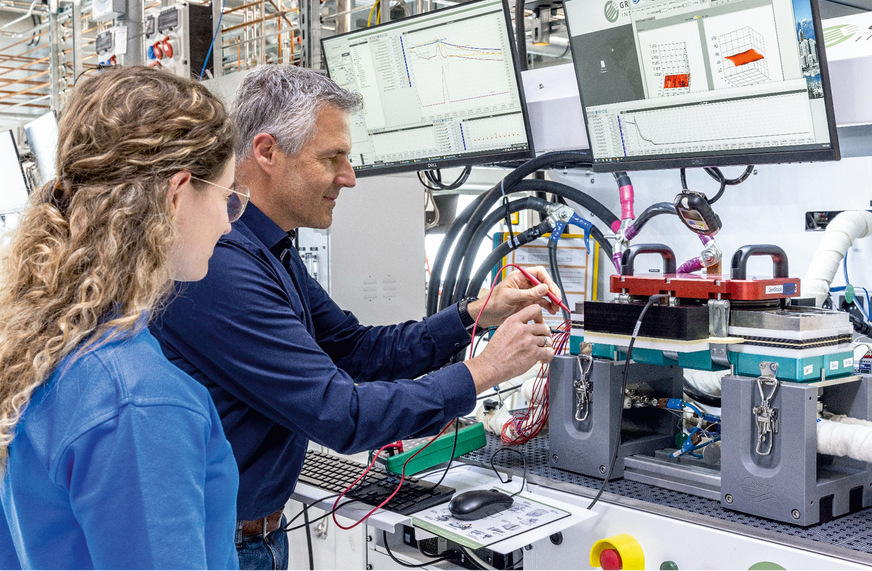
Fuel cells, by contrast, need a few seconds of start-up time. Their strength lies in long-duration supply: as long as hydrogen is available, they deliver power continuously, for hours or even days. Batteries are usually depleted after a few hours and then simply empty, says Alexander Kabza, Head of the Fuel Cell Systems Division at the Center for Solar Energy and Hydrogen Research Baden-Württemberg (ZSW). The key question is how long a UPS must operate independently of the grid. For minutes or a few hours, batteries can usually be dimensioned sufficiently. “If, on the other hand, longer grid-independent operation must be ensured during a dark doldrums period, or if no adequate grid infrastructure is available at all, which is already the case for large data centers today, then fuel cells can also provide large amounts of electrical energy on a sustained basis via hydrogen stored on-site or delivered by pipeline.”
Ulrich Misz, Head of the Fuel Cell Systems Department at the Center for Fuel Cell Technology (ZBT) in Duisburg, Germany, confirms this assessment: “The central advantage of fuel cells lies in extending autonomy time. While battery systems quickly become large and expensive for long bridging periods, the energy capacity of fuel cell systems can be increased relatively easily by using larger hydrogen storage,” says Misz. In addition, the high energy density of hydrogen allows large amounts of energy to be buffered in a compact form.
Longer runtime, easier storage, less maintenance
The real competitive battle in the future will be between fuel cells and diesel generators. Compared with diesel, fuel cells score with several advantages: they operate not only emission-free and virtually silent but also require significantly less maintenance. Oil changes, “diesel bug” (microbial contamination of fuel) and regular load testing are eliminated. Hydrogen can also be stored for years without self-discharge, whereas batteries require active charge management.
For a 48-hour emergency power supply, a pure battery system would in many cases simply be too large and too expensive; a hydrogen tank is considerably more compact. “Fuel cell solutions can be expanded very easily to achieve longer backup times,” says Stephan Laistner, Director Sales Europe at SFC Energy, based in Munich, Germany. “Battery systems must be completely replaced after ten to fifteen years.” Laistner, too, is seeing rising demand for UPS solutions combined with a fuel cell.
© ZSW, Martin Duckek
Bridging 72 hours
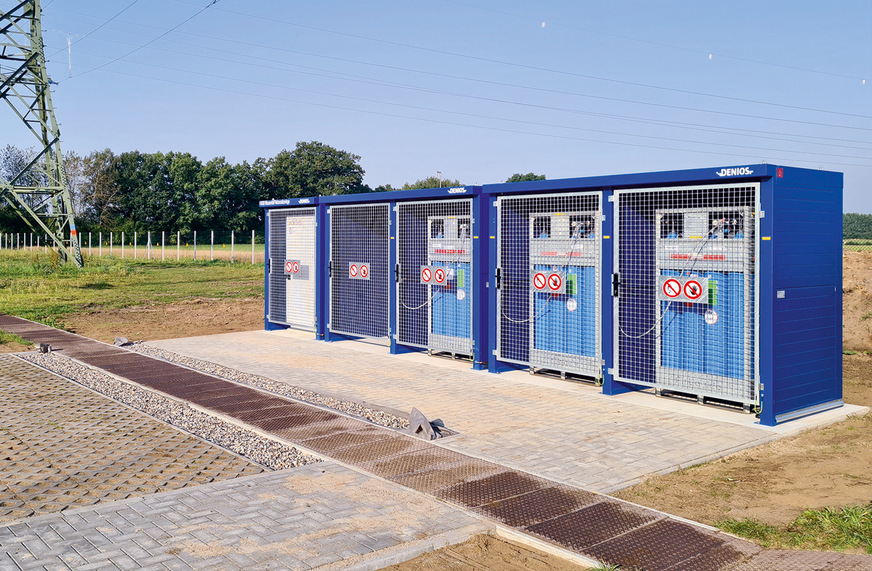
That the technology works beyond the pilot stage is demonstrated by several ongoing projects. The grid operator Schleswig-Holstein Netz has replaced the previous battery solution with a hydrogen fuel cell from SFC Energy at a substation. The old system no longer met new statutory requirements for bridging time. The new system, an Efoy H2-Cabinet, delivers four kilowatts of power over 72 hours using two fuel cell modules.
The hydrogen supply is provided by three cylinder bundles, each with twelve cylinders at 300 bar; an automatic switchover controls the operation. “This energy solution offers the opportunity to ensure emergency power supply with an innovative approach while simultaneously contributing to climate protection,” says Tobias Lützen of Schleswig-Holstein Netz. The entire system is housed in a space-optimized outdoor cabinet on approximately 16 square meters and can be integrated into existing plant structures.
Deutsche Telekom is also field-testing the technology. At the Nibirii Festival in Düren, Germany, a hydrogen fuel cell, also from SFC Energy, powered a mobile cell tower continuously for 14 days for the first time, replacing the diesel generator that would otherwise have consumed 35 to 40 liters per day. The mobile tower, developed by two Telekom employees themselves, supports 5G and LTE and can be set up by a single person within 20 minutes. The test demonstrates that such a solution is suitable not only for short-term events but also for longer-term standby power operation, for example in disaster areas.
© SFC Energy AG
Data centers as micro power plants
The biggest driver for hydrogen-based emergency power supply is the rapidly growing demand for computing capacity, also driven by artificial intelligence. Data centers are increasingly evolving from passive power consumers into independent micro power plants. So-called microgrids combine battery storage, on-site power generation and grid-forming inverters into a self-sufficient campus grid that can, in an emergency, decouple from the public grid and independently maintain a stable 50-hertz power supply.
Microsoft is already operating a three-megawatt PEM-based fuel cell system in Wyoming, housed in two 40-foot containers. Vertiv, in cooperation with Ballard Power, offers a modular system designed to replace conventional diesel generators. Rolls-Royce supplies H2-ready certified gas engines under the MTU brand that initially run on natural gas and can later be converted to up to 100 percent hydrogen.
Market growing every year According to analysts, the European fuel cell market will grow by approximately eleven percent annually through 2034. The ZSW also sees clear market prospects: “The mere fact that companies are developing products for these applications shows that a market is forming,” emphasizes Alexander Kabza. Nevertheless, further hurdles remain: the acquisition costs for fuel cell systems are still significantly higher than those of conventional generators, the hydrogen infrastructure is still patchy, and lithium-ion batteries are becoming steadily cheaper and more powerful. Yet fuel cells score particularly where diesel generators have dominated so far, with emission-free energy and high flexibility. The political framework conditions and climate targets are playing into the fuel cell’s hands. It is not only in Groningen at NorthC that this signal has been recognized early on.