
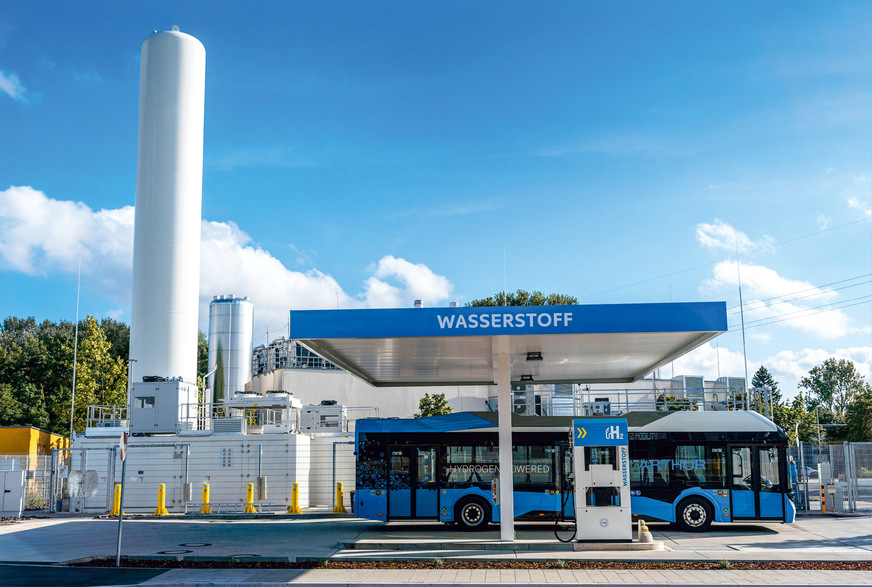
© H2Mobility
Across Germany, federal states and municipalities are investing heavily in green hydrogen, whether through funding programmes or via publicly owned companies. In the south, the Federal State of Baden-Württemberg is supporting the purchase of an electrolyser that the municipal utilities of Ulm and Neu-Ulm plan to operate near the A8 motorway from mid-2029. Green Hydrogen Esslingen, in which the Esslingen municipal utility holds a stake, and VK Energie in Munich are jointly organising the energy supply for the “Neue Weststadt” urban district in Esslingen, with an electrolyser at its heart. In the north, EWE in Oldenburg – 74 percent owned by 21 cities and districts in the Federal State of Lower Saxony – is investing one billion euros in its hydrogen strategy, including a 320 MW electrolyser in Emden. And in Hamburg Moorburg, where a coal-fired power plant was dismantled in 2021, a 100 MW electrolyser is being built along with a 40-kilometre hydrogen pipeline to the industrial port area of Hamburg (see detailed report in HZwei 5/2025).
Setbacks prompt criticism of funding
However, such success stories are tempered by news that Berlin-based operator H2 Mobility closed 14 filling stations nationwide at the end of the year, mainly in North Rhine-Westphalia and Lower Saxony, but also in Wendlingen in Baden-Württemberg. This is not only frustrating for users like Frank Stuckstedte from Rheda-Wiedenbrück, who launched a petition to the Federal Ministry of Transport on 6 December that needs 30,000 signatures by June to remain online (as of 8 January, 432 had signed). Stuckstedte also criticises the fact that the filling station in his town alone received €600,000 in state funding in 2019. In Bielefeld, where seven refuse collection vehicles have been running on hydrogen for years, refuelling options have also disappeared. One oddity: there is another hydrogen filling station in front of the MHKW waste incineration plant. This too received state funding – but from different sources. As a result, the municipal trucks have so far not been permitted to refuel there.
What at first glance looks like a bureaucratic absurdity can be explained by H2 Mobility CEO Martin Jüngel. While the first filling stations were primarily designed for passenger cars and 700-bar tank systems, trucks, buses and other heavy-duty vehicles are now increasingly running on hydrogen. This requires more powerful facilities with greater hydrogen capacity, more dispensers and a 350-bar tank system that limits the refuelling process to a maximum of 15 minutes.
Cooperation advances hydrogen
Such disruptions create uncertainty. But with every step forward, predictability improves. In December, H2 Mobility opened its fifth new-generation filling station in Ludwigshafen. And with major business partners such as Hylane, Germany’s largest lessor of carbon-neutral trucks, H2 Mobility has negotiated a price of €8 per kilogram of hydrogen for its customers. These customers include Rewe, Schenker, GLS, Hermes and haulage associations such as the one in Stuttgart, which now offers its members a hydrogen truck for quarterly test use. This dovetails with the hydrogen expansion strategies of the municipal utilities in Ulm, Stuttgart and Esslingen.
Predictability grows, quota desired The Rems-Murr waste management authority (AWRM) is currently considering building two five-megawatt electrolysers in Winnenden for €38 million, which could produce 850 tonnes of hydrogen annually from solar power generated on former landfill sites. The Federal State of Baden-Württemberg, which has been led by the Green party since 2011 and has put together a €100 million funding package for hydrogen expansion, would subsidise the project with €10 million.
Before the district council makes a decision, AWRM is researching regional hydrogen demand and specific off-takers – as is every potential operator across Germany. The cost per kilogram, which all those surveyed discuss only rarely and vaguely, plays a central role. This lack of price transparency is grist to the mill of hydrogen critics.
Any step that brings greater predictability is therefore welcome, including with regard to grid expansion and availability, which is gradually improving. At the turn of the year, the Federal Network Agency (BNetzA) set the prices for transporting hydrogen through the grid, closely aligned with natural gas costs. The physical completion of the first pipelines – such as the 400 km from Lubmin to Bobbau – also provides a degree of certainty. This is essential, as users need to be able to plan their requirements and infrastructure based on trailer deliveries or grid connections.
For all investments, proponents and operators argue, legally mandated quotas for a green hydrogen share in the energy mix would therefore be important on a transitional basis – to stimulate and secure demand and baseline utilisation of electrolysers and grids.
EU taxonomy channels capital into green hydrogen
At the same time, the EU taxonomy, which requires major capital market players to align their portfolios with sustainability criteria, means that sufficient capital is fundamentally available. This is evident, for example, in the Axa Group’s stake in EWE in Oldenburg, or in the shareholder structure of the French, publicly listed hydrogen producer Lhyfe, which commissioned a €30 million plant in Schwäbisch Gmünd as recently as October. “We expect the hydrogen economy to ramp up in the coming years, followed by falling hydrogen prices,” says Alexander Hauk, press spokesperson for the Association of Municipal Enterprises (VKU) in Berlin.
Billion-euro investments and off-the-record criticism
One of the largest municipal hydrogen players is EWE from Oldenburg. “Hydrogen is a building block of the energy transition for us, particularly where direct electrification reaches its limits – for example in industry or in certain systemic applications,” says CEO Stefan Dohler. With 10,900 employees, annual revenues of €8.7 billion and 1.4 million energy customers, EWE is one of Germany’s major energy companies, although these figures include its communications and IT business. The group is 74 percent owned by 21 cities and districts along the Weser, Elbe and Ems rivers, and 26 percent by Axa’s investment arm Ardian.
In total, EWE plans to invest one billion euros in its hydrogen strategy. This includes building a 320 MW hydrogen production facility in Emden, converting a large-scale natural gas cavern in Huntorf for hydrogen storage, and developing pipeline infrastructure through new construction and conversion of several pipeline sections in the northwest. EWE is receiving €350 million in funding from the federal government and a further €150 million from the Federal State of Lower Saxony.
These high subsidy amounts, in the context of strained public finances, are repeatedly criticised by municipal utility directors who believe the money could be invested more efficiently elsewhere. However, no one is willing to be quoted publicly with such statements.
Southern German players push for reliability
At the Stuttgart municipal utility and the Stuttgart Region Association (VRS), the alliance of the state capital with the five surrounding districts, the message is that words must be followed by action – whether it is the Southern German Natural Gas Pipeline (SEL) transporting hydrogen from 2030, the city of Stuttgart aiming for climate neutrality by 2035, or the EU-wide hydrogen network being in place by 2050. Companies, property owners and municipal utilities need this reliability, because without trust there will be no investment.
The Stuttgart municipal utility and the VRS plan to commission a 9 MW electrolyser at the Neckar harbour by the end of 2026 as part of the H2-GeNeSiS project. The hydrogen is to be purchased by the SSB public transport operator, Daimler Truck, Neckar river vessels and residential developments. Two thirds of the €18.6 million cost will be borne by the federal state and the EU.
The electrolyser is to be powered by surplus solar electricity that cannot be used directly, including from the roofs of state-owned buildings. A programme for these solar installations has been in place for years.
The investment is considered money well spent. It amounts to economic development, as hydrogen is needed for fuel cell research and test stands for hydrogen combustion engines, as well as for process heat in steel and cement production and the chemical industry. Felix Mayer, Managing Director of Green Hydrogen Esslingen GmbH, which operates the energy concept in Esslingen’s “Neue Weststadt” district, says: “Hydrogen is the ideal medium for buffering electricity surpluses or shortfalls and for linking the individual sectors.”