

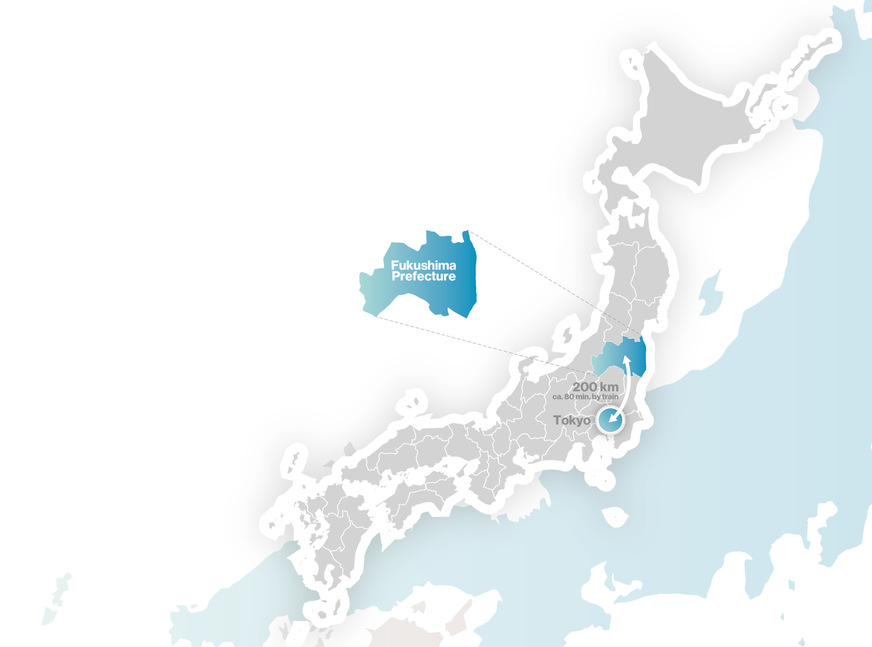
Masao Uchibori refers to the province of Fukushima as a “treasure chest of nature” when he addresses around 70 experts in renewable energy and hydrogen in Hamburg. “Beautiful landscapes, castles, ramen, and our world-famous sake,” continues the governor of the prefecture. “Fukushima was so magnificent and so peaceful. And then came March 2011.” The regret is still audible in his voice.
Fifteen years after the devastating meltdown in three reactors at the Fukushima Daiichi nuclear power plant, Japan presents a divided picture in terms of energy policy: while the country continues to rely on nuclear power and reactivated two reactor units of the 8.2-gigawatt Kashiwazaki-Kariwa nuclear power plant in early 2026, the Fukushima region is steadfastly committed to renewable energy and hydrogen.
This has led to the curious situation that two energy-related superlatives are located just about 150 kilometers apart as the crow flies: the largest nuclear complex in the world and one of the world’s largest facilities for the production of green hydrogen.
“Fukushima has truly undergone an energy revolution,” says Katharina Fegebank, Second Mayor of the Hanseatic City, in welcoming the representatives from business, science, and politics who are attending an economic seminar in Hamburg. This is intended to further deepen the partnership between Hamburg and Fukushima, with a focus on scientific exchange and sector coupling.
Previously, Hamburg’s First Mayor Peter Tschentscher had welcomed the high-ranking delegation from Japan at City Hall, where he and Governor Uchibori ceremoniously extended the cooperation, particularly in the field of hydrogen technology.
Since 2018, the city-state and the Japanese region, each with around 1.8 million inhabitants, have been cooperating on the basis of a Memorandum of Understanding. They support companies in entering each other’s markets and implement joint research projects. Both partners also share the highly ambitious goal – especially for industrial regions – of becoming climate neutral by 2040.
Fukushima already generates 60 % of its electricity needs from renewable energy sources – equivalent to the share of renewables in Germany as a whole. The province aims to become a model region for a hydrogen-based society, while the central government in Tokyo continues to rely on nuclear energy. Japan is not aiming for climate neutrality until 2050.
Reconstruction with renewables and hydrogen
“Our experiences have taught us that it is better not to depend on nuclear power,” explains Uchibori. Electrolyzers and wind turbines from Germany are also contributing to this independence. German technology and expertise are of great interest: “We even have a German electrolyzer installed in a school as a demonstration and teaching tool,” says the govenor.
The prefecture, whose name will forever be associated with one of the worst nuclear disasters in history, is now one of the leading and politically most important regions for hydrogen-based mobility in Japan. This applies in particular to fuel cell-powered commercial vehicles, whether trucks or buses, police or ambulances.
“Even hydrogen-powered bicycles are part of everyday life for us,” says Uchibori. Stationary fuel cell systems supply the city hall, residential buildings, and an Olympic sports facility in the city of Fukushima with electricity and heat. The local industry uses electrolytic hydrogen, for example, in afterburner furnaces, in a semiconductor glass factory, and at the Falken/Sumitomo tire plant in Shirakawa. There, it is used to produce climate-neutral tires. In the past, this factory already used grey H2 in the vulcanization process. Fukushima not only has its own hydrogen strategy (in addition to the national one from 2017, which made Japan the first country in the world to adopt such a strategy).
With the Fukushima Hydrogen Energy Research Field (FH2R), the region is home to one of the world’s largest demonstration facilities for the production and research of green hydrogen.
H2 research is further strengthened by the Hydrogen Energy Research Institute at the University of Fukushima. The Fukushima Renewable Energy Institute (FREA), one of the country’s most important research institutions, is also located there – and maintains close exchange with H2 specialists from Germany.
“On our campus, we have demonstration and pilot plants for electrolysis, ammonia synthesis, and the use of ammonia and hydrogen in engines, turbines, and CHP systems,” explains Hirohide Furutani, Director General of FREA. “Storage, catalyst development, and load-following operation under fluctuating power generation also play a major role for us.”
© freepik / NEONBOLD
Pioneer in hydrogen research
FREA is researching hydrogen and ammonia engines for stationary energy applications and is working with partners from industry and plant engineering. “In April 2018, we commissioned a pilot plant for green ammonia with a capacity of around 20 kilograms of ammonia per day,” Furutani continues.
“The goal is flexible ammonia synthesis from electrolytically produced hydrogen.” It is considered one of the world’s first ammonia pilot plants of this kind to be operated entirely with renewable electricity. In April 2024, the University of Fukushima established the Hydrogen Energy Research Institute (HERI), which pursues an integrated research approach along the entire value chain.
Hydrogen from biomass and circular economy
Particular attention is being paid to a joint project with the prefecture of Fukushima, in which a novel process is being developed to simultaneously extract hydrogen and carbon from forest biomass.
“The goal is to establish a regional circular system for decarbonization that utilizes local resources and contributes to the sustainable development of the region,” explains Tsukasa Matsuda, Executive Director of the university. The project is part of a comprehensive biomass-hydrogen research initiative that combines technological innovation with regional value creation.
The fact that the implementation of the hydrogen society in Fukushima, but also in other parts of the country, is progressing so well is also due to “cultural differences,” summarizes Jan Rispens, head of the EEHH cluster of the Hamburg Ministry of Economic Affairs and co-organizer of the seminar. Japan’s Ministry of Economy, Trade and Industry (METI) is managing the various areas of the hydrogen economy with military precision.
Europe: simply too complicated
The economy there understands that this is a long journey and requires extensive research and development investment.
“In Germany and Europe, on the other hand, we are trying to use overly complex regulations to encourage the economy to invest in something that simply isn’t profitable at the moment. The rules for the production of green hydrogen are just too complicated.”