

A landscape like a promise about to be fulfilled. We are driving by car through a stony expanse; it looks as if one were traveling across the moon. Shortly before the coast, a construction-site fence comes into view, and on the horizon the outlines of one of the most ambitious energy projects in the world take shape: a “one-stop” factory that produces green ammonia from sunlight, wind, water and air – as a transportable energy carrier or as a fertilizer feedstock for the world market. It is being built by a company that hardly anyone in Europe knows, while in India it is established as a pioneer of the energy transition: ACME.
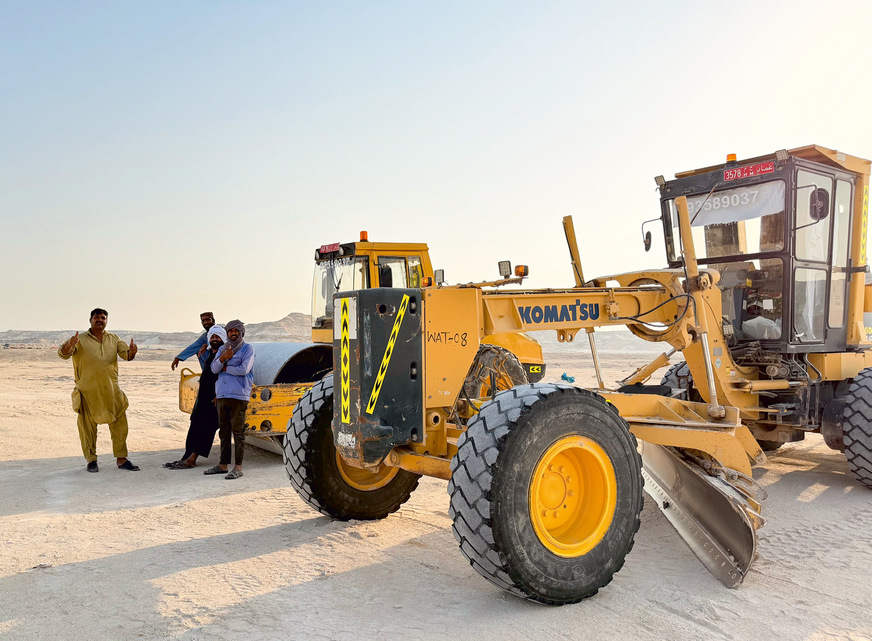
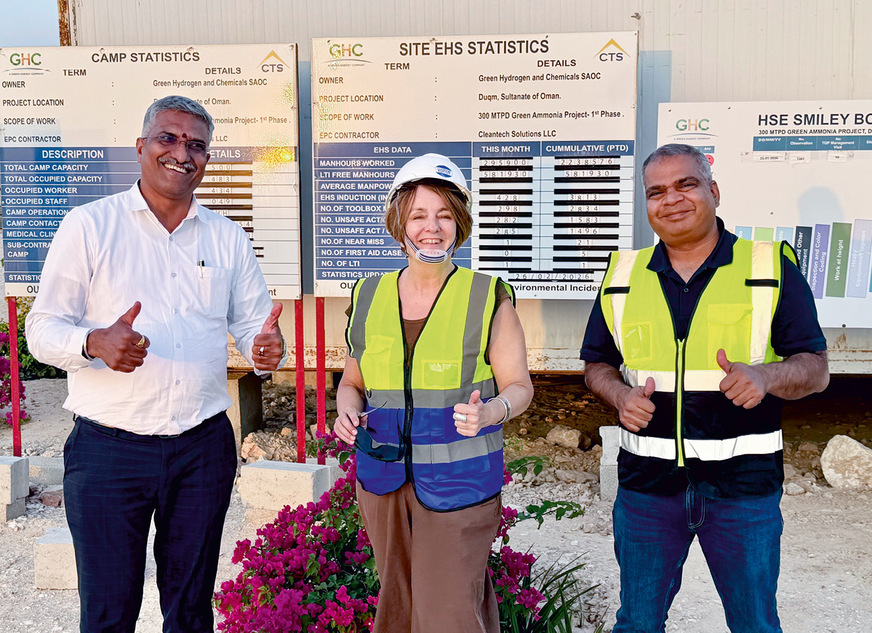
The construction site sits like a balcony above the Indian Ocean. Below, the Arabian Sea roars; above, the excavators roll. A broad cut runs down toward the sea through the terraced sandstone cliffs: this is where the pipeline that will connect the project with Europe by ship is to run. Seawater is pumped up for desalination, liquefied ammonia flows down to the tanker. A simple image for a complex transformation in full swing: “We built the road to the coast in one and a half years, now the terminal without a jetty will follow,” explains project supervisor Naveen Sharma, who is accompanying me. He is the coordinator for project partners. We meet some of the more than 800 workers deployed here around the clock in rotating shifts. Pride shines from their eyes; respectfully, they speak the name of their company’s founder.
From solar developer to molecule pioneer ACME – more precisely: ACME Cleantech Solutions Pvt. Ltd., whose name is said to derive from the Greek akmē for “summit” – was founded in 2003 by Manoj K. Upadhyay in Gurugram, not far from New Delhi. Upadhyay, entrepreneur and engineer, started out as a technology supplier for the telecom industry before discovering renewable energies for himself in 2008. By 2015, ACME was already India’s largest private solar developer, with a portfolio of over 1,500 MW. Two years later, ACME secured the contract to build a 200 MW solar plant in the Bhadla Solar Park in the Indian Federal State of Rajasthan. The electricity generated there was sold for 2.44 rupees per kilowatt-hour (at the time about 33 euros per megawatt-hour) – according to the company, the lowest price ever negotiated for solar electricity in India at that point.
Further steps followed: in September 2021, ACME commissioned in Rajasthan one of the world’s first integrated pilot plants for green hydrogen and green ammonia. It began with around 5 MW of solar capacity and a 2.5 MW electrolyzer. Initially, a modest 5 metric tons of ammonia per day were produced; the signal, however, was what mattered: the project showed how renewable energy can be converted into a transportable feedstock. Upadhyay said at the time: “Green ammonia is the most viable way for India to become a global exporter of clean energy.”
At the same time, ACME was looking for the right location for its first major international project. It was found on the coast of Oman.
Billions for Duqm In March 2021, ACME signed a Memorandum of Understanding with the Special Economic Zone at Duqm (SEZAD) – becoming one of the first companies to act in line with Oman’s national hydrogen strategy. In August 2021, a binding lease for 92 square kilometers in Duqm followed. The investment volume was put at US$3.5 billion. Today, according to the company, the total investment volume for the expansion stands at around US$6 billion.
Several reasons spoke in favor of Oman, as ACME’s Executive Vice President Arnava Sinha explained at the Green Hydrogen Summit in December 2025 in Muscat: a large potential for generating renewable energy, a structured permitting pathway, and a location where several parties can jointly use a shared infrastructure. Above all, however, a stable, supportive government structure. Duqm also lies outside the geopolitically sensitive Strait of Hormuz and has an industrial port. And from ACME’s perspective, perhaps the most important factor was something less tangible: confidence in the country’s long-term commitment. For projects that require billion-dollar upfront investments and decades of operation, the company sees political stability and reliable legal frameworks as just as decisive as sunshine and wind.
Oman, for its part, has a strategic interest: Duqm is being purposefully developed as a hydrogen and ammonia hub, with the national agency Hydrom as coordinator.
Natascha Plankermann
Key project data The project is divided into three phases; the first is already under construction. A production facility for 100,000 metric tons of green ammonia per year is being built, for which around 240 MW of electrolysis capacity and around 650 MW of solar capacity are envisaged. The electrolyzers are being supplied by Chinese specialists: Shuangliang Group and Sungrow Hydrogen.
The technology for producing ammonia comes from the American company KBR, which also supplies specially developed plant components. In order to generate as much electricity as possible, the solar panels on site are equipped with an automatic rotating mechanism – they follow the position of the sun and thereby capture more light. This technology is supplied by the companies Game Change Solar and Arctech.
In addition, the facility has a seawater desalination unit that can process around seven million liters of drinking water per day, as well as a storage unit in which up to 60 metric tons of hydrogen can be stored.
Phases 2 and 3 are in planning. In the next expansion stages, production is to rise to a total of 900,000 to 1.2 million metric tons of ammonia per year. For this, around 2 GW of electrolysis capacity and about 4 GW of solar capacity are envisaged.
The project was initially certified by TÜV Rheinland as a green production facility. It has since become one of the first worldwide to be pre-certified by CertifHy – a European certification system that evaluates sustainably produced hydrogen and related fuels according to uniform standards, thereby creating transparency for buyers and markets. The pre-certification confirms that the plant meets the EU requirements for Renewable Fuels of Non-Biological Origin (RFNBO) under the EU Directive RED III – that is, for fuels produced exclusively from renewable energy sources such as sun or wind.
Deliveries to start in 2027 The original timelines have been postponed several times; in 2023, the parties involved reached a milestone with the financial close: a US$488 million loan from India’s state-owned green infrastructure financier REC Limited. Meanwhile, in view of the rapid progress visible on the site, it now appears realistic, as Oman’s Energy Minister Salim Al Aufi announced at the World Hydrogen Summit in May 2026 in Rotterdam, that the delivery of green ammonia to Europe is to begin in one year. ACME itself plans to start with its offtaker Yara in early 2027.
Offtaker Yara: the first major agreement The course has been set: ACME and Yara International – the Norwegian fertilizer and ammonia group – signed a long-term offtake agreement in 2024 for 100,000 metric tons of green ammonia per year, one of the first worldwide on this scale. “The green hydrogen market has been slow to move for a long time – all the more reason why everyone, in Oman or beyond, is eager to see the ACME-Yara project!” explains Dr. Dawud Al Ansari, head of the Muscat-based Shaheen Institute for Strategy and Development and professor of hydrogen economics. The deal was made possible after 18 months of negotiations because the regulatory framework in Europe had stabilized.
Yara President Magnus Ankarstrand viewed this as programmatic and announced: “The agreement demonstrates the power of partnerships in developing value chains that reduce emissions.” The ammonia produced in Duqm is intended to meet the European RFNBO requirements – thus qualifying as fully renewable and electricity-based. It is to be fed into Yara’s global distribution network, with a focus on Europe. Over the entire life cycle of the project, the business partners expect that nearly 45 million metric tons of CO2 equivalents will be saved – which corresponds to about seven percent of Germany’s total annual greenhouse gas emissions, which according to the Statista portal most recently stood at around 649 million metric tons.
Natascha Plankermann
Europe debates, Asia moves ahead Green ammonia is no longer a niche topic: it is being traded as a climate-friendly shipping fuel, as a building block for the steel industry, and at the same time remains a central feedstock for fertilizers. In Europe, the political framework is taking shape – but slowly. The new EU Directive RED III obliges industry and fertilizer manufacturers to source a growing share of their hydrogen from renewable, electricity-based sources. By 2030, it must be 42 percent; by 2035, 60 percent. In practice, this means: Europe will have to import large quantities of green hydrogen – and thus green ammonia – because domestic production is not sufficient. The Carbon Border Adjustment Mechanism (CBAM) reinforces this development, because it makes the import of fossil ammonia and fertilizer more expensive. “The economies of the Arabian Gulf see CBAM above all as an opportunity, since they are in a position to provide green energy and clean industrial goods at favorable prices,” explains Dr. Al Ansari. According to the Dutch agricultural bank Rabobank, prices will rise by 10 to 20 percent in 2026 as a result, and by 2030 it could be up to 50 percent.
Nevertheless, price remains a problem even for green ammonia. Jorgo Chatzimarkakis, President of the Hydrogen Europe association, sums up the dilemma: “Europe is steering demand with rules, quotas and verification systems. But the instruments that trigger investment are missing.” What is meant are, for example, binding offtake guarantees and clear price commitments. There are positive signals – such as possible funding for lead markets, or integration into EU programs such as the ETS Innovation Fund or the Hydrogen Bank. But: none of this is binding so far.
Asia is further along – there, the focus is increasingly shifting from regulation to concrete procurement: Japan and South Korea have created import pathways, state funding and long-term contracts. While the large project in Duqm (Oman) is aimed at the European market, ACME has in parallel concluded a supply agreement with the Japanese industrial group IHI – though for a separate ammonia project in the Indian Federal State of Odisha.
Duqm as a testing ground At present, it looks as though Duqm is developing into a testing ground for whether the green molecule economy is industrially scalable – under real conditions, beyond pilot projects.
For Germany this means: if the steel industry – Thyssenkrupp, HKM, Salzgitter – switches to direct reduction with hydrogen from the late 2020s onwards, green molecules will have to be imported. The ammonia from Oman could come via Rotterdam, Antwerp or Duisburg. All three ports are currently expanding corresponding terminals.
Oman’s Energy Minister Al Aufi already said it at the Green Hydrogen Summit 2025 in Muscat: the ACME complex could in the long term be expanded to 1.2 million metric tons of ammonia per year. So far, however, the question remains open as to whether Europe will act quickly enough to secure the volumes to be produced in phases 2 and 3 – or whether Asia will take up the production volumes. That will not be decided in Duqm, where ACME’s excavators are building the future. It will be decided in Brussels, Berlin, in the corporate headquarters of the investors, and at the next Oman Climate Week from September 14 to 16, 2026.