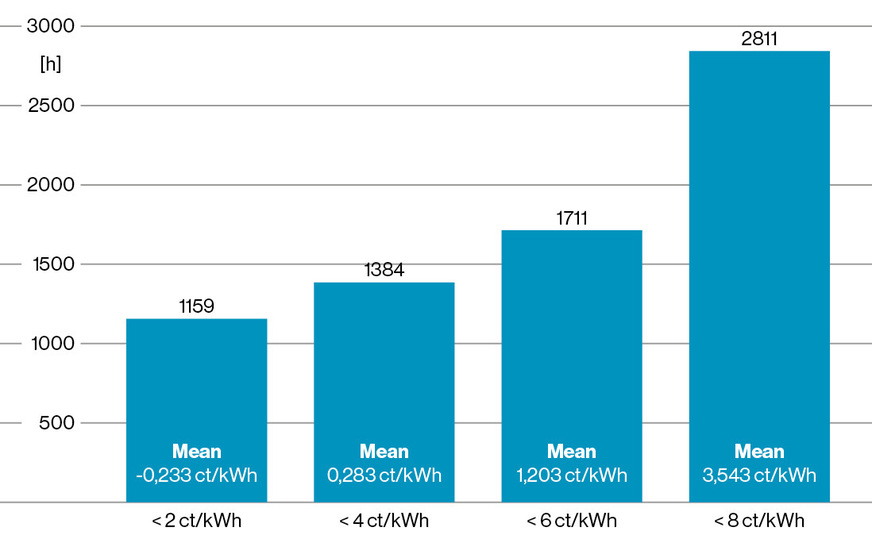
Trend of exchange electricity prices in Germany 2025: The average electricity price was below 9 ct/kWh.
Green hydrogen in the natural gas grid already bridges the gap between producers and consumers today. This potential should be leveraged more strongly to accelerate the German market ramp-up, argues our guest author from the engineering firm Emcel. No technical adjustments are required while simultaneously providing climate benefits.
Text: Marcel Corneille
Blending hydrogen into the natural gas grid could play an important role in the market ramp-up of the hydrogen economy. Large industrial consumers and parts of the transport sector are only gradually developing their hydrogen demand, and many projects are still waiting for viable sales markets. Blending can already create additional marketing opportunities today and support the build-up of electrolysis capacities.
Numerous demonstration and pilot projects over the past years have proven that this is technically feasible and safe. Eon demonstrated this as early as 2013 with its 2 MW power-to-gas facility in Falkenhagen, in the federal state of Brandenburg. Further examples can be found in Haßfurt, a small town in Bavaria, and in the grid area of Eon subsidiary Avacon, among others.
Marketing via existing gas grids has proven successful in practice. In Falkenhagen and Haßfurt, utilities offered the blended hydrogen to their customers as “wind gas” under a green energy tariff. At the same time, electrolysis capacities can be built up that can later serve additional fields of application. In Haßfurt, for example, the green hydrogen produced is additionally used in a hydrogen combined heat and power plant.
Often ten percent feed-in possible A great deal has changed in the regulatory framework in recent years. The feed-in of hydrogen into gas grids is now generally regulated by law and takes place within a framework similar to the feed-in of biogas. Technical requirements are defined in particular by the code of practice of the German Technical and Scientific Association for Gas and Water (Deutscher Verein des Gas- und Wasserfaches, DVGW).
Currently, hydrogen shares of up to ten percent by volume are possible in many grid areas in Germany. Beyond that, practical tests with higher shares have already proven successful, for example a 20 percent blending in the Jerichower Land region in the federal state of Saxony-Anhalt, also carried out by Avacon in 2022. Further adjustments to the limit values are therefore to be expected.
What is decisive here is not only the hydrogen in the gas mixture. The blended hydrogen can additionally be combined with bio-methane, thereby further increasing the share of green gas in the gas grid.
Decarbonization includedThe aim of blending is to provide climate protection today. Depending on the operating mode and utilization, a 1 MW electrolyzer can avoid several hundred tons of CO2 per year. Blending thus represents a way to put renewably produced hydrogen to effective use immediately in principle, while simultaneously gaining experience for the further expansion of the hydrogen economy.
One of the greatest challenges of the hydrogen economy at present is not the production of hydrogen but its marketing. While demand in many future target markets, such as industry, aviation, or heavy-duty transport, still lags behind expectations, blending hydrogen into the existing gas grid can be an interesting and attractive business model for operators of decentralized electrolysis plants.
The underlying principle has been known from the electricity market for many years. With the help of guarantees of origin and a balance sheet allocation between generation and consumption, customers can specifically choose a green electricity tariff. A comparable model can be transferred to the gas market. Customers who consciously opt for a more climate-friendly gas product take out a corresponding green gas tariff and receive proof of the balance sheet share of renewable gases. Such offers already exist on the market, but only in very limited quantities.
The analysis of exchange electricity prices in 2025 shows that there were around 1,200 hours in which electricity was available for an average of 0 ct/kWh. This makes the operation of electrolyzers and H2 blending economically interesting.
Without technical effort The decisive advantage of this approach is that the moderate blending of one to two percent requires practically no adjustments to the existing infrastructure. At the same time, a marketable product emerges that addresses different customer groups. In addition to private households, particularly municipal utilities, commercial customers, and companies with their own sustainability and decarbonization targets come into question as consumers.
Experience from the green electricity market shows that a notable share of customers is willing to pay a premium for climate-friendly energy sources. From a business perspective, it is precisely this premium that is the key to economic viability. Hydrogen is currently still more expensive than natural gas.
The decisive factor is therefore not the energy price alone but the willingness to pay for a climate-friendly product. Even a comparatively small surcharge on a green gas tariff can be sufficient to generate economically interesting revenues for hydrogen fed into the grid.
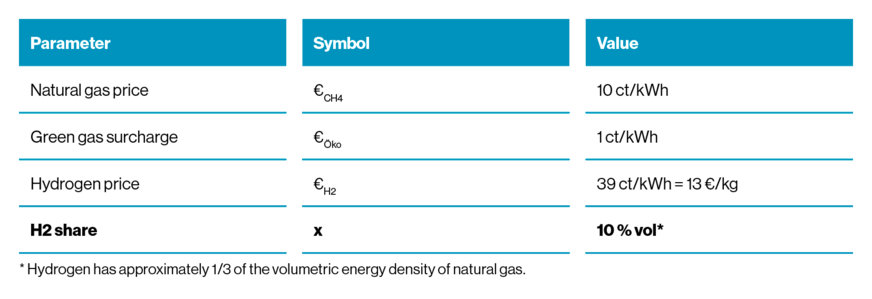
Sample calculations show that at suitable locations, with a blending of ten percent hydrogen by volume, sales revenues on the order of around 13 euros per kilogram of hydrogen are achievable, a value that is already economically attractive for many projects today.
In addition, the framework conditions for the operation of electrolyzers have improved significantly in recent years. Various levies and grid fees are waived under certain conditions for hydrogen production from renewable energies.
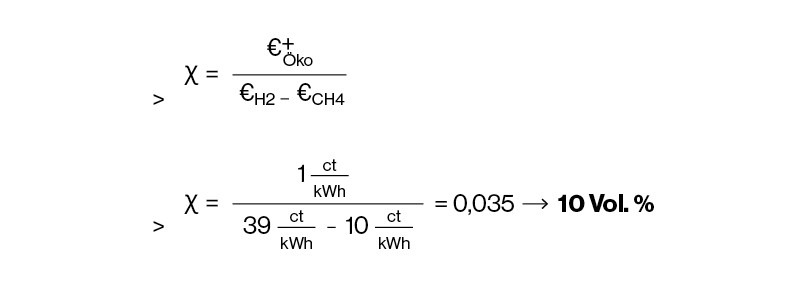
The table and calculation show that with a natural gas base price of 10 ct/kWh, a green gas surcharge of 1 ct/kWh, and an assumed hydrogen price of 13 €/kg, a hydrogen blending share of ten percent by volume results.
Already economically viable As a result, electricity costs, which account for a large share of hydrogen production costs, are reduced. Furthermore, there are additional revenue potentials for by-products of electrolysis, such as the use of waste heat, the marketing of oxygen, or revenues from grid-serving operating modes.
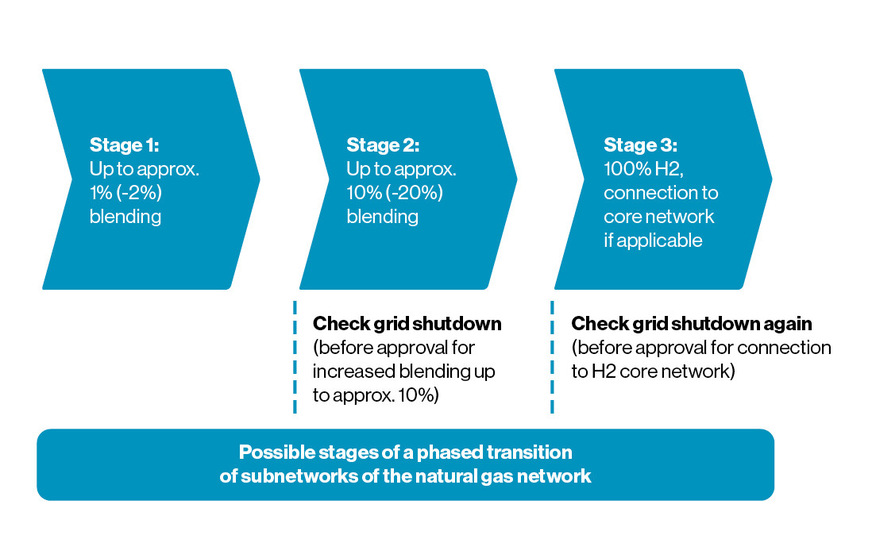
Blending hydrogen enables a gradual transformation of existing gas grids without immediately requiring extensive infrastructure measures or complete grid conversions. Instead of an abrupt change, development should take place in three essential stages (see corresponding figure).
First, small hydrogen shares of one to two percent by volume are fed in. Practically all sub-grids are already capable of this today. In a second phase, the shares can be increased, depending on the technical prerequisites of the respective sub-grid, to ten to twenty percent.
In the long term, a fully hydrogen-capable grid can emerge from this, or a connection to the hydrogen core grid being built up in parallel can be made.
Between these steps, there is always the critical examination of whether the decommissioning of the respective sub-grid is advisable or whether the sub-grid will no longer be utilized in the future because former users have, for example, switched to heat pumps. A key advantage of this approach lies in its flexibility.
As the hydrogen economy expands, the quantities produced can later also be made available to other sectors, for example industry, mobility, or directly to the hydrogen core grid.
“Investments in electrolyzers are thus already creating production capacities today for the future hydrogen supply.”
Local value creation This approach is particularly interesting for decentralized projects. While large electrolysis plants with capacities of several hundred megawatts will often be built in the immediate vicinity of the hydrogen core grid, plants of one to ten megawatts of capacity can specifically tap regional potentials.
They use existing renewable energy sources on site, reduce transport requirements, and create local value. At the same time, they can contribute to gaining experience with the operation of hydrogen plants and gradually building up regional markets for hydrogen.
Hydrogen blending should therefore not be understood as competition to the hydrogen core grid or other green gases. All approaches fulfill different tasks on the path to complete decarbonization.