

Hyfindr
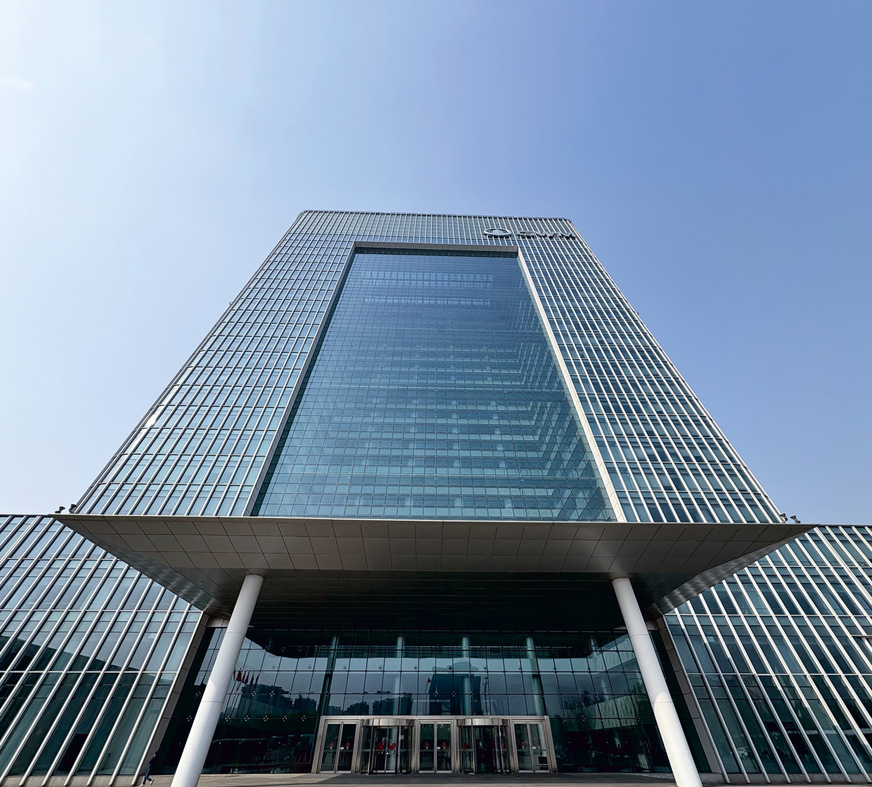
Experiencing one of the world’s most dynamic hydrogen markets up close, deepening contacts and initiating new collaborations – that was the goal of our trip. In addition to the Hyfindr team, the delegation included guests from Croatia, Spain, Switzerland, France and Germany, as well as Hyfindr’s Chinese partner.
Daxing: An industrial ecosystem in full operation The travel group’s first stop was the Daxing International Hydrogen Energy Demonstration Zone near Beijing. The industrial area, which was only established in 2020, has grown into one of the most significant hydrogen clusters in China.
More than 200 companies there cover nearly the entire value chain – from research and development through component manufacturing to concrete applications. The difference from many European initiatives lies in the level of maturity: production halls and development centers have been built and are in use – here, things are not merely planned but tested and scaled.
The same applies to the infrastructure: the hydrogen refueling station in Daxing reaches a refueling capacity of approximately five tons per day. At its inauguration in 2021, it was considered the largest in the world; in Europe, it was only in 2025 that the H2Mobility station reached a similar capacity. In China, this station supplies a fleet of buses and commercial vehicles. Hydrogen vehicles are part of the street scene in the industrial park.
Applications with pace: Hybot and Nowogen Also in Daxing, Hybot, a manufacturer of hydrogen-powered heavy-duty trucks, made the jump from concept to production within a short time. The company works with a 300 kW fuel cell system and, prior to the delegation’s visit, announced a significant scale-up of its production capacities in the fourth quarter of this year; the plan is to manufacture 100 trucks per month.
And the company Nowogen develops fuel cell stacks and systems in Daxing. The development speed is impressive here as well: projects that were announced as a concept a year ago are in the testing phase today – for example, a fuel cell stack with a maximum output of 1 MW that we were able to see on the test stand. This stack is used in a modular system for maritime applications. Later this year, it is intended to power inland vessels of 3,000–10,000 tons on the Beijing–Hangzhou Canal and the Yangtze River. These short innovation cycles are typical of the Chinese market.
150 kilometers to the southwest, in Baoding, is the headquarters of the automotive corporation Great Wall Motors. Through its subsidiary FTXT Energy Technology, the company bundles central components of the hydrogen value chain: fuel cell stacks, complete systems, power electronics and hydrogen storage. Development, integration and application are closely interlinked – an approach that significantly shortens development times and accelerates industrialization, and which is rarely seen in Europe with this level of consistency.
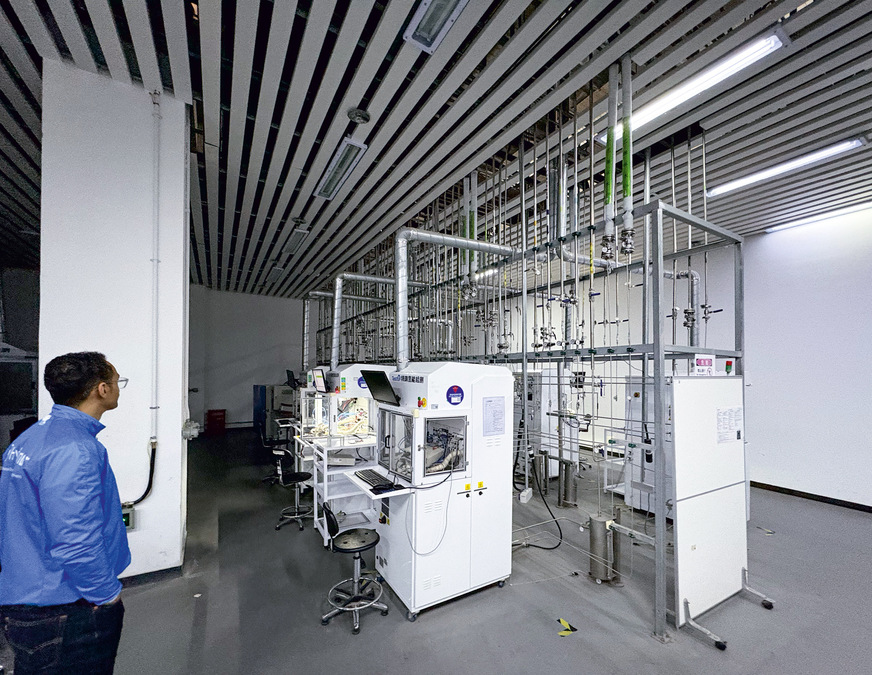
The visit to the neighboring testing facilities was also revealing. The company TestHy has operated for several years as an independent testing and validation center. The laboratories operated by TestHy cover an area of more than 20,000 m2 and, according to the company, can perform over 300 test procedures. TestHy supports companies – particularly international partners as well – in accessing Chinese standards and testing processes.
Beijing: Trade fair as a mirror of industrialization Back in Beijing, we visited the China International Hydrogen Congress & Expo (CIHC) and the Beijing International Hydrogen Technology & Equipment Exhibition (HEIE).
The HEIE is a hydrogen trade fair embedded within a large industry and energy fair. The CIHC congress fair is entirely focused on hydrogen and fuel cell technologies – electrolyzers, fuel cells and stacks dominate the picture. With around 20,000 visitors, 500 exhibitors and 1,000 products on display, it is one of China’s leading H2 trade fairs; in terms of presentation quality, it is comparable to Europe’s leading hydrogen trade fairs.
At the CIHC, the sheer scale of the exhibited products was particularly impressive: electrolyzers in the megawatt range are part of the fair scene, and even larger ones are being installed by companies in practice in China. This gives rise to projects in the range of 100 to 600 MW, which are either under construction or already in operation.
Competition, innovation pressure and rapid technological progress can be experienced firsthand at the trade fair: new generations of fuel cell stacks in the range of up to 300 kW were presented specifically for commercial vehicles – not by just one company, but by several at once.
And the state-owned enterprise Shanghai Hydrogen Propulsion Technology (SHPT), a subsidiary of the likewise state-owned automotive corporation SAIC, illustrates how closely industry, government structures and real-world applications are interconnected: SHPT develops the fuel cell stacks, SAIC integrates them into its buses and trucks, which then reach the roads with the help of state subsidy programs. In addition, however, SHPT is also advancing its third-party business internationally, which by European standards is somewhat surprising for a state-owned enterprise.
Hyfindr
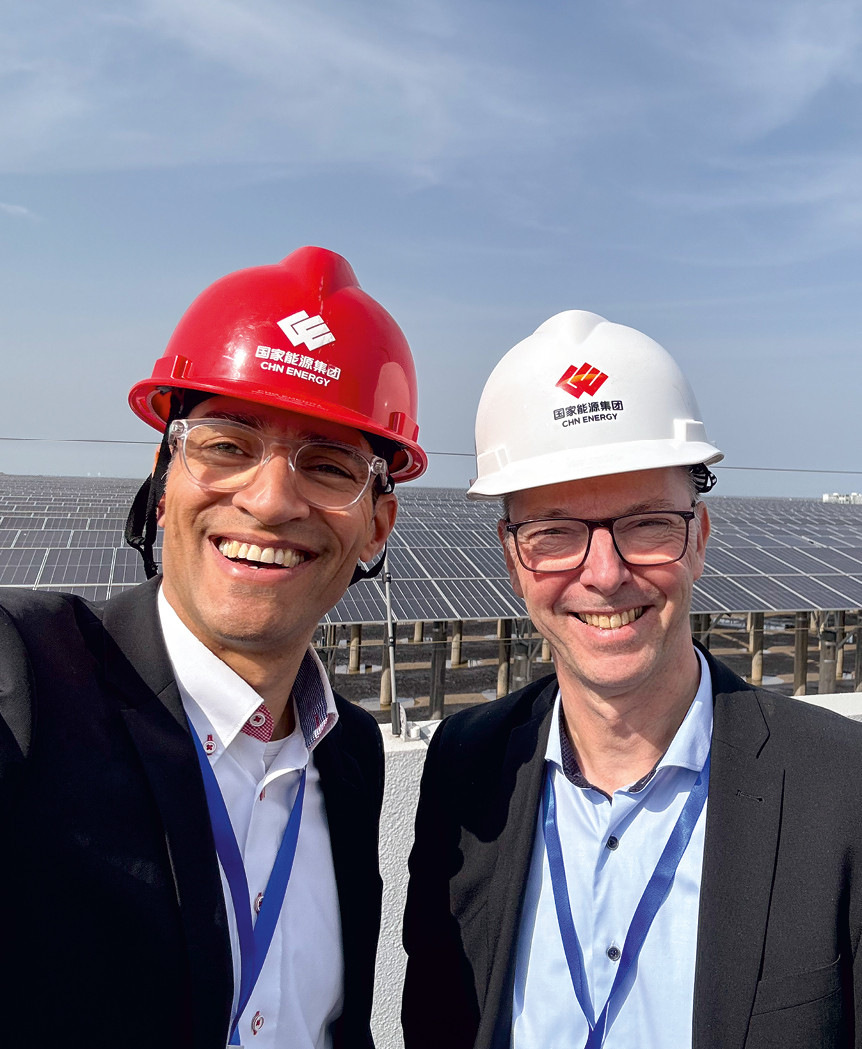
Rudong: An integrated energy system in practice A good distance to the south, in the coastal region of Rudong, there is a large-scale energy project that combines renewable power generation and hydrogen production.
With 400 MW of installed photovoltaic capacity and around 468 million kWh of annual production, the facility supplies, on a balance-sheet basis, roughly 700,000 households. The facility has its own connection to the high-voltage grid (220 kV), a battery storage system of 60 MW/120 MWh, an electrolysis plant with a production capacity of 1,500 Nm3/h (135 kg/h) for the production of green hydrogen (corresponding to approximately 7 to 8 MW of electrolysis capacity), and its own hydrogen refueling station for up to 500 kg of H2 per day.
Rudong follows the principle of “generation – storage – use – reserve,” thereby showing an integrated energy system – and at the same time is only a tiny snapshot of China’s fully industrialized energy transition. In 2024, China had approximately 70 percent of the world’s electrolysis capacity with 3.5 GW, has led the rankings of new PV and wind energy installations for years, and in 2024 broke through the 1,400 GW mark of installed wind and solar energy that had been targeted for 2030.
Hyfindr
Understanding through travel where the journey is heading In total, the delegation visited eight cities. In addition, we visited the Jiading Hydrogen Park, a demonstration center for integrated system solutions near Shanghai, and four additional companies, including the safety equipment manufacturer MSA Safety (see video link).
International delegation trips are of great importance in China: for local companies, cities and industrial clusters, they are a platform for initiating international collaborations. Interest in international cooperation is high – not least because competitive pressure in the domestic market is enormous.
Everywhere, our group was received with great openness and hospitality. Direct exchange opens up possibilities that scarcely arise from a distance. Trusting conversations often emerged after the actual business appointments during shared meals – this, too, is part of the business culture.
The speed at which the hydrogen industry is being developed, built and scaled in China can hardly be grasped from a distance. You have to have seen it yourself to truly understand it. Therefore, in 2027, Hyfindr will once again organize a delegation trip to China together with its Chinese partner.
Hyfindr GmbH