
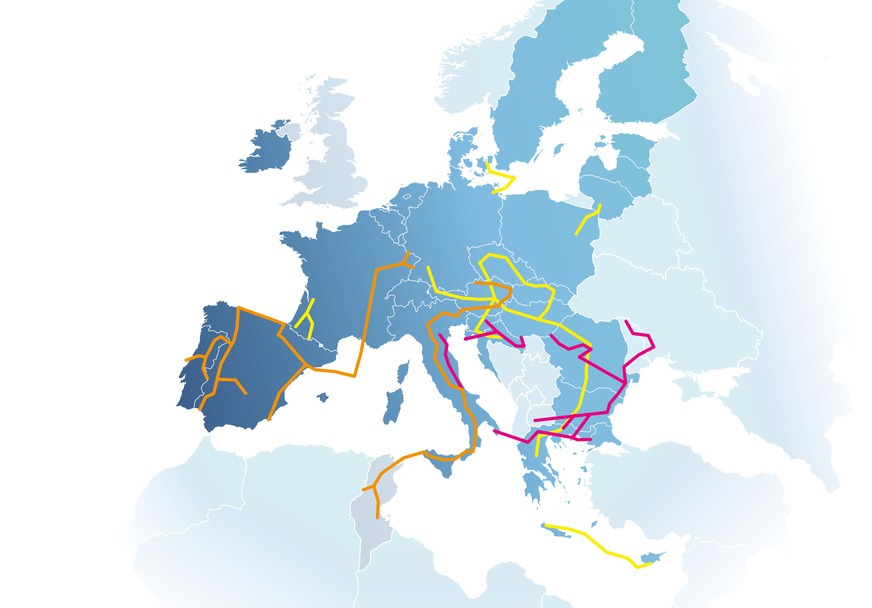
© Source: European Commission,
graphic: NEONBOLD
yellow – Electricity
magenta – Gas
On 10 December 2025, the European Commission presented proposals for the joint modernisation and expansion of energy infrastructure. These cover electricity, natural gas and hydrogen networks, as well as energy storage and charging infrastructure for electric mobility. To accelerate progress, the package aims to simplify planning, permitting and financing through improved coordination, more transparent cost-sharing models and the use of joint financing tools such as special purpose vehicles.
A seat at the planning table
Much like Germany’s grid development plans, which are coordinated between operators and the responsible authority, a similar process takes place at EU level – until now covering natural gas and electricity. With the new grid package, the European Commission is now anchoring hydrogen in European network planning.
Going forward, a central EU scenario for electricity, gas and hydrogen will be drawn up every four years. This will serve as the basis for the Ten Year Network Development Plans (TYNDPs) and the European infrastructure needs assessment. The associations representing the respective network operators play a key role in this process. Until now, these have primarily been the European Network of Transmission System Operators for Electricity (ENTSO-E) and the European Network of Transmission System Operators for Gas (ENTSO-G). The latter has also been responsible for hydrogen matters to date. That is set to change.
The European Network of Network Operators for Hydrogen (ENNOH), founded in June 2025, will now participate on an equal footing and take responsibility for hydrogen networks. For 2026, however, responsibility will remain with ENTSO-G on a transitional basis. Existing natural gas infrastructure is also to be more rigorously assessed for potential conversion to hydrogen use.
The Commission expects these measures to improve integration across sectors. The hydrogen association Hydrogen Europe expressly welcomes this. However, ENNOH remains excluded from the Offshore Network Development Plan – a point of criticism from Hydrogen Europe, given that it also contains targets and plans for hydrogen infrastructure.
Mapping the route
The Commission not only outlines future planning processes but also identifies eight specific network expansion projects, known as Energy Highways, that are of particular strategic importance. Two of these are hydrogen pipelines.
The South H2 Corridor is to involve Tunisia, Italy, Austria and Germany, while the South-Western Hydrogen Corridor will run from Portugal to Germany.
In addition, three priority corridors for hydrogen and electrolysers have been designated: Hydrogen Infrastructure in Western Europe (HI West), Hydrogen Infrastructure in Central Eastern and South Eastern Europe (HI East) and Baltic Energy Market Interconnection Plan in Hydrogen (BEMIP Hydrogen). These are intended to create cross-border connections, resolve bottlenecks and link import corridors with industrial consumption centres. In doing so, they are to form the backbone of a future EU hydrogen network.
According to the German Association of Energy and Water Industries (BDEW), this marks the first time the European Commission has included hydrogen projects in its core energy infrastructure corridors. This demonstrates that the Commission now views hydrogen pipelines as systemically important components of the European energy system.
Significantly more funding
The Commission estimates that around €240 billion will be needed for hydrogen networks by 2040. Compared to the €1.2 trillion required for electricity grids, this is a considerably smaller but still significant amount. To avoid passing all these costs on to consumers through network charges, the Commission intends to commit more of its own funds. The current long-term EU budget (2021–2027) allocates €5.8 billion under the Connecting Europe Facility for cross-border energy projects. For the next budget period, from 2028 to 2032, the Commission plans to increase this fivefold to €29.91 billion.
Hydrogen Europe welcomes the Commission’s willingness to assume part of the economic risk through public funding and to spread costs over time. These principles are similar to those underpinning the financing of Germany’s core hydrogen network.
Exactly how the funding for EU hydrogen infrastructure will be distributed remains unclear. Direct grants are apparently not envisaged. The Commission intends to explore contracts for difference, among other options. The European Investment Bank (EIB) is also providing a counter-guarantee of €1.5 billion for network components. Industry is invited to submit concrete proposals, which will be discussed at the Energy Infrastructure Forum – an annual event organised by the Commission’s Directorate-General for Energy in Copenhagen each summer. Hydrogen Europe has indicated its intention to contribute. The Commission plans to set out how it intends to convince private investors to invest in network expansion in its Clean Energy Investment Strategy for Europe, due to be published next year.
Hydrogen pipeline and electrolyser projects will also continue to be eligible for designation as Projects of Common Interest (PCI) or Projects of Mutual Interest (PMI). This status brings streamlined permitting, higher political priority and improved access to EU funding.
Fast-track permitting for pipelines – storage takes longer
Hydrogen Europe also welcomes the permitting acceleration directive included in the grid package, which is explicitly intended to streamline processes for hydrogen infrastructure. According to the association, however, this does not apply to the same extent as for electricity networks.
Hydrogen storage facilities are expressly excluded from accelerated permitting and simplified procedures – a significant obstacle for projects, according to Hydrogen Europe. The BDEW also emphasises that, given the long development timelines, storage must be included in the simplification measures.
Overall, both Hydrogen Europe and the BDEW see the grid package as a major boost for hydrogen infrastructure – with points deducted for the omission of hydrogen storage and the lack of integration into offshore planning.
“Network operators need an appropriate financial and regulatory framework to invest in grid expansion and digitalisation,” says Kerstin Andreae, Chair of the BDEW Executive Board. However, she considers the intervention in planning to go too far. The focus should be “on stronger European coordination rather than centralised planning.” She regards the hydrogen corridor from Portugal to Germany as particularly important for Germany.
The grid package is now in the regular legislative process. The Council and the European Parliament will deliberate on and amend the proposals during 2026. In parallel, technical groundwork is beginning for the next round of European network development planning, in which hydrogen will be systematically incorporated into scenarios and needs assessments for the first time. The concrete design of the financing mechanisms – such as the use of contracts for difference or additional EU guarantees – will be specified by the Commission in its announced Clean Energy Investment Strategy during 2026. At that point, it will become clear whether the planned hydrogen corridors will swiftly become reality or remain planning projects for the time being.