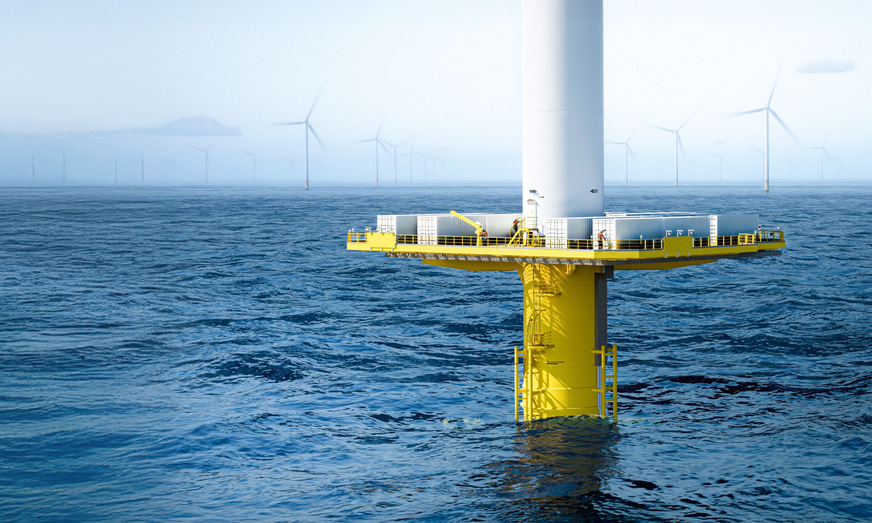
Robert Seehawer (left) moderates a panel discussion on H2 production in the North Sea at the “ Hydrogen Technology World Expo. ”
The core message of a new analysis by Aqua Ventus is that green hydrogen could be produced profitably right on the doorstep. It deals with the systemic integration of offshore wind energy and H2 production in the North Sea by the year 2045.
The Aqua Ventus (AV) initiative aims to build an offshore production capacity of 10 gigawatts (GW) for green hydrogen in the North Sea. To realize this large-scale project along the entire value chain – from production through transport to utilization – more than a hundred companies, associations, and research institutes have joined forces. They come from various sectors, from the gas and offshore wind industry to hydrogen production and maritime logistics.
The AV consortium sees itself as an industry-driven platform for the development and scaling of H2 production at sea. It includes several sub-projects, including infrastructure projects like Aqua Ductus, which envisions a hydrogen pipeline from the North Sea to Germany. Additionally:
• Aqua Primus: Pilot plants for offshore electrolysis
• Aqua Campus: Training and further education for specialists
• Aqua Navis: Development of hydrogen-powered ships for offshore use
• SEN-1: Pioneer projects for testing technologies under real conditions
The North Sea as an eco-power plant for Europe
Through international networking with similar initiatives in neighboring countries, Aqua Ventus aims to create a European hydrogen economy throughout the North Sea region. This would significantly contribute to Europe's supply security, industrial competitiveness, and climate protection. The analysis now published by the European consulting firm Frontier Economics is related to the current spatial development plan (FEP). The responsible Federal Maritime and Hydrographic Agency (BSH) discusses a possible overplanting of offshore wind farms in zones 4 and 5 of the German North Sea. These zones are more than 300 kilometers from the coast and are referred to as the “Duck’s Beak.”
Current discussion on overplanting
Specifically, it concerns whether the installed capacity of the wind farms may exceed the capacity of the power cables to the coast. This so-called “overplanting” would mean that not all generated energy can be transmitted during power peaks. However, since peak performance is rarely reached and larger amounts of electricity can be transported by cable through overplanting, the costs for grid connection would be reduced.
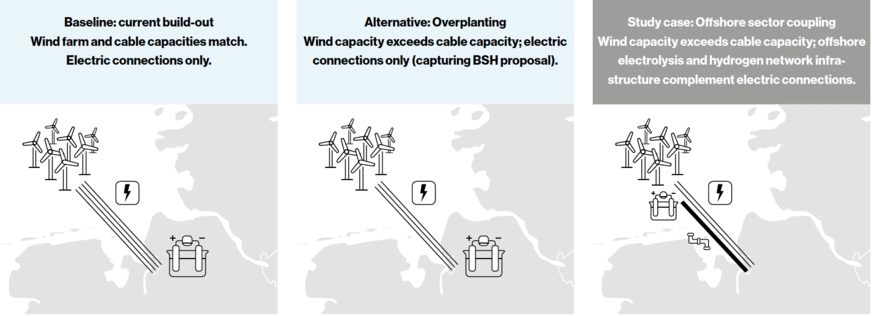
The focus of the investigation by Frontier Economics is on two scenarios: an expansion to 70 gigawatts (GW) according to the legal target and a more conservative scenario with 55 GW. Various technical configurations were examined for both: a baseline scenario with equally sized wind turbines and power cables and onshore electrolysis, an overplanting scenario with more turbine capacity than cable capacity and also onshore electrolysis, and thirdly, an offshore sector coupling with overplanting, offshore electrolysis, and hydrogen pipelines. The results show: The latter reduces grid integration costs the most.
More efficient use of infrastructure minimizes system costs
Basically, it is cheaper to transport green electricity generated at sea far from the coast in the form of hydrogen via pipeline to land than via high-voltage transmission. An analysis by the consulting firm E-Bridge in 2024 showed this. Alone, this would reduce the expansion costs for energy from the North Sea over a 25-year horizon by 31 billion euros.
“The study showed that overplanting is good, but sector coupling at sea is better. By this, I mean that expansion costs can be more effectively reduced through hybrid connection concepts,” says Seehawer. However, it is most effective to consider both measures.
Therefore, the offshore electrolysis model is also worthwhile, even though the investments for it are higher than for onshore electrolysis. The option to flexibly use electricity or hydrogen depending on the market price increases returns in operation. Offshore wind farm operators then produce electricity and hydrogen in a market-integrated and profit-maximizing manner. Additionally, losses during electricity transport on the mainland decrease due to curtailment, which would otherwise have to be compensated by redispatch with fossil power plants – which is very expensive.
Robust against price and technology risks
The advantages of offshore sector coupling remain even with changed price and model assumptions, according to another result from Frontier Economics. Even if offshore electrolysers were twice as expensive as their onshore counterparts, this configuration would still be profitable. And fluctuating electricity prices of ±20 percent or different electrolyser capacities would not change the economic advantages of this concept according to the analysis. These could be further optimized if the project duration were extended from 25 to 35 years. According to Frontier Economics, this could reduce system costs by around another seven percent.
All configurations assume identical capacities for wind farms and electrolysis. In the “Baseline” and “Overplanting” scenarios, the electrolyser is located onthe coast, whereas in offshore sector coupling it is near the wind farms.
Legal and planning adjustments necessary
“To exploit the potential of offshore sector coupling, however, regulations must be adjusted,” says Robert Seehawer. “This primarily includes a change in the Offshore Wind Energy Act (WindSeeG) so that offshore electrolysis can be combined with overplanting.” So far, the either-or principle applies: The BSH prescribes to offshore wind farm operators whether they should connect to a power or hydrogen line. Combined grid connections are not yet possible. Significant synergy potentials would result from this: The grid expansion could be correspondingly smaller and cheaper and also implemented faster.
Aqua Ventus proposes treating offshore electrolysis equally by law and giving offshore wind developers the opportunity in the spatial development plan (FEP) to reduce economic system costs and increase their own returns through combined electricity and hydrogen production.
In addition to the economic and resilience benefits that building a pipeline compared to power lines in the North Sea would have, there is also the issue of nature conservation. In the long-overused habitat of the North Sea, fewer interventions in the marine environment would be necessary. This is certainly desirable: After all, the entire European Wadden Sea from Denmark through Germany to the Netherlands is considered a World Heritage Site.
Overplanting is good, but sector coupling at sea is better. Expansion costs can be more effectively reduced through hybrid connection concepts.”
EXPANSION TARGETS FOR OFFSHORE WIND AND ELECTROLYSIS
Germany plans an offshore wind capacity of 30 gigawatts (GW) by 2030. By 2040, it should be 50 GW and finally 70 GW by 2045. Parallel to this, an expansion of electrolysis capacity to 10 GW by 2030 is planned. Independent of these political goals, the discussion about overplanting and offshore electrolysis is in the context of how these goals can be achieved cost-effectively.