

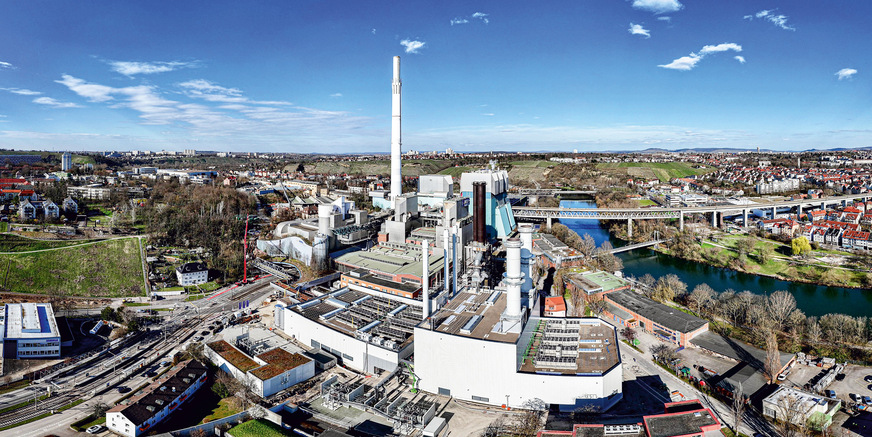
© EnBW
They have reached an agreement. In mid-November, the German government, made up of the Social Democratic Party (SPD) and the Christian Democratic Union (CDU), announced that it had produced a joint results paper on the national power plant strategy. Ten gigawatts of new power plant capacity are to be built quickly, and all plants are to be made convertible to hydrogen in the future.
The agreement was long overdue. Germany urgently needs quickly available power plant capacity. Even after the agreement, the goal of actually launching tenders for this in early 2026 remains extremely ambitious. Here are the main threads of the debate on Germany’s power plant strategy, which has been ongoing for many years.
Why have a power plant strategy at all?
At the end of the previous coalition government, which consisted of the Social Democratic Party (SPD), Alliance 90/The Greens, and the Free Democratic Party (FDP), in November 2024, there was a draft bill from the Federal Ministry for Economic Affairs and Climate Action of Germany (Bundesministerium für Wirtschaft und Klimaschutz) for the so-called Power Plant Security Act, abbreviated as KWSG. The idea of minister Robert Habeck (Alliance 90/The Greens) was: gas-fired power plants that can be converted to hydrogen in the future are to serve as backup for electricity generation from wind and solar. In a liberalized electricity market, however, such gas-fired power plants have been an unpopular business model for decades. Whenever wind and solar power are abundantly produced, they are also inexpensive and push gas power plants out of the market. Gas power plants would therefore have to finance themselves with fewer and fewer operating hours, since only generated electricity is traded on the electricity market and not capacity held in reserve – so capacity is really not profitable here. This brings existing gas power plants to the brink of economic viability, not to mention new builds. The problem has been known for well over ten years, and many experts have been calling for a so-called capacity market. This means that the government tenders secured capacity and offers power plant operators a kind of basic income for keeping their plants available.
The draft bill from the ministry under Robert Habeck was the first legislative initiative to address this problem. Various technologies were to be allowed to compete. A requirement, however, was prospective climate neutrality – so for gas-fired power plants, it was essential from the outset that they could be converted to hydrogen. In total, 12.5 gigawatts of power plant capacity were to be secured in this way. Legal questions regarding state aid with the European Union had, after lengthy preliminary talks, been largely resolved. The German Association of Energy and Water Industries (BDEW) therefore called for this draft law to be used as a basis, even though some changes would still be necessary from the perspective of power plant operators.
What changes with Katherina Reiche?
The Federal Ministry for Economic Affairs and Energy of Germany, now under Katherina Reiche of the CDU, initially assumed that Germany needs not 12.5 gigawatts of flexible power plant capacity, but 20 gigawatts – explicitly in the form of gas-fired power plants and despite a lower projected electricity demand than before. She is relying on a “pragmatic” approach, as she emphasizes. This means: first, the power plants should be built; whether and how they can be converted to hydrogen will be decided later. However, this resets the state aid discussion with the EU to zero, because the EU requires technology and climate neutrality.
Reiche initially relied on a “fast-track program” with direct subsidies for five to ten gigawatts of power plant capacity. She was quoted in business media as saying that the EU had given positive signals for “significantly more than half” of the planned 20 gigawatts. In mid-November, the coalition committee then agreed on the ten gigawatts and on making the power plants hydrogen-ready. What the EU will say about this is not yet known, and the concrete tender rules are also still outstanding.
First H2-ready power plants from EnBW
Various power plant operators are already planning, building, and operating gas-fired power plants that could at least partially be fired with 20 to 30 percent hydrogen, if it were available.
In October 2025, EnBW put one of the first hydrogen-capable gas turbine power plants in Germany into commercial operation in Stuttgart-Münster. In southern Germany, secured generation capacity is particularly urgently needed, as there is both high energy demand from industry and little wind power generation. The reason EnBW took the investment risk, even though the Power Plant Security Act is not yet complete, is also due to another subsidy – the Combined Heat and Power Act of Germany (Kraft-Wärme-Kopplungsgesetz). Under this scheme, the company received a grant. This “fuel switch” alone is expected to reduce CO2 emissions by 60 percent.
This is not only for Stuttgart-Münster, but also for replacing the coal-fired power plants Altbach/Deizisau and Heilbronn. Together, all three are to provide a generation capacity of around 1.5 gigawatts. Strictly speaking, Stuttgart-Münster is not a standalone gas-fired power plant, but rather an addition to a waste incineration plant, which was previously supplemented by three coal-fired boilers. The new facility is to deliver 124 MW of electrical and 370 MW of thermal output. EnBW is targeting the switch to hydrogen for the second half of the 2030s. For this, changes to the gas turbine’s fuel supply as well as a complete hydrogen logistics system would of course be necessary.
The other two hydrogen-capable power plants from EnBW are not as far along. Construction in Altbach-Deizisau has been underway since November 2023, with completion currently scheduled for the first quarter of 2027. In Heilbronn, construction began in February 2024, with commissioning planned for the second half of 2027. All three plants also supply heat and are therefore subsidized under the Combined Heat and Power Act of Germany.
Hamburg: CCGT power plant scheduled to go into operation in 2026
The municipal energy supplier Hamburg Energiewerke are also under considerable time pressure. They are currently building a new combined gas and steam turbine plant in the port area. This plant is to be able to burn up to 30 percent hydrogen. If higher shares are required in the future, adjustments are to be made as part of normal “product maintenance” during routine overhauls.
Hamburg’s decision to build the hydrogen power plant was also driven by political pressure. Amid fierce controversies and two citizens’ initiatives, one of which went to a referendum, the people of Hamburg secured the conversion of the district heating network.
The new hydrogen-capable power plant is to replace the dilapidated Wedel heating plant, which is now only operating with special exemptions. However, as it is essential for district heating supply in the west of the city, it must keep running until the replacement is complete – including a new pipeline under the Elbe to bring heat from the port into the city. Construction work, including on the pipelines, is in full swing.
The power plant is to receive funding under the Combined Heat and Power Act of Germany (KWKG), just like the EnBW plants. It is still unclear whether and to what extent a capacity market will be relevant, as the plant is to be operated based on heat demand and is intended to have the shortest possible operating hours in order to give priority to renewable heat sources – at least, that is the current plan. This is also reflected in the performance data: the electrical output is only 180 MW, while the plant can supply up to 290 MW of heat. This also includes a power-to-heat system, which generates heat from electricity when there is an abundance of power on the market. Since electricity and heat generation are not always needed at the same time, a heat storage unit with a capacity of 50,000 cubic meters of water is also planned.
According to Hamburg Energiewerke, the CCGT plant is now 85 percent complete, even though installing some pipelines has proven to be more laborious than expected. To ensure completion by the end of 2026, 100 additional fitters have been deployed, according to the municipal energy supplier.
RWE wants to make Voerde site a hydrogen hub
RWE, one of Germany´s largest utility companies and mainly active in the federal state of Northrhine Westphalia, is working on three projects. They would like to build a hydrogen-capable gas power plant at their existing site in Werne-Stockum, but the project is on hold. The plan is for 800 MW of electrical output, up to 50 percent of which could be produced from hydrogen. The permitting process is complete, according to the press release. In another town, Weisweiler, RWE also announced in 2023 that it had begun the permitting process. At the end of October this year, RWE also announced its intention to reactivate their Voerde power plant site. Until 2017, a hard coal power plant operated by STEAG was in operation there, but it was no longer profitable. RWE took over the site in 2021 to develop hydrogen projects there. An announcement from 2023 mentioned a 400 MW electrolyzer. Now, a new gas-fired power plant is being discussed, with 850 MW of capacity and also up to 50 percent hydrogen-capable. In 2024, RWE commissioned an American-Spanish consortium consisting of GE Vernova and Tecnicas Reunidas to handle planning, and the permitting process “based on proven technologies” is complete. According to current plans, the plant in Voerde could start producing electricity in 2030. RWE is determined to participate in the German government's tenders – and is calling on the government to announce the conditions.
© LEAG
LEAG pushes for decisions on Schwarze Pumpe & Co
The Lausitz Energie Kraftwerke AG (LEAG) also wants to make its Schwarze Pumpe site ready for the energy transition. Schwarze Pumpe is one of the largest lignite energy generation sites in Germany. A hydrogen-capable gas power plant with up to 850 MW could be built here, based on the existing infrastructure of the large coal-fired power plant. By 2030, 3,000 MW of coal-fired power plants are to be taken offline. This will only work if the secured capacity is replaced.
New build projects for H2-ready power plants with a combined capacity of around 2,000 MW are planned for the Schwarze Pumpe, Lippendorf, and Leipheim sites. Some of these already have partial permits, press spokesman Thoralf Schirmer explained upon request from H2international. However, he said no more detailed technical information could be provided yet.
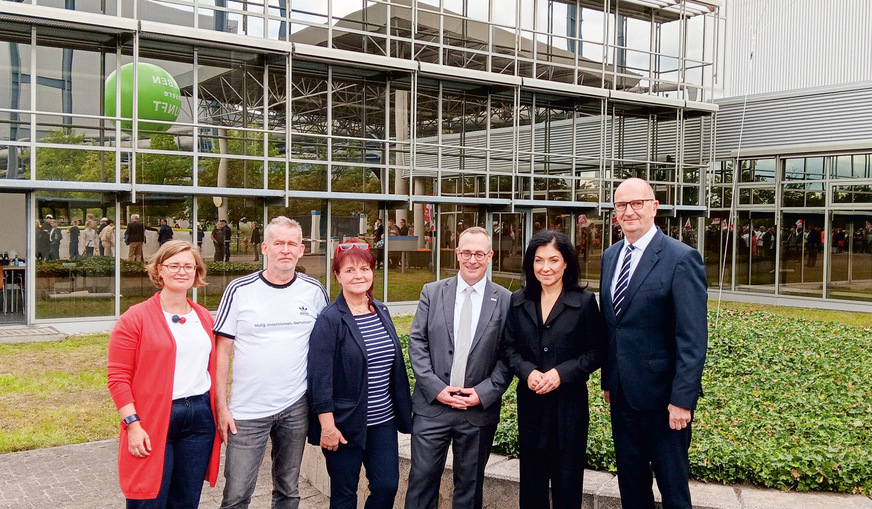
“Now it is up to policymakers to resolve the investment backlog for future power plants with clear regulations and fair tender conditions,” said Adi Roesch, chairman of the board of LEAG, during a visit by Reiche to the Schwarze Pumpe power plant site. Reiche assured that “a significant share of the planned 20 gigawatts of gas power plant capacity will be put on the market and auctioned off this year.” This announcement remained the status quo as of early November, the editorial deadline for this issue.
Of course, the power plants can only run on hydrogen if it is available. Economics Minister Reiche has already stated in connection with the energy transition monitoring that the core network and import corridors should be built up step by step and depending on demand – which she, in turn, does not particularly want to accelerate. In any case, the technology and the power plant operators would be ready.