

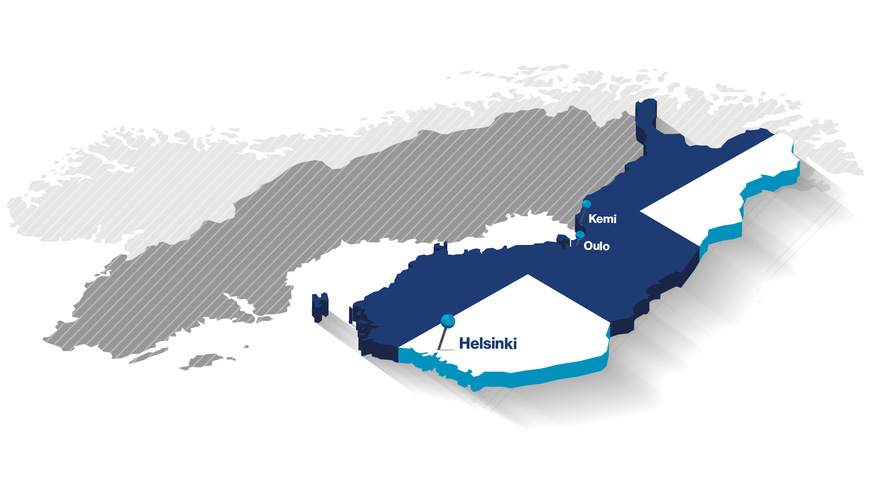
Plenty of space, cheap electricity, a well-educated workforce, solid infrastructure and ports: northeastern Finland has a lot to offer for building a hydrogen economy. In 2023, the Finnish government adopted a plan to contribute up to 10 percent of Europe’s hydrogen demand. While this is “only” a government resolution and not a law, the municipalities in the northeast are determined to attract companies along the hydrogen value chain. At the Nordic Hydrogen Week in February, the regions jointly promoted their locations. Around 2,000 guests had traveled in for the event, according to the organizers.
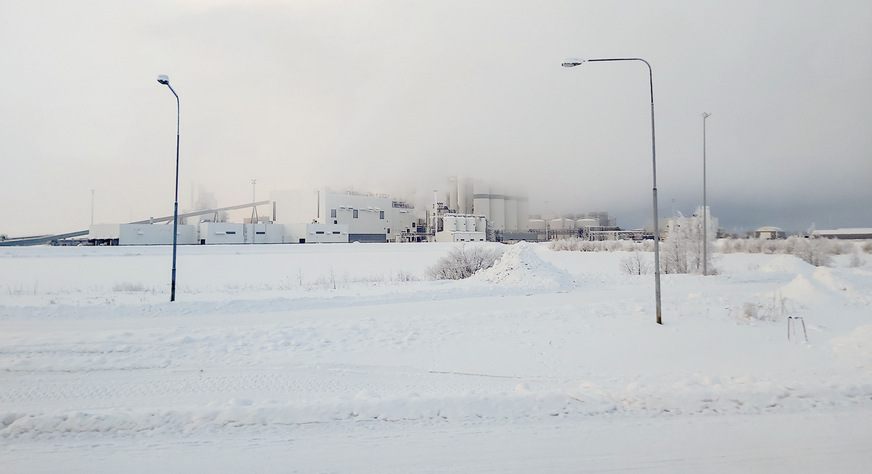
In Sea Lapland, the five municipalities of Tornio, Keminmaa, Kemi, Simo and Tervola along the Gulf of Bothnia have joined forces to promote their region as a hydrogen location. Janne Rautio of Kemi Digipolis wants to “bring the right people to the right place” and has organized a site visit for interested parties and potential investors. Through a winter wonderland of deeply snow-covered conifers, the tour first heads to a pulp mill, then to a seminar hall.
Markku Kivistö of Business Finland backs up Rautio’s thesis with figures: Finland uses 96 percent CO2-free electricity, including nuclear energy, at electricity prices of around 50 euros per megawatt hour. The Finnish domestic market is very small, which is why the country sees all of Europe as a kind of home market. “Finland is the most open economy in the world,” says Kivistö. And Sea Lapland, he is convinced, is the best location in Europe for hydrogen production.
Biogenic CO2 for e-fuels
The site visit in Sea Lapland begins with a tour of a pulp mill, the Metsä Bioproduct Mill in Kemi. The owner of the facility, which is only two years old and cost 2 billion euros, is the Metsäliitto Cooperative, in which around 90,000 Finnish forest owners are organized. On the premises, fully automated cranes receive the incoming logs from northern Finland and Sweden. They learn and improve on their own; no people are to be seen here. The logs are turned into wood chips, which are then cooked with chemicals to extract cellulose. The residues are burned to generate the energy that powers the pulp mill, creating a nearly closed loop. According to the operator, the facility, with 4 million tonnes of biogenic CO2 per year, is the largest single source of biogenic CO2 in Europe.
In the seminar room, Minna Mentzer of the Metsä Group explains the corporation’s climate strategy. At 12 million tonnes per year, the corporation accounts for around 6 percent of biogenic CO2 emissions across Europe, Mentzer says. Metsä intends to capture this resource and use it for e-fuels. However, CO2 capture is not being tested in Kemi but at the Rauma site. There, a pilot plant housed in shipping containers ran for six months, developed jointly with technology partner Andritz. The capacity: one tonne of CO2 per day. The result was encouraging, Mentzer says. The captured concentrations were higher than expected, and energy consumption was within an acceptable range. However, it also became clear that waste heat falls far short of what is needed. The energy costs for capturing and, where applicable, liquefying would be the most significant cost factor of the capture process. The use of heat pumps is being evaluated, but details are still pending.
Metsä is planning a phased scale-up: the next step is to be an industrial demonstration plant with 30 to 100 kilotonnes per year; at full build-out, 300 to 1,000 kilotonnes per year would be possible, still well below the theoretical total capacity of the Kemi site.
A decision on the next steps is now pending. Time is pressing, because in order to claim the currently available funding for the demonstration plant, Metsä must have it operational by 2030. At the same time, the market for biogenic CO2 is barely developed. And long-term climate policy also seems uncertain. “It is currently being questioned,” says Mentzer.
As an application example, Mentzer shows concrete made with biogenic CO2 by Finnish start-up Carbonaide. But she qualifies: “The market is still undeveloped.” Building new, complex value chains requires collaboration among many partners, from capture through transport and storage to utilization. There is a hard deadline: for the currently available funding, at least the demonstration plant must be operational by 2030. “Regulation carries risks,” Mentzer warns. “It could be changed. It is currently being questioned.”
© Freepik / NEONBOLD
E-fuels from carbon monoxide
Juha Erkkilä of Outokumpu’s EvoCarbon project presents an approach where, at first glance, one might suspect a typo. The steelmaker Outokumpu does not want to capture CO2 but CO, which is generated in steelmaking. Because it has a higher energy level than CO2, it can be used to produce e-fuels with less energy input than CO2. The main drivers for decarbonization for Outokumpu are the European Emissions Trading System (ETS) and the Carbon Border Adjustment Mechanism.
Outokumpu has signed a letter of intent with Norsk e-Fuel, and a feasibility study is set to begin in 2026. At the Tornio site in neighboring Koivuluoto, a plant is to produce 80,000 to 100,000 tonnes of e-SAF per year. For Outokumpu, this would mean a direct CO2 reduction of around 200,000 tonnes per year, roughly 20 percent of the corporation’s global direct emissions. If the feasibility study yields a positive result, Norsk e-Fuel expects an investment decision around 2028 and the start of production in 2032.
1,500 km hydrogen network planned
The Finnish gas grid operator Gasgrid has been tasked by the state with connecting a large share of the country’s industrial customers to a hydrogen network in the early 2030s. The first step is now an environmental impact assessment (EIA). A total of 1,500 kilometers of transmission pipeline is planned, covering 70 municipalities and 14,000 landowners in the study area. This makes the hydrogen network historically the largest EIA process in the country. The assessment began in spring 2025, and the final route planning is to be finalized by early 2027.
Similar to the German core hydrogen network (Kernnetz), Gasgrid in Finland is also collecting letters of intent from parties interested in hydrogen in order to factor them into the planning. So far, 2 million tonnes have been mentioned, according to Gasgrid. Unlike in Germany, the Finnish hydrogen network is to be built entirely from scratch, without repurposing natural gas pipelines. And although Gasgrid is a transmission system operator and will only operate transmission networks, the company is initially also taking on the planning at the subordinate distribution network level.
© Messukeskus / Northern Power Business Forum 2026
A stage for hydrogen in Oulu
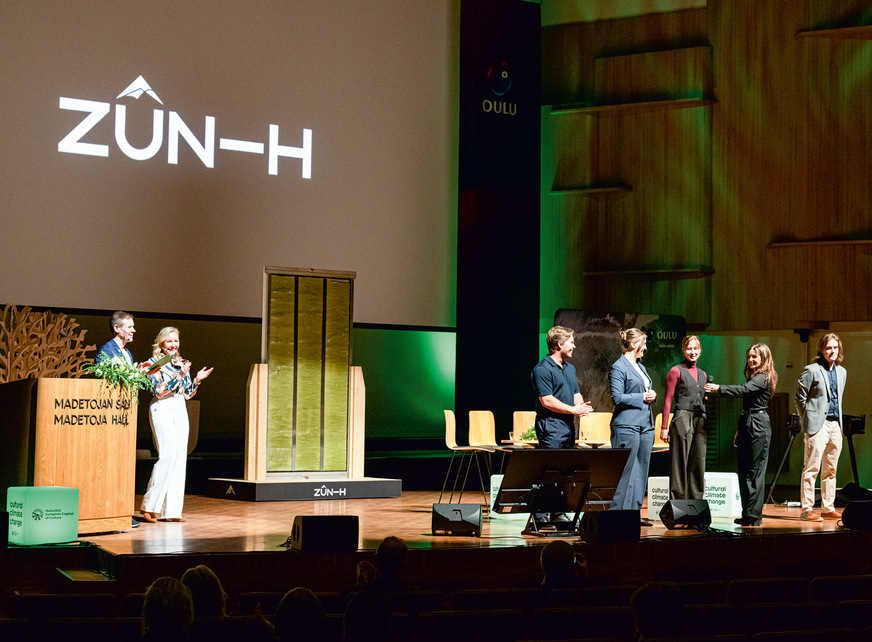
At the Northern Power Forum in Oulu the following day, around 700 guests had attended, according to the organizers. The focus was on hydrogen production and large-scale applications: steelmaking, e-fuels for aviation and fuels for shipping.
Racing driver and moderator Emma Kimiläinen co-hosted the program together with Herkko Plit, founder and CEO of P2X Solutions. Mayor Ari Alatossava enthusiastically promotes his city: Oulu is young (average age 40), well-educated (one third of the population holds a university degree) and international (with residents from 140 countries). In addition, the city, with just under 220,000 inhabitants, is a European Capital of Culture this year.
The Finns are not short on ambition and vision when it comes to hydrogen. Mikael Lindvall, Chief Technology Officer of Blastr Green Steel, for example, aims to produce 2.5 million tonnes of green flat steel per year. The company intends to build a complete value chain for this purpose. According to the current plan, the production of direct reduced iron (DRI) pellets is to take place in the United Kingdom, while the actual steel production would then be in Inkoo, in southern Finland. The company is currently assembling all the building blocks that precede the actual investment decision. The trader and processor Vogten Staal has declared its intent to purchase from Blastr Green Steel. The city of Inkoo has included the steel mill in its zoning plan. And CTO Lindvall is convinced: “End consumers will prefer low-emission steel. But it also has to be competitive on cost.” And so, as with many projects, the final investment decision is still pending. The year 2027 was floated at the conference.
The market for marine fuels is tough. Will consumers actually buy the product? That is the question also preoccupying the aspiring producers of green marine fuels. “When we press the start button for production, we need to see that the demand is really there,” says Hege Økland of Hy2Gen. So far, there are no long-term offtake commitments. The company, headquartered in Wiesbaden, Germany, intends to produce green hydrogen at a number of locations across Europe. However, the company’s flagship ammonia production project in Norway evaporated between the conference and the editorial deadline for this issue: the grid operator withdrew the connection commitment for 270 MW. Unless they opt for drop-in fuels, shipping companies would also need to invest in new vessels. Ilkka Rytkölä of the Finnish shipyard Meyer Turku describes the customer reaction: “The demand seemed to be there. But when they heard the price, the demand was suddenly gone.”
Like Lindvall of Blastr Green Steel, Økland also sees end customers as important allies. Environmentally friendly logistics is a good marketing tool. And she also sees the cruise industry as an important customer segment, especially when it comes to access to sensitive areas such as the Norwegian fjords. The public sector can also be a good partner for initial demonstration projects, for example with the hydrogen ferry that is scheduled to enter regular service to the Lofoten Islands from 2026. According to Økland, politics plays a major role not only as a source of support but, more recently, also as an active brake. When the International Maritime Organization (IMO) sought to establish a climate target last spring, several countries initially blocked it under pressure from the United States. “It was very good work by the IMO Secretariat that an agreement was still reached,” she says.
Aviation under cost pressure
Cost pressure hits the aviation sector hard and head-on. Hardly anyone books a flight without having consulted at least one price comparison engine. Accordingly, margins in the industry are tight. According to Antti-Mikael Kaljunen, who is responsible for sustainability topics at the industry association IATA, the sector expects an average profit margin of 3.9 percent for 2026. There is therefore little financial room to make aviation carbon-neutral on a net basis by 2050. Technologically, the lion’s share is to come from Sustainable Aviation Fuels (SAF), contributing 65 percent. The remainder is to be saved primarily through CO2 capture and offsetting (19 percent) as well as new technologies such as hydrogen and electric aircraft, but that is likely to take a while yet. The order books of the major aircraft manufacturers are full for the next decade. It could take about 30 years before aircraft with entirely new propulsion concepts take to the skies, it is said.
SAF production figures to date are modest; the association expects 2.4 million tonnes for 2026 (2025: 1.9 million tonnes). These are produced almost entirely from biomass, often used cooking oils, but also alcohol from corn and sugar beets. Their share amounts to less than one percent of aviation fuels in total. The crux with bio-SAF is the limited feedstock. Projections therefore assume that around 176 million tonnes of e-SAF will need to be produced by 2050. If air traffic grows as expected, e-SAF and bio-SAF combined will still not be enough to cover demand. Moreover, the cost of e-SAF is twelve times that of fossil jet fuel, and this will need to change drastically with scaling. Unlike steel in the case of automobiles, fuel prices are not a side issue for airlines. According to Zita Baranova of Air Baltic, they account for around 30 percent of costs.
Jeremiah Dutton of EIT InnoEnergy emphasizes the importance of reliable regulatory frameworks, including for financing. “The certainty of return is important.” One option would be contracts for difference. A small mandatory SAF blending quota would also help with offtake. Without reliable frameworks and calculable returns, there will be no financing. And Kaljunen suggests saving the necessary subsidies from fossil fuel subsidies. “Use that money more wisely,” he says.
© Eva Augsten
Hydrogen from compact panels
One could have left the conference after these discussions with an uneasy feeling. But at the end, there was something tangible to see: a module that produces hydrogen directly from sunlight, developed by a young start-up from Oulu. The module, which the team wheels onto the stage, is similar in size to a solar panel. Inside, sunlight splits the water it contains photocatalytically, entirely without an external power supply. On stage, small gas bubbles can be seen rising inside the module.
Field testing on the Canary Islands is still ahead, as is the establishment of a production line or even a viable commercial use case. But at least Zun H, pronounced “Sun Age,” brings the spirit of optimism back to the stage.