

The H2 Forum Berlin 2026 shows an industry in transition, away from visions and toward implementation. In terms of content, it quickly became clear that the classic “chicken-and-egg” problem of the hydrogen market is no longer the main focus. Instead, the emphasis is now primarily on “offtakers” and “lead markets.” What is meant are clearly defined fields of application with secured demand, intended to trigger investments along the entire value chain. There is also largely consensus on another aspect: the technology is available, the industry is ready, but the political framework conditions are holding things back. “Hydrogen does not take place in PowerPoint presentations, but in pipelines,” as one participant put it.
Capital on an H2 trip
The Berlin-Brandenburg region in particular shows what potential exists and what concrete implementation can look like. Jörg Buisset, Chairman of the Management Board of the H2Berlin initiative, presented its projects at the H2 Forum. Around 30 companies in the capital region are working along the hydrogen value chain to build three H2 hubs, one of them at BER Airport. Its operation is to be completely decarbonized with the help of hydrogen. This affects not only the energy supply of the buildings, but also the drives of baggage tractors and passenger buses on the apron, as well as the ground power that aircraft require before takeoff. This is to be converted from diesel to hydrogen in the future. In addition, there is enough space on the BER site to produce climate-neutral kerosene via PtL in the future.
The H2Berlin projects also include the Ruhleben energy triangle in western Berlin, where a fossil cluster is being converted into an H2 hub. The existing combined cycle gas and steam plants are to be retrofitted so that they can in future be operated entirely or partially with hydrogen. Ruhleben is also a possible feed-in or utilization point for the planned German and European H2 core network. In the energy triangle, hydrogen is to serve primarily as a seasonal energy storage and backup when renewable energies are insufficient, for example during a period of low wind and solar generation. It also links the sectors of electricity (electrolysis), heat (district heating supply), industry (high-temperature processes such as automotive painting at cooperation partner BMW), and mobility (company fleets).
Next to the energy triangle is the Ruhleben wastewater treatment plant, which will use the oxygen produced by the planned 10 MW electrolyzer for the fourth purification stage. It is scheduled to be ready in summer 2027. The waste heat from electrolysis will also be used and fed into the connected district heating network.
Berlin City Cleaning Authority („Berliner Stadtreinigung“) is also participating in the initiative. It already has more than a dozen H2-powered refuse collection vehicles in operation and will further expand its fuel cell fleet. On the outskirts of Berlin, surplus wind power from Brandenburg is to be increasingly used in the future to produce hydrogen and later serve as the basis for e-fuels.
Curtailment as the Achilles’ heel of the energy transition
A recurring theme throughout the conference is that renewable electricity continues to go unused on a large scale due to grid bottlenecks. In 2025 alone, interventions together with voluntary curtailment amounted to an estimated around 8.5 terawatt-hours; exact figures were not yet available at the time of editorial deadline. This green electricity should finally be used for hydrogen production.
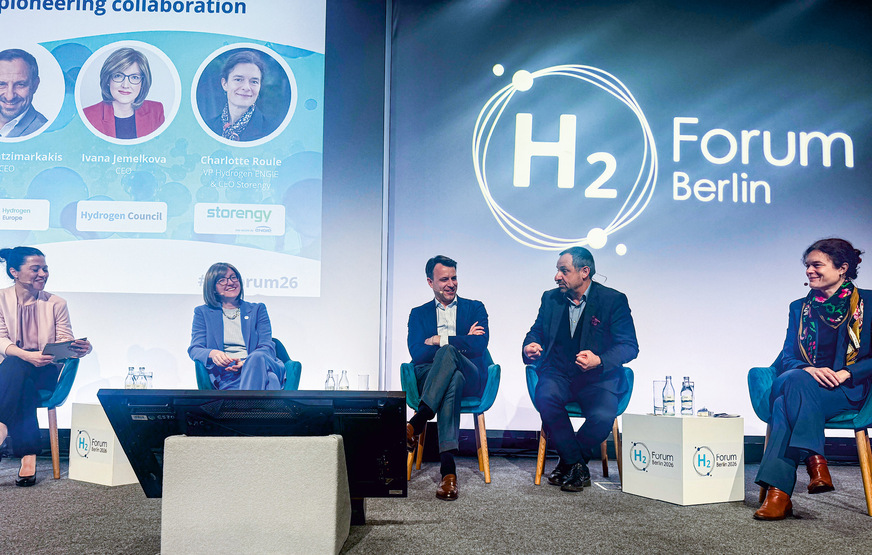
“The fact that we are still curtailing renewable energy today is simply absurd,” criticizes Jorgo Chatzimarkakis, CEO of Hydrogen Europe. For him, as for many other industry representatives, this is a symptom of political failure, not to say mismanagement. Unlike China, which interprets the rules in its own way, “we in the EU are far too nice,” he says. And he deliberately asks provocatively: why not disregard excessive rules for once, enter into conflict, and, if necessary, risk legal proceedings? After all, “what can be wrong with producing CO2-free molecules?” A stimulus for thought that led to lively discussions not only during the following lunch break, but also echoed on the panel on the second day of the forum.
Industry is also voicing clear criticism. Stefan Engelshove, Managing Director at Siemens Energy, points out that neither the technology nor scaling are obstacles, his company already produces electrolyzer stacks in Berlin with a capacity of one gigawatt. “The technology is there. But we need clear regulations in order to be able to invest.” Hybrid connection nodes are also necessary.
“We have no choice but to rely on the use of green molecules such as hydrogen,” says Georg Friedrichs, CEO of the energy supplier GASAG, particularly to store renewable energy from summer for winter. Hydrogen is the most important storage and import medium for green energy. He therefore views the development of the H2 core network positively, especially since his company is involved via its subsidiary NBB with 60 kilometers. The emerging infrastructure does allow initial investments, but without clear demand perspectives the risk remains high. Contracts for Difference (CfDs) could be one way to remedy this.
How fragile business models currently are is illustrated by an example from EWE Hydrogen: subsidized green hydrogen can currently be offered for about five to six euros per kilogram, says Managing Director Geert Tjarks. After the subsidies expire and with additional grid charges, however, prices of nine to ten euros threaten, hardly competitive for industrial off-takers.
© Monika Rößiger
Geopolitics increases pressure to act
At the same time, the pressure to accelerate the transformation is growing. The geopolitical situation – the blockade of the Strait of Hormuz began on the day before the H2 Forum – has once again highlighted dependence on fossil imports. “H2 made in Europe is a value in itself,” emphasizes Christian Feuerherd, CEO of Berliner Energie und Wärme (BEW). Hydrogen is not only an instrument for decarbonization, but also a strategic building block for security of supply and resilience.
Against this background, the price per kilogram of H2 is almost secondary, says the head of Western Europe’s largest heating network, thus speaking from the offtaker perspective. Industry representatives competing internationally are likely to see this differently, because for them the price is decisive. How Berlin’s more than 2,000-kilometer district heating network can become climate-neutral by 2045 is another question.
The perspective of security of supply runs through many discussions at the forum. Alongside climate protection and sustainability, industrial resilience is increasingly coming into focus. International actors such as Ivana Jemelkova, CEO of the Hydrogen Council, warn that Europe risks falling behind in global competition, while countries such as China, India, and Korea are moving ahead decisively. Like Chatzimarkakis, she — no less temperamental — also denounces the “policy problem” from which the entire industry suffers.
Or, as Jasmin Kaboni-Voit, Head of Hydrogen Regulatory & Funding at RWE, puts it: “All solutions are on the table. Nothing needs to be invented anymore.” Politicians should also understand this and support companies in implementation, at least by reducing “over-complexity.”
© Monika Rößiger
Criticism of regulation
A recurring topic is therefore the simplification of rules. In particular, the implementation of European requirements such as RED III or the definition of RFNBO criteria are considered by many to be too complex and impractical. “There are already so many rules at EU level, for example for green, blue, turquoise, and pink hydrogen. But there is not enough hydrogen,” says Heike Denecke-Arnold, Chairwoman of the Executive Board of Salzgitter Flachstahl.
In addition to supply, demand also remains a sticking point. Without binding offtake guarantees or quotas for green products, for example steel, many projects lack an economic basis. Accordingly, support at the H2 Forum is strong for instruments such as Contracts for Difference or EU-wide offtake guarantees.
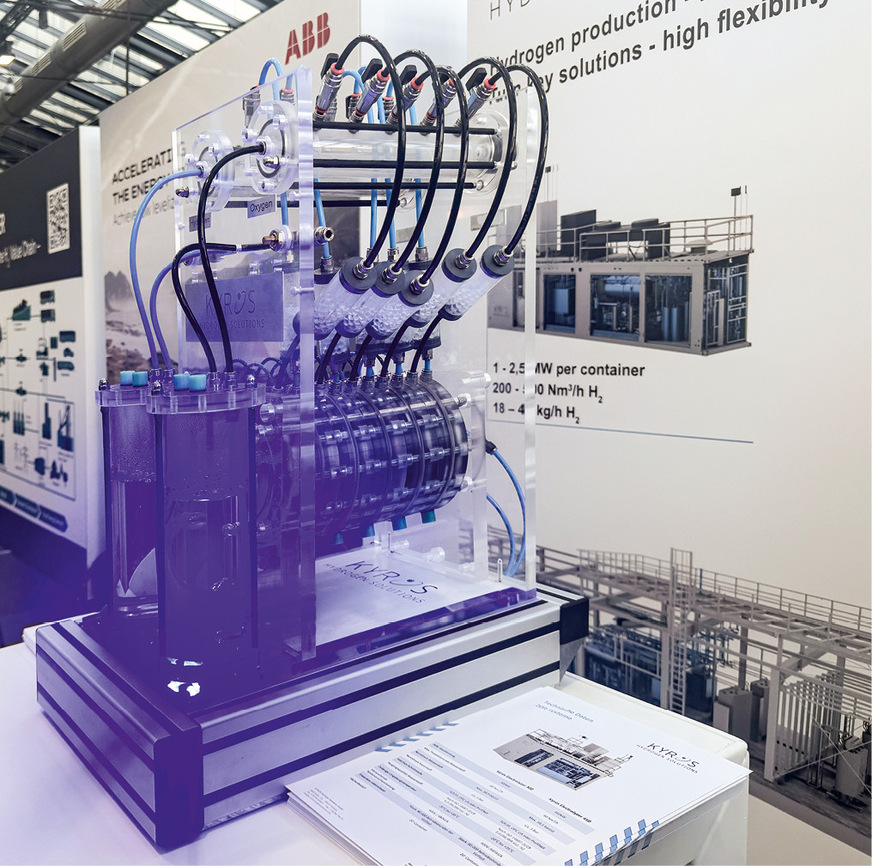
In addition to politics and the market, technical progress is also showcased at the Berlin H2 conference. Start-ups and established companies present solutions ranging from modular electrolysis systems to underground storage and AI-supported efficiency improvements. The tenor is that major innovation leaps are increasingly occurring in system integration, no longer in basic development. The potential for cost reductions also lies in the areas of integration, operation, and digitalization.
“We produce hydrogen from sh.....,” says Andy Gradel bluntly at the beginning of his short presentation. “And very successfully.” Of course, the young engineer means green H2 from slurry and manure or biogas via steam reforming, and describes this as a “decentralized boost for the expansion of the hydrogen economy.”
Gradel, who is also founder and managing director of BtX energy, lists the advantages of the innovative process: “We do not have a chicken-and-egg problem. We do not have to wait for sun and wind. We use methane that would otherwise be harmful to the climate and even achieve negative emissions with H2 production.” It is also “pretty cool” to refuel one’s own hydrogen car just 20 meters away from the cows that provide the feedstock for the fuel.
Despite all the challenges, cautious optimism prevails in Berlin. The ramp-up of the hydrogen economy is progressing more slowly than expected just a few years ago, but it is happening, step by step. Projects and industrial applications are going into operation, infrastructures are under construction and becoming visible.
The decisive factor will now be whether it succeeds in developing scalable markets from individual projects. Lead markets could play a key role here, provided that policymakers and regulation set the course accordingly. Or, as one participant put it: hydrogen is not decided in strategy papers, but in real projects. Berlin has shown that such projects already exist. Now they must be scaled and rolled out broadly.