

© H2 Mobility
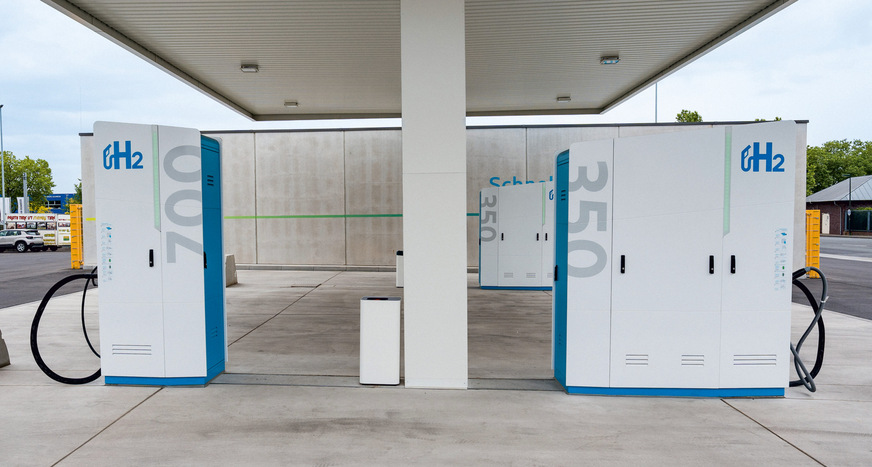
Hydrogen refuelling stations are a long-term investment – at least that is how it should be, so that it pays off for everyone involved. This is where a current recommendation by the independent expert body Clean Energy Partnership (CEP) comes in. “Technical performance parameters for classifying refuelling station configurations” translates regulatory requirements and lessons learned from initial large-scale projects into practical planning criteria for the heavy-duty sector.
Refuelling large quantities quickly While standards such as AFIR (Alternative Fuels Infrastructure Regulation) set minimum targets for network coverage and capacities, the concrete technical design of hydrogen refuelling stations for heavy-duty transport remains a complex undertaking. The requirements of trucks weighing up to 40 tonnes are fundamentally different from those of typical passenger car installations.
Refuelling volume: While a passenger car takes about 5–7 kg of hydrogen, the energy quantity required per heavy-duty truck is usually between 40 and 60 kg.
Fast refuelling: Short downtimes are an economic necessity – the target is a maximum refuelling time of ten minutes.
Back-to-back refuelling: The standard benchmark is at least three trucks per hour, without the storage being depleted afterwards or the chiller overheating.
All of this calls for high-performance, redundant and modularly designed systems.
At least three trucks per hour
In the discussion about hydrogen refuelling stations, reference is often made to the nominal daily capacity of a facility, for example in the form of a “1-tonne station.” However, this metric is of limited use. What is actually decisive for practical suitability in truck operations is the ability to refuel quickly and repeatedly, as well as ensuring a throughput that keeps pace with the work cycles of major logistics operators.
This is particularly important in long-haul transport. Often, several vehicles need to be refuelled almost simultaneously in the morning, each with 40 to 60 kg of hydrogen. A high calculated daily capacity is of little help in that case. Rather, storage and cooling must be designed for back-to-back refuelling.
On this point, the CEP recommendation sets a clear focus: The pure hourly or daily quantity must be backed by high-performance storage, compressor and cooling systems, so that multiple trucks in succession – at least three per hour – can be served without significant waiting times, refilling or regeneration phases.
Checklist for performance parameters
Together with the Sustainable Transport Forum and on the basis of industrial experience, the CEP partners have defined the most important parameters that enable a refuelling station to meet the actual needs of the logistics sector. The most important ones are summarised in the table. They assist with system design, procurement and operation. According to CEP, they represent the minimum for refuelling stations to remain economically and technically viable in the future.
Two technical components are central: the storage capacity of the high-pressure storage systems and the pre-cooling of the hydrogen. Both must be designed so that individual full-volume refuelling events in regular operation as well as multiple consecutive truck refuelling events can be carried out without capacity loss and with consistent quality. A typical 700-bar station dimensioned for passenger car throughput would reach its limits in a short time.
CEP recommends modularity.
From the outset, systems should be designed so that they can be scaled through straightforward retrofits, for example by adding storage bundles, compressor stages or dispensers. As the vehicle fleet grows – as freight carriers particularly expect in metropolitan areas and at logistics hubs – a single-bay solution designed for today’s needs will quickly no longer suffice.
Logistics, economic viability and funding compliance Last but not least, a refuelling station must be designed so that it can be seamlessly integrated into existing logistics processes.
Refuelling must be ensured outside conventional opening hours, for example. The station must be quickly accessible and the process straightforward. In addition, all parameters that are relevant for funding eligibility must be met.
The CEP recommendations show that the dimensioning of an H2 refuelling station does not have to be a compromise between cost and future-proofing. Those who observe the minimum standards foreseeable today and rely on modularity are not only laying the foundation for investment and funding eligibility, but also for a smooth adaptation to steeply growing demand. This is how the technical and economic backbone of sustainable logistics for the future is created.