

With its five-year plans, China has already announced and captured market-leading positions in several key industries, for example in solar, battery, semiconductor, and automation technologies. With the 15th Five-Year Plan (2026–2030) presented in March 2026, the Middle Kingdom is going one step further. The draft submitted to the National People's Congress reads like a catalog of the most important future technologies: artificial intelligence, semiconductors, robotics, quantum technology, biotechnology, nuclear fusion, drones, 6G technology, and brain-computer interfaces. China intends to set the tone in all of these areas in the future.
The most recent five-year plan lists an additional area for this: hydrogen technology. Since 2021, a large-scale trial has been underway in 44 Chinese cities in so-called "China Hydrogen City Clusters" to empirically investigate the benefits of hydrogen in transportation and in other industries. The deployment of buses and other fuel cell vehicles is an important part of the experiment. However, pipelines for transporting hydrogen and refueling stations are also being built. That said, even the Asian superpower cannot work miracles: according to the statistics of the automotive manufacturers' association CAAM, only 23,501 fuel cell vehicles in total were sold in the People's Republic between 2015 and 2024, with a downward trend since then.
But things are slowly picking up in the Middle Kingdom when it comes to H2 vehicle models. In mid-May 2026, Dongfeng presented a 49-ton truck in Wuhan equipped with the 400 kW Hydrogen Core fuel cell system on board. According to the Chinese commercial vehicle giant, it is said to have a service life of more than 30,000 hours and to allow a cold start at temperatures as low as -40 °C. The fuel cell platform with metallic bipolar plates has also passed the 10,000-hour endurance test according to the new national standard. According to Dongfeng, the tractor unit weighs only 8.8 tons and, with a refueling time of 15 minutes, achieves a range for the entire truck combination of up to 1,700 km, notably measured according to the less stringent Chinese CLTC test cycle.
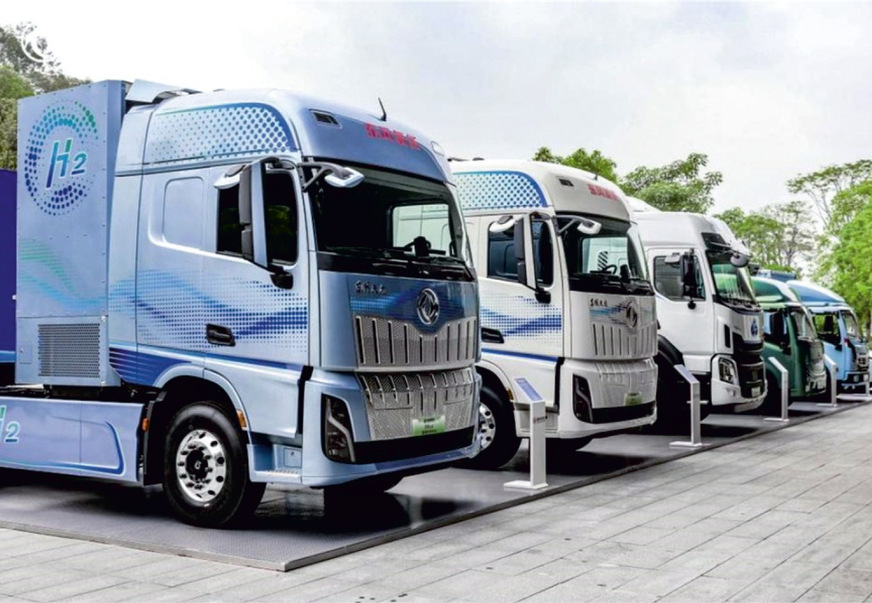
Dongfeng
European manufacturers are well positioned How worried should Europe, and specifically Germany as the leading European nation in the field of fuel cell technologies, be about being overtaken by China? Technologically, Europe is well positioned, both in terms of fuel cell technology and matching vehicle models. In the logistics sector, this ranges from vehicles such as the Mercedes-Benz NextGenH2 Truck with liquid gas tanks, to the brand new EVA dispenser from H2 Mobility with its short refueling time of on average 6:45 minutes for 20 kg of hydrogen, and the CryoPump station from Bosch Rexroth for hydrogen refueling stations, to the BZA375 fuel cell system from Cellcentric. The latter two were only recently presented at the Hannover Messe in April 2026 in Hanover. With the BZA375, a fully loaded 40-t truck should be able to get by with less than 6 kg of hydrogen per 100 km under real driving conditions, achieve ranges of more than 1,000 km, and reach refueling times comparable to those of diesel.
Vehicle and tank technology is not currently the biggest hurdle. Where things are stalling can be summed up in four words: funding, bureaucracy, customer initiative, hydrogen price. But here too, there is light at the end of the tunnel. In January 2026, the German Federal Ministry of Transport re-entered the funding of H2 mobility in Germany. It is providing 220 million euros for the establishment of a nationwide initial network of hydrogen refueling stations for heavy commercial vehicles in Germany. Up to 40 refueling stations and 400 hydrogen-powered commercial vehicles are being funded. Refueling station operators can be reimbursed for up to 50 percent of the eligible expenditures for building new hydrogen refueling stations. The prerequisite is that the facilities meet the requirements of the European AFIR regulation (Alternative Fuels Infrastructure Regulation). For new hydrogen trucks of vehicle classes N2 and N3, the funding amounts to up to 80 percent of the additional investment expenditures compared to a diesel vehicle. Originally, a deadline of May 31, 2026 had been set for submitting applications. Due to the strong response, however, the submission period was extended to June 30, 2026.
Hopes pinned on GHG quotas Excessive bureaucracy and regulatory frameworks have so far stopped or delayed many projects. For a long time, this also applied to the application of greenhouse gas reduction quotas (GHG quotas). After lengthy bureaucratic processes, this process is now slowly getting underway. Both producers of green hydrogen and the logistics industry are pinning great hopes on it.
The incentive system at the German federal political level works as follows: those who exceed their GHG quota can sell the surplus certificates to a third party who also has to meet reduction quotas. If companies place green, RFNBO-certified (RFNBO = Renewable Fuels of Non-Biological Origin) and thus quota-eligible hydrogen on the market via their refueling stations, they can participate in this certificate trade. This generates additional revenues for fuel traders and lower costs for logistics operators, which in the first market phase mitigates the additional costs for the infrastructure and the vehicles.
For example, Tyczka Hydrogen GmbH, a hydrogen producer and supplier from the Federal State of Bavaria, certified since April 2025, can already offer hydrogen at 350 bar at its refueling station in Augsburg for approximately 9.00 euros/kg net under the GHG quota scheme. And refueling station leader H2 Mobility also announced at the end of May 2026 that as of June 1 it would initially reduce the prices for hydrogen at several high-throughput refueling stations by around 10 percent. This affects the locations in Mannheim, Heidelberg, Frankenthal, Ludwigshafen, and Düsseldorf-Höherweg and applies to the 350 and 700 bar pressure levels. Martin Jüngel, managing director and CFO of the company, commented: "With the price reduction at our high-volume locations, we are making the benefits of GHG quota trading tangible for our customers for the first time. Our goal is to make green hydrogen competitive and to actively accelerate the market ramp-up."
However, H2 Mobility also reports to H2international that "at present, tenders for hydrogen refueling stations frequently stall or even fail several times." In one specific case, a tender came to nothing three times and could only be successfully implemented on the fourth attempt, after the approach had been fundamentally redesigned. H2 Mobility itself has recently closed several hydrogen refueling stations, especially for 700 bar passenger car refueling, but also smaller commercial vehicle depot stations. The company is now building new facilities primarily at locations with larger transport companies as anchor customers, which with their city buses form a reliable daily core customer base.
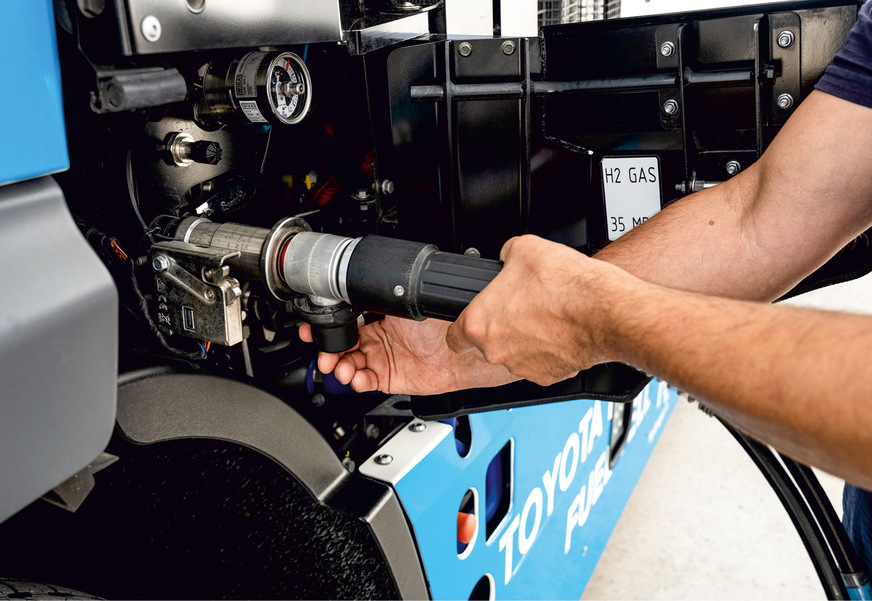
Toyota
Showcase projects with varying success But it is not only bureaucratic hurdles that prevent customers from getting on board. Many shy away from the risk of the "hydrogen adventure." Lighthouse projects, such as the following two, are intended to show how it works in the best case. Between the two first available liquid hydrogen refueling stations in Duisburg and Wörth and in the region, five Daimler GenH2 hydrogen trucks have been in operation for around one and a half years. And four DAF CF trucks, converted into fuel cell trucks by the Dutch vehicle manufacturer VDL, have been running for a year from Toyota's European central warehouse in Diest, Belgium, to various depots in Amsterdam, Rotterdam, Lille, and Cologne.
Scaling up in reality is often more complex. The Korean passenger car and commercial vehicle manufacturer Hyundai alone has delivered 165 of its Xcient Fuel Cell heavy-duty trucks, which are on the road in Germany, France, the Netherlands, and Austria. All trucks together exceeded the mark of 20 million kilometers in the winter of 2025/26, and did so within a very short time compared to the 10 million km mark, which was only reached in June 2024. But of all things, in the showcase project in Switzerland, where the first vehicles started almost six years ago, only 50 trucks are on the road instead of the 1,500 planned by 2025. Hyundai is planning neither a successor to the Xcient nor a model refresh, and from 2030 a performance-related heavy vehicle charge (LSVA) will also be due in Switzerland for such electrified vehicles. The continuation of the Swiss federal model project is therefore up in the air.
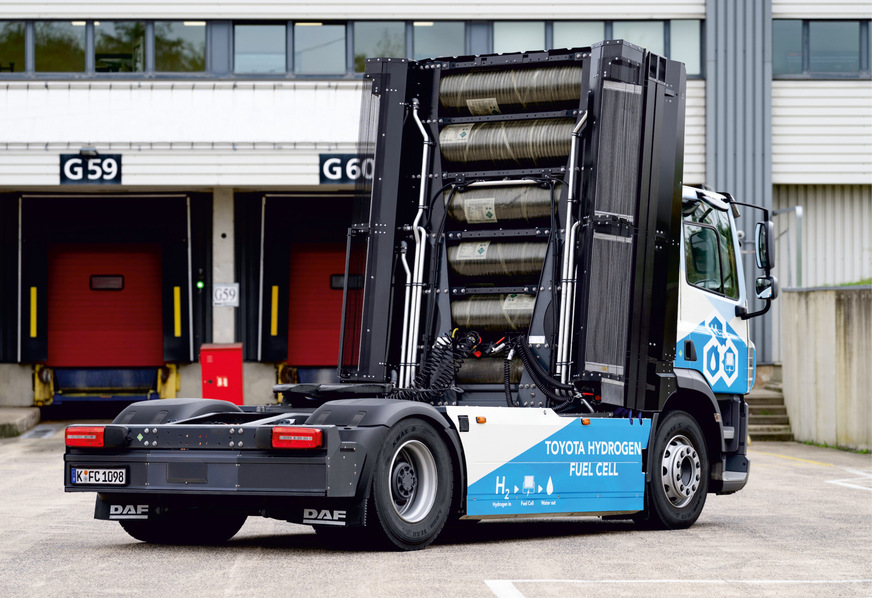
Toyota
The hydrogen price must come down All projects have one thing in common: the participating hauliers complain about the far too high H2 price per kilogram. In the case of Toyota's parts supply, up to 18 euros/kg sometimes have to be paid, for example in the Netherlands. Even at 9.90 euros/kg, the operation of fuel cell trucks can hardly keep up in the long term given the increasing presence of their battery-electric counterparts, especially as the latter are catching up in terms of range in seven-league boots, according to reports from the ranks of the logistics companies involved.
The cost comparison between pure battery electric vehicles and their fuel cell counterparts paints a clear picture: a heavy-duty electric truck consumes around 110 to 130 kWh per 100 km depending on the field of application and topography, while the H2 counterpart consumes about 6 to 8 kg of hydrogen. At a current commercial electricity price of 27 ct/kWh, the electric truck "refuels" for this distance at its own depot at 29.70 to 35.10 euros, significantly cheaper than the hydrogen truck at kilogram prices currently mostly between 13.85 and 15.80 euros with a price range of 83.10 to 126.40 euros/100 km.
At least: the current energy price crisis as a result of the Iran war has significantly narrowed the gap to classic diesel, still the most important benchmark. At a net price of 1.71 euros per liter in April 2026 and a consumption of around 30 to 35 liters per 100 km, the 40-ton combustion engine truck at currently between 51.30 euros and 59.85 euros/100 km is no longer significantly cheaper than a fuel cell truck. However, the gap could widen again should the conflict at the Strait of Hormuz come to an end.
The hydrogen price is still the biggest hurdle for the rollout of fuel cell technology in logistics. All other problem areas can be resolved in the short to medium term. For hauliers, every cent counts in pricing for their customers, even more so than for municipal transport companies, for example. Approaches such as the GHG quotas and other governmental regulations therefore appear urgently necessary.
Claus Bünnagel is editor-in-chief of the magazine busplaner and writes as a freelance journalist for trade media in the transportation sector. He has personally tested the hydrogen trucks from Toyota.