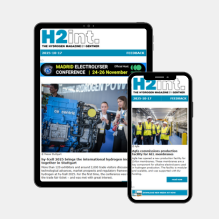

Sometimes the world feels like a circus. You rub your eyes and ask yourself: Did that really just happen? And whoever is sitting in the front row hopes not to be called into the ring for the sawing trick. This issue of H2international also offers reasons for amazement, about people driving innovations forward and about technical progress. Some developments, however, also make you shift uneasily in your seat.
In Namibia, many people are placing great hopes in hydrogen. Our authors met them and got to know projects that are intended to deliver iron, fertilizer, food and fuel locally. It is about more than energy: it is about economic independence.
Technical progress can be seen at the Hydrogen Technology World Expo. Scaling and automation take center stage. For our trade fair preview, we have pre-sorted the innovations so that you can more easily find your way around on your hydrogen world tour. Artificial intelligence is also becoming a highly specialized helper for the hydrogen industry. It not only optimizes project planning but also helps to make plants safer. How important scientific guardrails are for this is shown in this issue.
The major upheavals at the same time raise new questions, which this issue also addresses: Will AI’s energy demand become a market for hydrogen? And how can companies build an economic ecosystem that equips them for disruptions?
No question, the opportunities are there. Our article on planetary boundaries, however, reminds us of what we should measure them against: hydrogen is meant to contribute to a better future. AI’s hunger for energy can in principle grow infinitely, but the planet’s resources cannot. Nuclear fusion will not solve this problem either, even if we succeed in using it (beyond the great central reactor of the solar system) as an energy source on Earth: power plants need material, sites, development and construction time, as well as cooling.
Hydrogen is an important building block for a better world. But we will not achieve that world through the technological scaling of electrolyzers alone. We also have to ask ourselves what exactly that world could look like when we include all planetary resources and their distribution.