

The representatives of Scotland pour their guests even older single malt; the Japanese serve sushi, and the North Germans currywurst. Apart from the country-specific cuisine, the more than a thousand exhibitors are likely united by the hope that now, in light of the delayed hydrogen ramp-up, things can only get better.
After reports of postponed or canceled projects had accumulated in recent months, neither pioneers nor established companies, whose business model is not solely based on hydrogen, let their spirits be dampened at the Hydrogen Technology World Expo. After all, there are hundreds of hydrogen projects in Europe, and they rely on their own successes; large and small progress that can be seen.
© Monika Rößiger
Hydrogen Drone for Rescue Missions
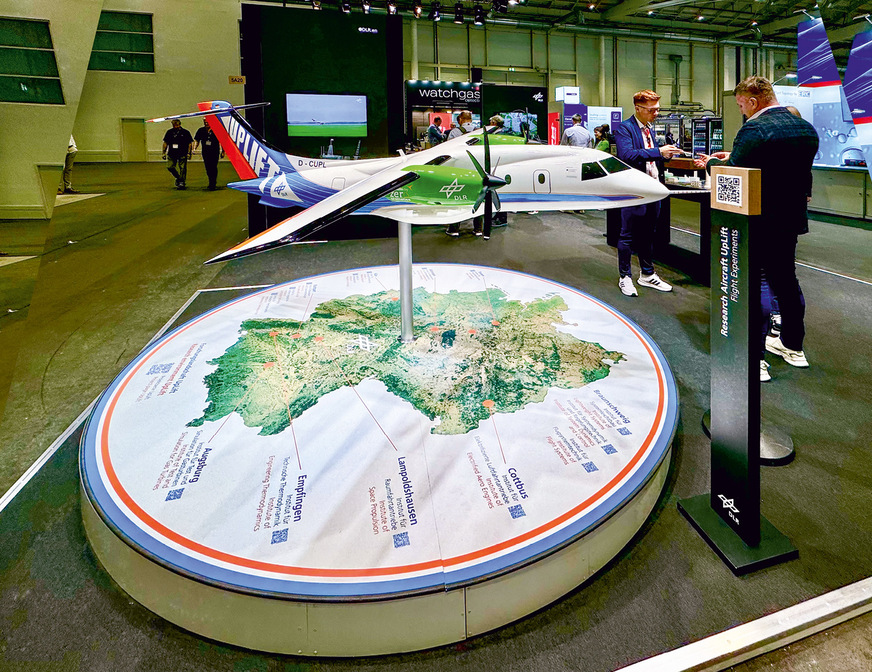
Visitors could see this for themselves at the fair, which expanded from three to seven halls. For example, the H2PM drone from the Center for Applied Aeronautical Research (ZAL) in Hamburg. Last year still a project, the 25-kilogram octocopter developed with partners is now on the market. The drone, powered by compressed hydrogen, is particularly suitable “for rescue missions, monitoring critical infrastructure, and detecting fires or gas leaks,” explains Sebastian Altmann, Senior Expert at the Fuel Cell Laboratory at ZAL.
© Monika Rößiger
H2 Octocopter Replaces Helicopter
With a payload of up to five kilograms, it can stay in the air for two to three hours and cover up to 150 kilometers. In comparison, a battery-powered drone only achieves a good half-hour flight time.
The hydrogen drone is also capable of replacing a helicopter flight – at a fraction of the cost. The latter costs between 1,000 and 3,000 euros per hour, depending on the provider; the H2 drone, on the other hand, 50 to 100 euros. It is actually intended for use in industry or the civilian sector. “But given the geopolitical situation, military interest in powerful drones for surveillance purposes is noticeably increasing,” says Altmann when asked by H2international. However, ZAL excludes the development of weapon-carrying drones. On the contrary, research is now increasingly focused on defending against military and espionage drones.
© Monika Rößiger
© Monika Rößiger
H2 Baggage Tug in Practical Test for the First Time
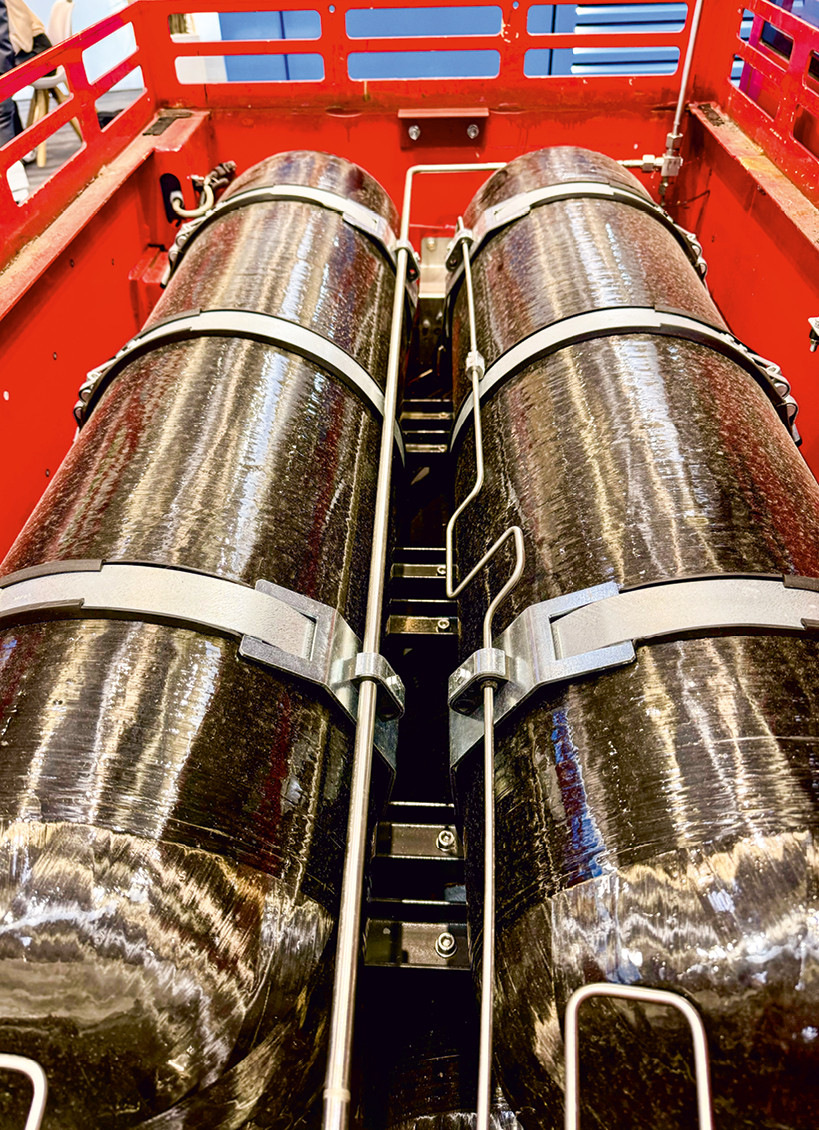
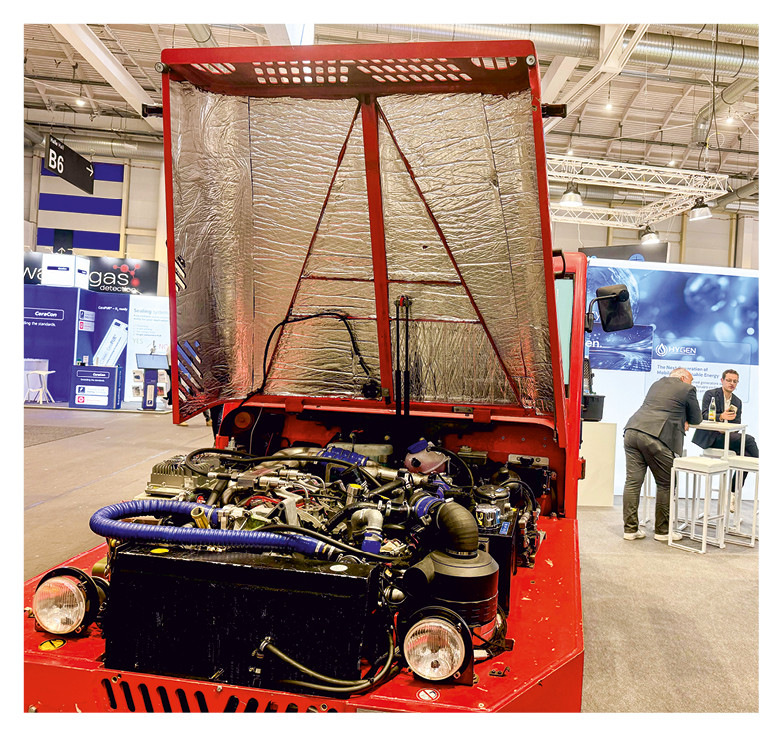
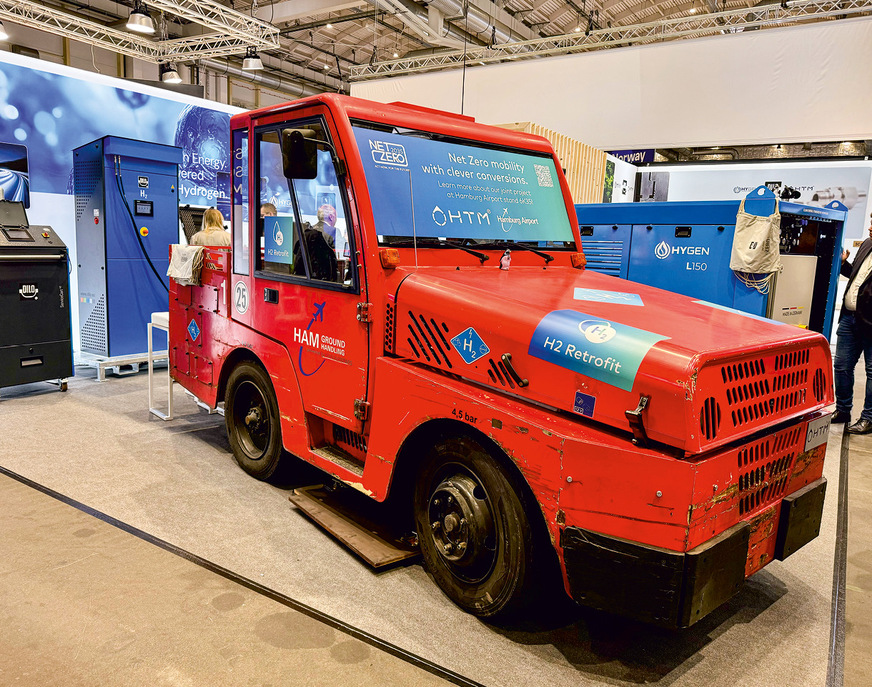
In any case, a red vehicle in Hall B5 comes across as harmless, which has been in test operation at Hamburg Airport since July 2025: A baggage tug that Hydro Technology Motors (HTM) from Bingen am Rhein has converted from natural gas to hydrogen propulsion. This concept was recently nominated in the “Hydrogen Innovation of the Year” category for the “German Renewable Energy Award,” which is presented by the cluster Renewable Energy Hamburg.
Two carbon fiber-reinforced pressure tanks (350 bar) on the loading area are filled on demand via a mobile refueling unit from Ryze Power directly at the airport. According to HTM, converting existing vehicles is a “cost-effective and environmentally friendly alternative to new battery or fuel cell vehicles.” Ten kilograms of hydrogen are enough for a three-shift operation.
The first practical test of a baggage tug converted to hydrogen combustion was deliberately conducted during the particularly busy summer months. The EU-funded project BSR HyAirport is scientifically accompanied as part of the energy transition joint project Northern German Real Laboratory.
Important for European Airports
The results regarding technical and economic feasibility are important not only for the further approximately 60 natural gas-powered baggage tugs in Hamburg but for airports throughout Europe. Because the collected data is shared with the operators. Hamburg Airport is already convinced “that hydrogen will play a significant role in the future of aviation on the ground and, of course, in the air.”
Electrolysis Without Platinum
A “real boost in performance” for electrolyzers is promised by José Manuel Sanchis Bernat at the stand of Matteco, a spin-off from the University of Valencia. “Our next-generation electrodes and catalysts increase the hydrogen yield of AWE and AEM electrolyzers,” says Iker Marcaide, co-founder and CEO of Matteco.
This is due to the enlarged catalytic surface. Advanced materials – without platinum – increase the efficiency of H2 production and thus contribute to the scaling of hydrogen technologies overall. “With our nickel-iron catalysts, the LCOH decreases by up to 20 percent. And that with minimal degradation.”
In addition to more sustainable catalysts, there were other innovative products, processes, and materials. For example, the Federal Institute for Materials Research and Testing (BAM) is investigating the use of glass fiber-reinforced plastic pipes as an alternative to conventional steel pipes for hydrogen. The goal is to develop new pipeline systems that remain efficient even under high pressures and reduce costs compared to previous solutions.
Asia at the Waterkant
Northern Germany presented itself in Hall 6 with its concentrated hydrogen expertise, both in terms of research and companies. Delegations from Japan and South Korea showed particular interest in the projects of this region, including employees of the Japanese Ministry of the Environment, the Fukushima Energy Agency, and foreign trade representatives.
A group of journalists from seven EU countries, who were researching in the metropolitan region, also visited the fair. The Hanseatic city aims to become a leading location for hydrogen. This concerns both the production and import of green hydrogen and its use in industry, business, and transport.
Go Big or Go Home
Central projects for this are the construction of a 100-megawatt electrolyzer (“Hamburg Green Hydrogen Hub”) at the site of the former Moorburg coal-fired power plant and a 60-kilometer hydrogen pipeline network for large industrial companies. In addition, the construction of the first large import terminal in Germany for hydrogen and its derivatives in the port.
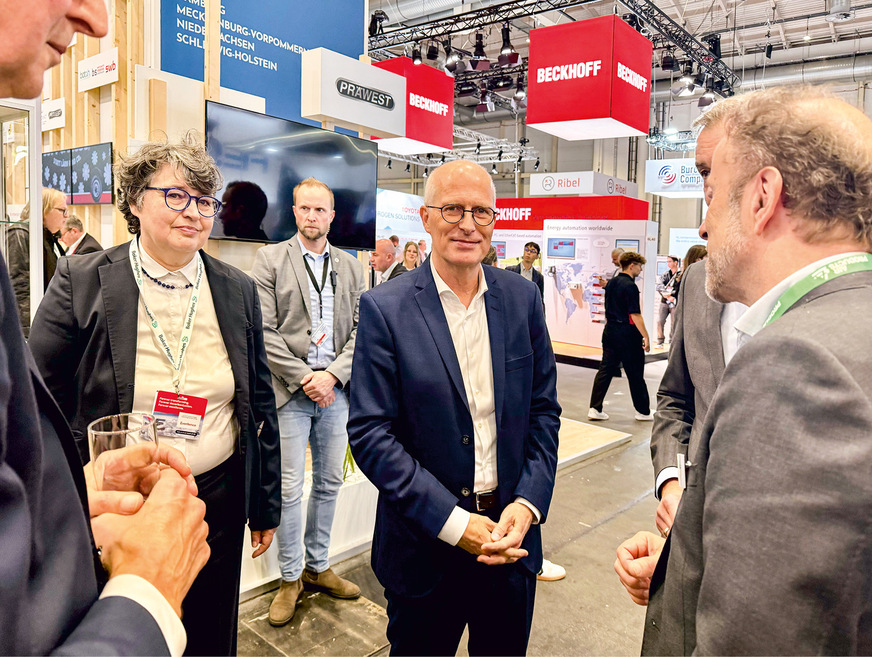
Thus, Hamburg’s First Mayor Peter Tschentscher also took the time during his tour of the fair to ask entrepreneurs in the industry, for example, where there are bottlenecks and what politics can do about it.
© Monika Rößiger
Champagne for the Hydrogen Fans
“Overall, the mood at the fair was quite positive,” summarizes Jan Rispens, head of the the cluster Renewable Energy Hamburg, which organized and managed the joint stand with 15 companies. “Some significant projects are progressing in Europe, technology development has gained momentum, and investors are still interested in project development.” At the end of the second day, the champagne corks popped at HZwei and H2international: Together with the German Hydrogen Association, the publisher invited to a reception.