

© Lhyfe
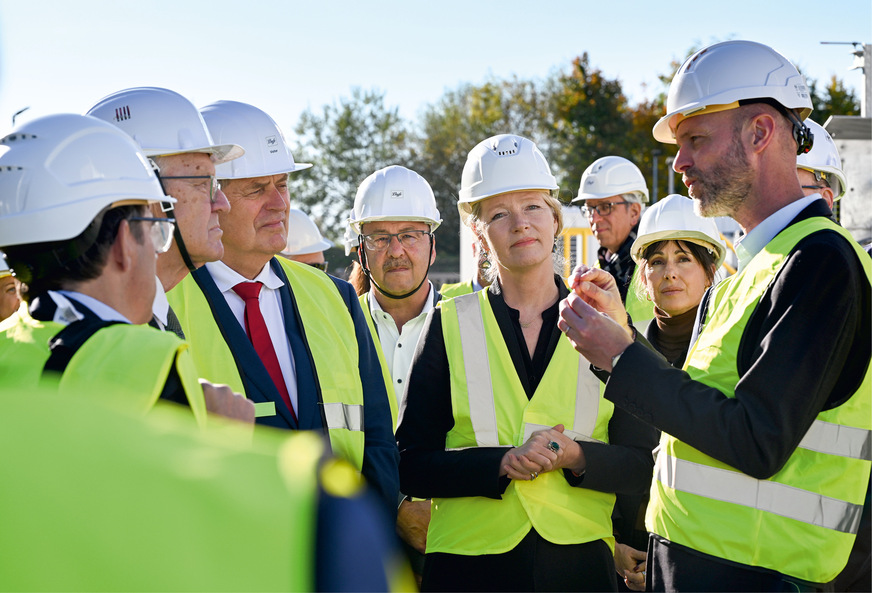
The plant in Schwäbisch Gmünd, inaugurated by Winfried Kretschmann (Green Party), Minister-President of the Federal State of Baden-Württemberg in the Southwest of Germany, on October 14, can produce up to four tonnes of hydrogen per day. However, the 30-million-euro facility, funded with 4.3 million euros from the EU and 2.1 million euros from the state, is still in the ramp-up phase. This is due not only to technical coordination in the initial phase but also to demand, which is only gradually increasing. The heart of the 10 MW facility is the electrolyzer, which receives its electricity from the public grid. Certificates ensure that the electricity is generated from renewable sources and that the hydrogen is therefore “green.” Four tonnes of this are enough to allow 100 trucks to travel 400 kilometers each.
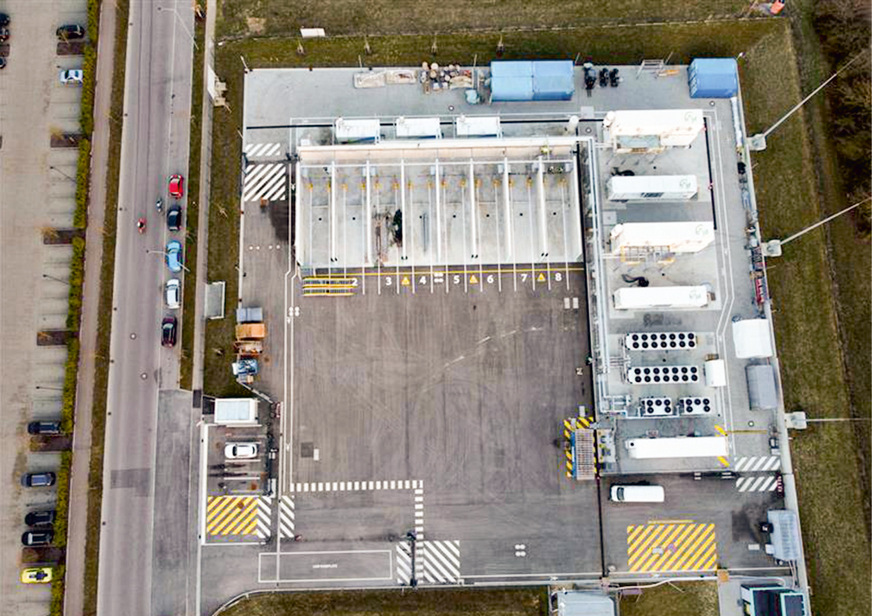
The operator is Lhyfe, founded in France in 2017 and listed on the stock exchange. The company has already realized three facilities in its home country and now operates its first German site on one hectare in the Ostalb region, built from containers, each with five stacks.
Until the facility is expected to be connected to the supra-regional natural gas network in 2032, customers from the mobility and industrial sectors as well as suppliers of this fuel cell technology will be supplied by trailers. H2 Mobility, the operator of hydrogen fueling stations nationwide, intends to supply its planned stations in southern Germany with energy from Gmünd, explained Pascal Louvet, Head of Sales for Lhyfe Germany, during a press tour before the inauguration. In the long term, the site in East Württemberg is also expected to feed into the hydrogen core network, which is to be established from 2032.
Approval at record speed
Potential customers in the region would then include energy-intensive companies such as Schwenk Zement in Herbrechtingen, the Palm paper mill in Aalen, and a district heating network in Ellwangen. At full capacity, Lhyfe aims to produce hydrogen at a price “significantly below ten euros” per kilogram. Since revenues from CO2 certificate trading could be taken into account, this alone would reduce the price by three to six euros, according to Louvet. The basis for this is the RFNBO certification (Renewable Fuel of Non-Biological Origin) of the Gmünd plant.
The sales manager: “Our green hydrogen is particularly a CO2-free alternative to gray hydrogen and fossil natural gas in the chemical, steel, and glass industries.” Schwäbisch Gmünd's Lord Mayor Richard Arnold (CDU) is hoping the facility will attract such companies to the planned industrial park “H2-Aspen,” which is also to have a hydrogen fueling station. Arnold expressly praised those responsible at the Stuttgart regional authority, who approved the facility in just four months in accordance with the German Federal Emissions Control Act, “for which there was no precedent.” This gives hope for the transformation that the country urgently needs.
Minister-President Kretschmann also praised the facility as a “lighthouse project” that had been significantly supported by the H2-Wandel association in Ulm and the Center for Solar Energy and Hydrogen Research Baden-Württemberg (ZSW), also in Ulm. Kretschmann: “It takes courage and pioneers like the partners involved here to get the hydrogen economy up and running.” The political sphere provides the legal framework and funding, “but we do not need skeptics.”
Nationwide, electrolysis capacity is currently at 170 MW. In Schwäbisch Gmünd alone, a further 10 MW is being added. The state will invest another 125 million euros in electrolyzers.
Environment Minister Thekla Walker (Green Party) added: “Hydrogen production is industrial policy, because we need a resilient energy supply and technological leadership in this field.” China is moving at a rapid pace in this area, but with Lhyfe, the southwest has a strong French partner. Nicolas Gibert-Morin from Brussels recalled decisions made in 2020 that the EU wants to produce ten million tonnes of hydrogen annually by 2030. The funding, as in Gmünd, would directly benefit the municipalities.
Just the beginning
“Gmünd is only the beginning of Lhyfe in Germany,” company founder and CEO Matthieu Guesné called out to the audience. Of around 200 Lhyfe employees, 30 are active in Germany, not only at the headquarters in Cologne but also distributed across the country. What motivates him, Guesné says, are his children – they have a right to a future worth living.
In France, the company already operates three facilities at onshore and offshore wind parks. Currently, Lhyfe operates 70 trailers to supply its 50 customers. Each trailer holds between 380 and 1,000 kilograms of hydrogen, depending on the pressure level. The company is building additional onshore and offshore sites in Europe and aims to establish itself as a major hydrogen producer.
In Lubmin, in the Federal State of Mecklenburg-Vorpommern, the French are planning an 800 MW project on the site of a former nuclear power plant, which is to be connected to the future European hydrogen network. Other sites are planned in the Saarland for a steelworks and in Lower Saxony at a port for refueling ships.
Before the electrolyzer could be put into operation in the southwest, the hydrogen region H2Ostwürttemberg carried out some preliminary work, also with the help of HyLand funding from the National Organization Hydrogen and Fuel Cell Technology (NOW), which belongs to the Federal Ministry of Transport.
In a 2022 survey, 40 companies in East Württemberg reported an annual demand totaling 200,000 tonnes of hydrogen. This corresponds to an energy quantity of 7 TWh. The main customers would therefore be the Palm paper mill in Aalen and Schwenk Zement in Heidenheim.
The South German Natural Gas Pipeline (SDL) crosses the district of Heidenheim; it is to be H2-compatible from 2032. In parallel, a regional distribution network is being built, 84 kilometers long and costing up to 185 million euros. To make all this viable, the offtake volumes must be organized via H2Ostwürttemberg. The state, federal government, and EU must co-finance the network expansion. The decision that the 60 billion euros from the coronavirus aid package cannot be used for climate protection has not made this any easier.
Nevertheless, progress continues. In the HyLand program, the H2Ostwürttemberg region has completed vision development as a “HyStarter” and planning as a “HyExpert.” It is now in the third and final phase. As a “HyPerformer,” it continues to receive grants from NOW, which now no longer flow into plans but into the actual implementation of the projects.
© Lhyfe